
UXO and mine clearance in Raqqa
Explosive ordnance risk management in Syria – DEMINETEC GroupUXO, ERW and mine clearance in Raqqa
The DEMINETEC Group provides explosive ordnance risk management to public and private clients with projects in Raqqa, Syria: historical desk study, non-technical and technical survey, UXO survey, battle area clearance, mine clearance and EOD support. The group has worked in 34 countries and operates to the International Mine Action Standards (IMAS), the requirements of the national authorities and the contract specifications.
In short.
- Islamic State group (ISIS) control from 2014 and the battle of June to October 2017 left Raqqa with dense explosive ordnance contamination.
- Improvised mines and booby traps inside buildings sit alongside unexploded bombs, rockets and shells in rubble, with minefields in farmland around the city.
- The Syrian National Mine Action Centre is the designated coordination body, UNMAS accredits operators against IMAS, and north-east operators now register in Damascus.
Historical UXO context of Raqqa
Raqqa came under non-state control in 2013, and in 2014 the Islamic State group (ISIS) made it the capital of its self-proclaimed caliphate. The Syrian Democratic Forces (SDF), supported by coalition air strikes, fought for the city from 6 June to 17 October 2017. In January 2026 Syrian government forces advanced into SDF-held parts of Raqqa governorate, and a ceasefire on 29 January left Damascus in control of much of the north-east; Mine Action Review notes that this fighting may have added contamination.
Human Rights Watch reported improvised mines in doorways, under stairwells, in debris and rubble piles, on roadsides and in fields. Places named in the sources include Meshlab, the Old City, and the Hurriyeh, Nahda and Tas-heeh neighbourhoods, where DanChurchAid (DCA) recorded 61,131 m² of improvised-mine contamination in 2024 and cleared it. Humanity & Inclusion (HI), active in northern Syria since 2018, cleared the Euphrates riverbed at Al-Rashid bridge in 2024, and MAG works in southern Raqqa and around Al-Thawra (Tabqa).
The United Nations estimated that about 80 per cent of Raqqa was destroyed or left uninhabitable. HI states that rubble removal, the precondition for any reconstruction, cannot be done without clearance first, and that dams and waterways are also contaminated. By September 2018 a US-funded programme had surveyed and cleared more than 300 sites in the city, including 9 hospitals, 66 schools and 76 infrastructure facilities such as water treatment, pumping and power stations. Larger multi-storey buildings can each take days or weeks to clear.
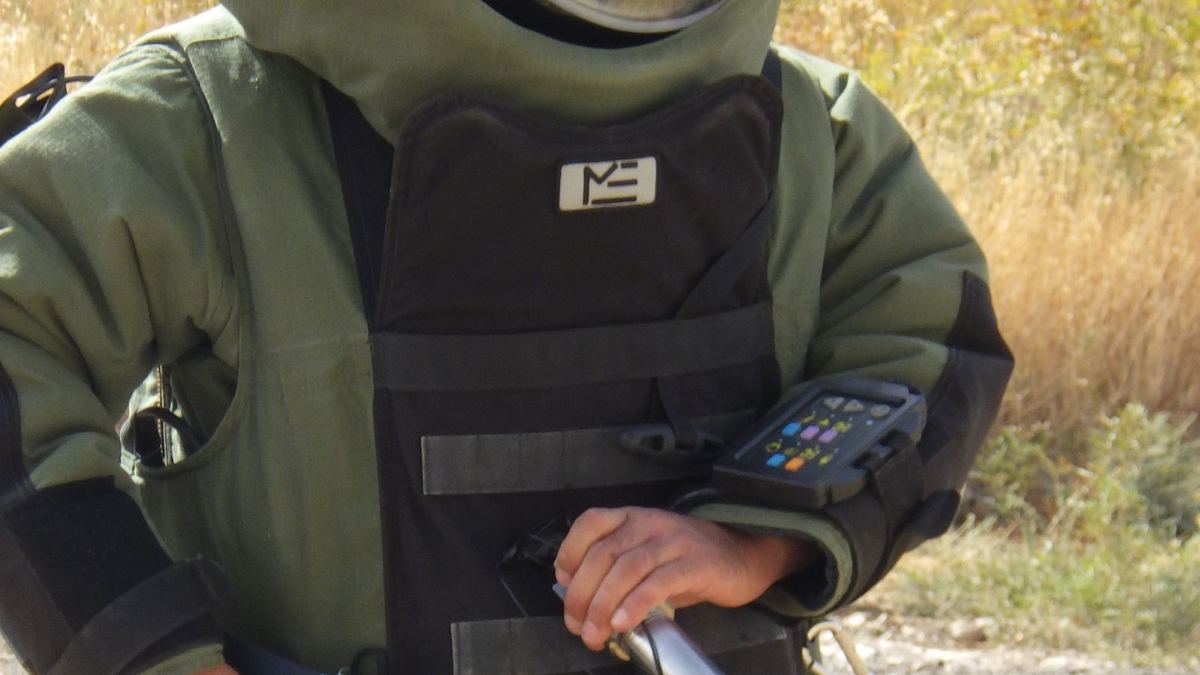
Our services for projects in Raqqa
Historical desk study and non-technical survey (NTS)
Collection and analysis of archives, testimony and field evidence to define suspected hazardous areas before any intervention. Non-technical survey
Technical survey and UXO survey
Geophysical detection (magnetometry, electromagnetics) and ground verification to confirm and locate explosive ordnance, on land or underwater. UXO survey
Battle area clearance and mine clearance
Search, identification and neutralisation or destruction of UXO, mines and improvised explosive devices by qualified EOD operators. Battle area clearance · Mine clearance
Client representation and quality control
Independent supervision, quality assurance and quality control of clearance contractors on behalf of the project owner, and explosive ordnance safety advice on site.
Training and stockpile management (PSSM)
EOD training, physical security and stockpile management assessments and destruction of surplus ammunition, through the group company GEODE. Stockpile destruction and PSSM
Underwater works
Survey and clearance in ports, rivers and offshore areas with the group company SEMTEC.
Why the DEMINETEC Group?
- ISO 9001, ISO 14001, ISO 45001 and MASE certified.
- Group pre-qualified by UNOPS in 14 disciplines since 2023.
- Experts who have worked in 34 countries, through GEODE (Global EOD Experts) for mine action and SEMTEC for underwater works.
- Teams of former French Navy and Army EOD operators.
- Onshore and underwater capacity within one group.
The DEMINETEC Group and Syria
The group’s experts carried out clearance, demining and training missions in Syria in 2018 and 2019. Any engagement in Syria is subject to prior verification of the applicable international sanctions and export-control rules.
See the international references of the group.
Conflict history and explosive contamination in Raqqa
The campaign to isolate Raqqa began on 6 November 2016 and brought the SDF the city of al-Thawrah (Tabqa) and the infrastructure at the Euphrates Dam. The battle for the city itself opened on 6 June 2017, when the SDF attacked with air strikes from the US-led coalition and fire support from US Marines. The district of al-Mashlab was taken in the first days, and fighting followed from 8 June at the former 17th Division base and the nearby sugar plant. The SDF completed the encirclement of Raqqa on 24 June. ISIS, which had held the city as its de facto capital since 2014, defended it with vehicle-borne IEDs, tunnel networks, bombing drones and mines.
The assault on the Old City began on 27 June 2017, and on the night of 3 to 4 July a coalition air strike destroyed a 25-metre section of the medieval wall around it. The Old City was under SDF control by 3 September. In the final phase the SDF took the Al-Naim roundabout on 16 October and the National Hospital and the stadium on 17 October; victory was declared on 20 October 2017. The use of white phosphorus munitions by US forces was reported during the battle. When residents began to return, the Raqqa Civilian Council urged them on 21 November 2017 to wait until neighbourhoods had been cleared, and humanitarian operators moved from spot tasks to systematic neighbourhood clearance from June 2018.
Areas and structures concerned
- Old City of Raqqa and its medieval wall
- Al-Mashlab (Meshlab)
- Al-Naim roundabout
- National Hospital and stadium
- Hurriyeh, Nahda and Tas-heeh neighbourhoods
- Al-Rashid bridge and the Euphrates riverbed
- Former 17th Division base and sugar factory
- Tabqa (Al-Thawra) and the Euphrates Dam
Expected ordnance and implications for survey
Raqqa's contamination is dominated by improvised devices: victim-activated IEDs and improvised anti-personnel mines, some triggered by passive infrared sensors or fitted to doors and household appliances, as documented by Human Rights Watch. Unexploded air-delivered bombs, rockets and shells lie in the rubble of destroyed buildings, and submunitions have been cleared at Al-Thawra. Survey therefore combines building-by-building IED search, mechanical support for rubble and multi-storey structures, and clearance of the defensive minefields laid in farmland around the city.
FAQ: explosive risk in Raqqa
Has Raqqa been cleared of explosive ordnance?
Not fully. In 2018 the UN stated that areas of return in Raqqa were not considered cleared according to IMAS, and work has continued since: HI secured 1,000 live items in 2022 and DCA cleared improvised mines from residential neighbourhoods in 2024. In 2025 DCA, HI and MAG were all still conducting survey and clearance in Raqqa governorate.
What kind of explosive ordnance is specific to Raqqa?
Improvised devices. Buildings such as clinics, banks and civil service offices were booby-trapped, and farmland around the city was turned into defensive minefields. These sit alongside conventional unexploded ordnance: from more than 2,500 recorded explosive weapon incidents between 2013 and 2019, HI assumes that some 250 to 750 unexploded air-delivered and artillery weapons remain to be found in the city.
Who coordinates clearance in Raqqa since January 2026?
After Syrian government forces took control of much of the north-east in January 2026, most mine action operators there suspended work for several months, pending registration with the Ministry of Foreign Affairs in Damascus. In March 2026 the Presidential General Secretariat directed all stakeholders to work with the Syrian National Mine Action Centre as the central coordination body, and UNMAS continues to support coordination.
Sources: Wikipedia — Battle of Raqqa (2017) · Human Rights Watch — Syria: Landmines Kill, Injure Hundreds in Raqqa · US Department of State — Removing Explosive Hazards to Promote Stability in Northeast Syria · OCHA (ReliefWeb) — Ar-Raqqa City Strategic Response Plan, July 2018 · Humanity & Inclusion (ReliefWeb) — Unprecedented levels of contamination in Raqqa · Mine Action Review — Clearing the Mines 2025: Syria · Mine Action Review — Clearing Cluster Munition Remnants 2026: Syria
Territorial coverage
Raqqa governorate on the Euphrates, including the city's neighbourhoods and nearby areas such as Tabqa (Al-Thawra), the Euphrates Dam and the southern Raqqa countryside. Teams and equipment are mobilised to fit each mission: documentary studies, short field surveys or long-duration clearance operations.
Other city pages for the Middle East and Libya: Baghdad · Erbil · Mosul · Tripoli · Misrata · Sirte · Benghazi · Damascus · Homs · Hama · Aleppo · Palmyra · Beirut · Amman
Frequently asked questions about UXO clearance in Raqqa
Which standards apply to explosive ordnance clearance in Syria?
Mine action in Syria is coordinated with the United Nations through the Mine Action Area of Responsibility, led by UNMAS with a co-coordinator hosted by Humanity & Inclusion, and operators must comply with applicable international sanctions and export-control rules. The Syrian National Mine Action Centre (SNMAC), created in August 2025 under the Ministry of Emergency and Disaster Management, is the designated coordination body, but Syria has no tasking authority yet. National standards were in draft in June 2026. UNMAS provides operational accreditation with IMAS as the baseline, and operators in the north-east need registration from the Ministry of Foreign Affairs.
What does a project owner need before starting works in Raqqa?
A historical desk study and a non-technical survey to define the hazard, then a technical survey or UXO survey of the project footprint, clearance where evidence of contamination is found, and a handover document stating the areas and depths treated. The scope depends on the site history and on the depth of the works.
How long does a mission take?
Duration depends on the area, the search depth and the density of contamination: from a few weeks for a desk study to several months or more for clearance operations on major projects.
Does the group work underwater?
Yes. Through the group company SEMTEC, the group carries out commercial diving, underwater magnetometry and neutralisation of submerged ordnance in ports, rivers and coastal areas.
Contact the DEMINETEC Group about Raqqa
For any desk study, survey or clearance request, contact our teams:
DEMINETEC SAS285 avenue Marcel Paul
83500 La Seyne-sur-Mer, FRANCE
Tel: +33 9 52 51 00 63
Email: contact@deminetec.com