
Stockpile destruction is the physical destruction of stocks of mines, cluster munitions and other ammunition that are surplus, obsolete, unsafe or banned by treaty. It is one of the components of mine action and the last step of ammunition stockpile management, known internationally as PSSM (physical security and stockpile management). DEMINETEC works on the whole life cycle of a stockpile of ammunition and explosives: audit, inventory and classification, compliance of storage facilities, surveillance of the condition of lots, and disposal of surplus or unserviceable items.
Why ammunition stockpiles are a safety issue
A badly managed depot concentrates three risks at once: accidental explosion, diversion, and loss of control of the inventory.
An accidental explosion can destroy the facility and severely affect its surroundings. Diversion feeds illicit circuits of weapons and explosives. Loss of control of the inventory makes the first two risks impossible to detect. The three reinforce each other: a stock whose accounting has failed can no longer be secured properly, because nobody knows what it really contains.
This work continues our activity in UXO risk management and UXO clearance and EOD.
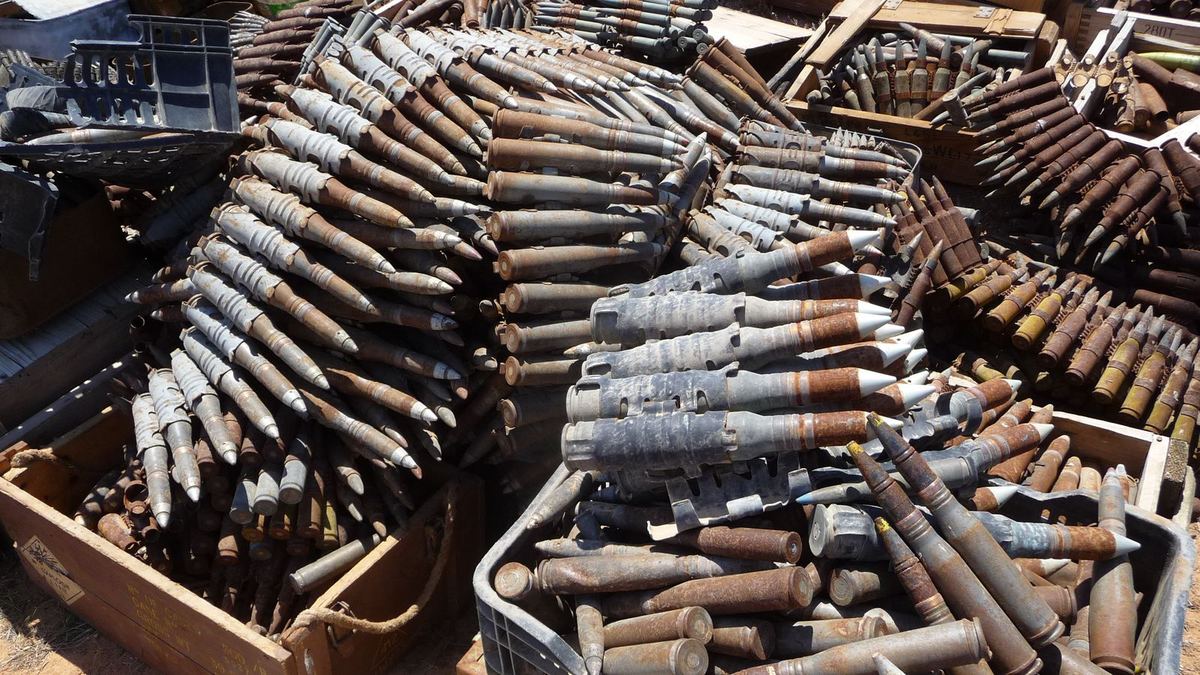
Inventory and classification come first
No safety measure can be sized without a reliable inventory. An inventory is more than a count. Each item has to be identified from its markings, colour codes and lot numbers, and sometimes by expert examination when markings have disappeared or the original documents are lost.
Each item is then assigned a hazard division and a compatibility group under the UN classification of Class 1 dangerous goods. The hazard division describes the expected behaviour in an explosive event: mass explosion for 1.1, projection without mass explosion for 1.2, fire with minor blast or projection for 1.3, hazard confined to the package for 1.4, very insensitive substances with a mass explosion hazard for 1.5, extremely insensitive articles for 1.6.
The compatibility group, a letter from A to S, sets which items may be stored together. It forbids, for example, storing primary explosives with filled munitions, or initiating devices with the charges they are meant to initiate. The storage plan turns these rules into the physical allocation of cells, bays and containers.
Destruction methods
Surplus or unserviceable stock has to leave through a controlled route. Four are in use.
Open detonation (OD)
The reference route for munitions whose condition rules out any fine handling. It is carried out on an authorised site, with control of blast, fragments and fallout.
Open burning (OB)
Controlled burning, used mainly for propellants and pyrotechnic compositions. Like open detonation, it requires an authorised site and defined safety distances.
Demilitarisation by disassembly
Components are separated, recoverable materials are recycled and the volume left to destroy is reduced. It requires a suitable facility and a specific safety study.
Industrial processing
Treatment in a dedicated industrial plant, when quantities and local capacity justify it.
The choice depends on the nature of the filling, the quantity, the state of preservation, the possible presence of special fillings, environmental constraints and the capacity available locally.
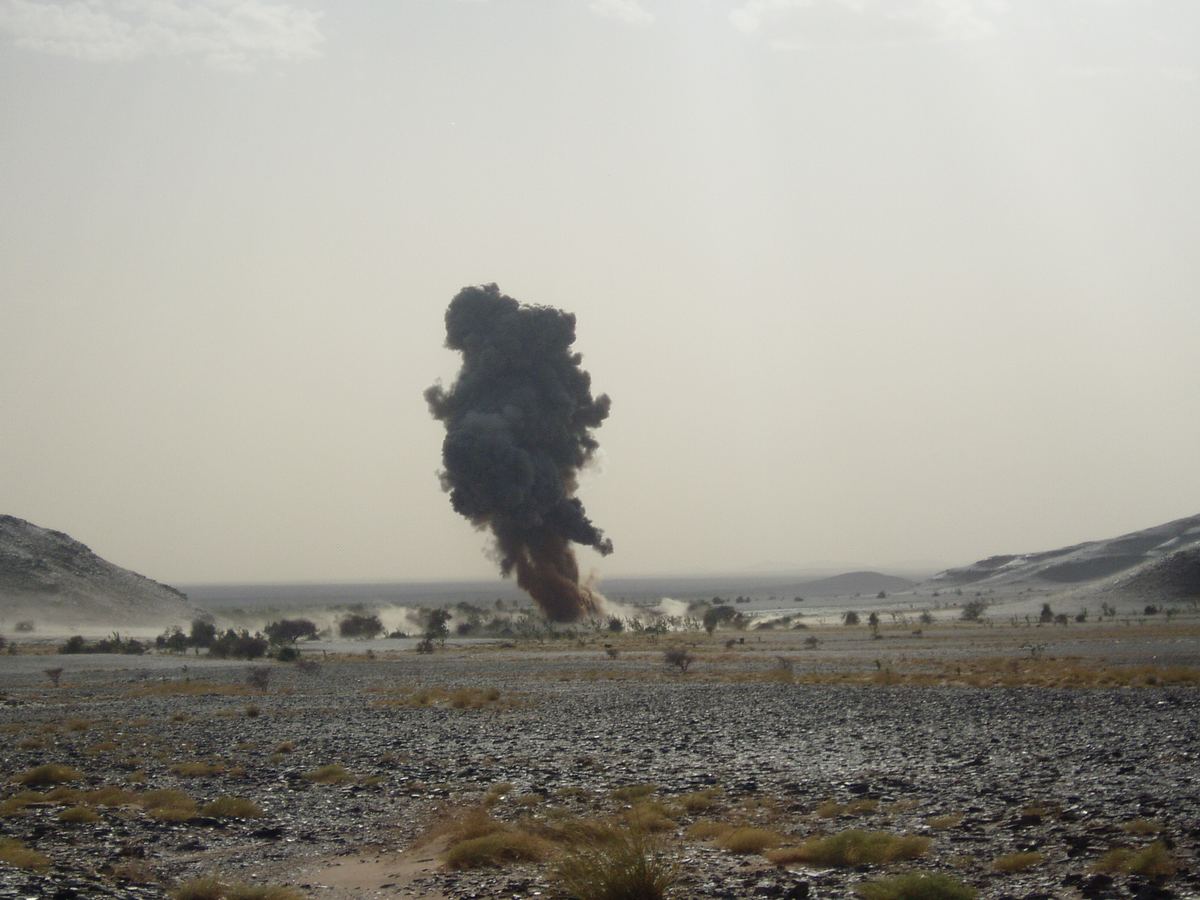
How a destruction operation is planned
- Identification and inventory: what is to be destroyed, by type, lot and quantity, with its hazard division and compatibility group.
- Choice of route: detonation, burning, disassembly or industrial processing, according to the criteria above.
- Explosive safety study: effect zones, protection of personnel and third parties, management of the explosive waste produced.
- Operation: on an authorised site, in batches sized by the safety study.
- Verification: the site is checked after each series and residues are treated.
- Records: each lot is traced from the inventory to its destruction, so that the result can be audited.
Storage safety while stocks await disposal
The safety of a depot rests on controlling the quantity of explosive present at each point and the distance between that quantity and the people and property exposed. Sizing covers the maximum quantity per cell, internal distances between storage units, external distances to third parties and roads, the nature and strength of traverses and dividing walls, and detection, alarm and response arrangements.
The International Ammunition Technical Guidelines (IATG) and the NATO manual AASTP-1 express these principles as quantity-distances.
Physical security completes the picture: access control, fencing and perimeter detection, guarding, lighting, and periodic checks of seals and inventories.
Surveillance of ammunition condition over time
Stored ammunition is not inert. Nitrocellulose-based propellants decompose slowly and release nitrogen oxides, which the stabiliser absorbs until it is used up. Once the stabiliser reserve is consumed, decomposition becomes autocatalytic and can lead to self-ignition. For that reason an old stock needs a chemical stability surveillance programme, based on periodic sampling and laboratory analysis.
Secondary explosives raise other problems: exudation, migration into gaps, formation of sensitive metallic salts in contact with certain metals, degradation of seals and casings. Periodic visual inspection looks for exudate, corrosion, deformation, packaging defects and marking anomalies. The results feed a decision recorded lot by lot: keep in service, downgrade or dispose.
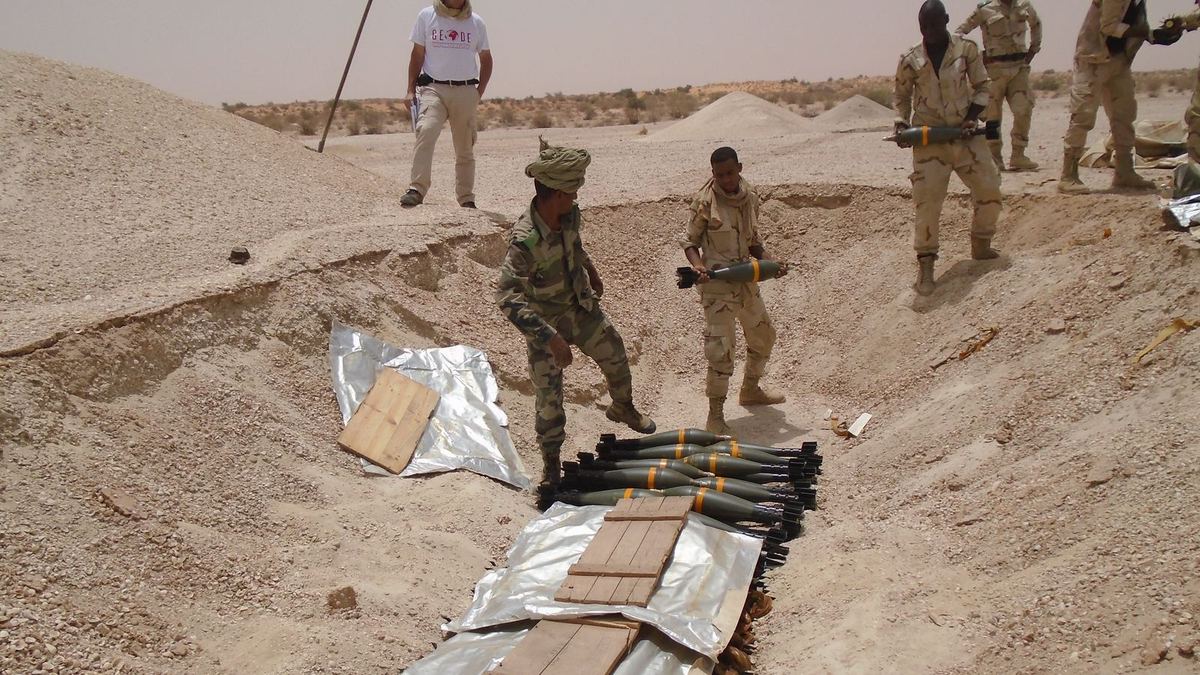
Treaty deadlines and post-conflict context
Two conventions set deadlines for stockpile destruction. Article 4 of the 1997 Anti-Personnel Mine Ban Convention (Ottawa) requires each State Party to destroy its stockpiled anti-personnel mines no later than four years after the Convention enters into force for it. Article 3 of the 2008 Convention on Cluster Munitions sets eight years for stockpiled cluster munitions.
After a conflict, national stocks are often oversized, poorly documented and stored in damaged facilities, with a high risk of unplanned explosion and of diversion. Work then combines support for the national inventory, rehabilitation or reconstruction of compliant storage, training and qualification of local personnel, and destruction operations.
The reference texts are IMAS 11.10 (destruction of stockpiled anti-personnel mines), IMAS 11.20 (open burning and open detonation operations), IMAS 11.30 (national planning) and IATG 10.10 (demilitarisation, destruction and logistic disposal of conventional ammunition). Ammunition found on the ground rather than in store is treated by battle area clearance.
DEMINETEC's approach
We start with a joint review of the existing situation: examination of the documents, visit of the facilities, spot checks of the declared inventory against the real stock, and a list of gaps against the applicable standard. The gaps are ranked by criticality, separating what needs immediate action from what can go into a multi-year programme.
The compliance programme is then built with the operator, taking its operating constraints and capacity into account. It sets out the infrastructure works, the changes to the storage plan, the procedures to formalise, the training to deliver and, where needed, the disposal operations to schedule. Everything is documented so that it can be audited.
Frequently asked questions about stockpile destruction
What is stockpile destruction?
Stockpile destruction is the physical destruction of stocks of mines, cluster munitions and other ammunition that are surplus, obsolete, unsafe or banned by treaty. It is one of the components of mine action and the last step of ammunition stockpile management.
What does PSSM mean?
PSSM stands for physical security and stockpile management. It covers the measures that keep a stock of ammunition and explosives safe, accounted for and under control for as long as it is held: physical security against theft and diversion, explosive safety against accidental explosion, stock accounting, and surveillance of the condition of the ammunition over time.
What is the difference between open burning and open detonation?
Open detonation destroys munitions with a donor charge and is the reference route for items that cannot be handled finely. Open burning is controlled combustion, used mainly for propellants and pyrotechnic compositions. Both are carried out on an authorised site, after a safety study that defines effect zones and safety distances. IMAS 11.20 gives the principles and procedures.
Which standards apply to ammunition storage and destruction?
Internationally, the International Ammunition Technical Guidelines (IATG), published by the United Nations under the SaferGuard programme, are the most complete reference; IATG 10.10 deals with demilitarisation and destruction. NATO applies the AASTP-1 manual. For mines, IMAS 11.10, 11.20 and 11.30 apply.
What deadlines do treaties set for stockpile destruction?
The Anti-Personnel Mine Ban Convention gives each State Party four years after entry into force to destroy its stockpiled anti-personnel mines (Article 4). The Convention on Cluster Munitions gives eight years for stockpiled cluster munitions (Article 3).
How do you know whether stored ammunition is still stable?
Stability depends on the filling and on storage conditions. Nitrocellulose-based propellants degrade by autocatalytic decomposition and need chemical stability monitoring and a check of the stabiliser reserve. Cast secondary explosives can exude or form sensitive metallic salts in contact with certain metals. Systematic visual inspection, lot traceability and sampling campaigns support the decision to keep a lot in service or dispose of it.
Does DEMINETEC work internationally on stockpile management?
Yes. DEMINETEC carries out ammunition and explosive risk management assignments internationally, including in post-conflict settings, and in France, in line with IMAS for mine action and IATG for ammunition. Services cover depot audits, compliance work, personnel training, inventory support and destruction operations.