
UXO and mine clearance in Hama
Explosive ordnance risk management in Syria – DEMINETEC GroupUXO, ERW and mine clearance in Hama
The DEMINETEC Group provides explosive ordnance risk management to public and private clients with projects in Hama, Syria: historical desk study, non-technical and technical survey, UXO survey, battle area clearance, mine clearance and EOD support. The group has worked in 34 countries and operates to the International Mine Action Standards (IMAS), the requirements of the national authorities and the contract specifications.
In short.
- Front lines north of Hama shifted in 2017, 2019 and again in 2024, when opposition forces took the city on 5 December.
- Hazards include landmines, cluster submunitions, unexploded bombs, surface-to-surface missiles, artillery shells and Grad rockets, largely on farmland and in villages north of the city.
- The Syrian National Mine Action Centre coordinates with UNMAS, which accredits operators with IMAS as the baseline; national standards are not yet adopted.
Historical UXO context of Hama
Hama city saw a Syrian army operation in July and August 2011, but most later fighting took place in the countryside to its north. An opposition offensive in March and April 2017 reached Suran, Maardis, Khitab and Qomhana before being reversed. The April–August 2019 offensive by Syrian government forces took Kafr Nabudah, Qalaat al-Madiq, Kafr Zita, Latamneh and Morek, and the 2024 opposition offensive crossed the same ground before Hama changed hands on 5 December 2024.
Mine Action Review reports that non-technical survey by Syria Civil Defence in Aleppo, Hama and Idlib in 2021–2022 found explosive contamination in 22 to 38 per cent of communities, with submunitions more than 40 per cent of items identified. Syrian Arab Red Crescent teams also surveyed in Hama, Humanity & Inclusion operated there in 2025 and set up a base in central Hama, and Syria Civil Defence disposal units respond to call-outs. HALO reported in December 2025 that Hama had recorded more than 100 explosive accidents since the previous year.
The exposure is largely rural. HALO reported that four children were killed in November 2025 when a landmine exploded as they picked olives in Hama, and that 348 people had been killed while farming across Syria since December 2024. Infrastructure also lay in the fighting zone: Hama Military Airport was hit by Grad rockets in April 2017 and by surface-to-surface missiles in 2019. Road, irrigation, power and housing projects north of the city cross ground fought over several times, so survey should precede excavation.
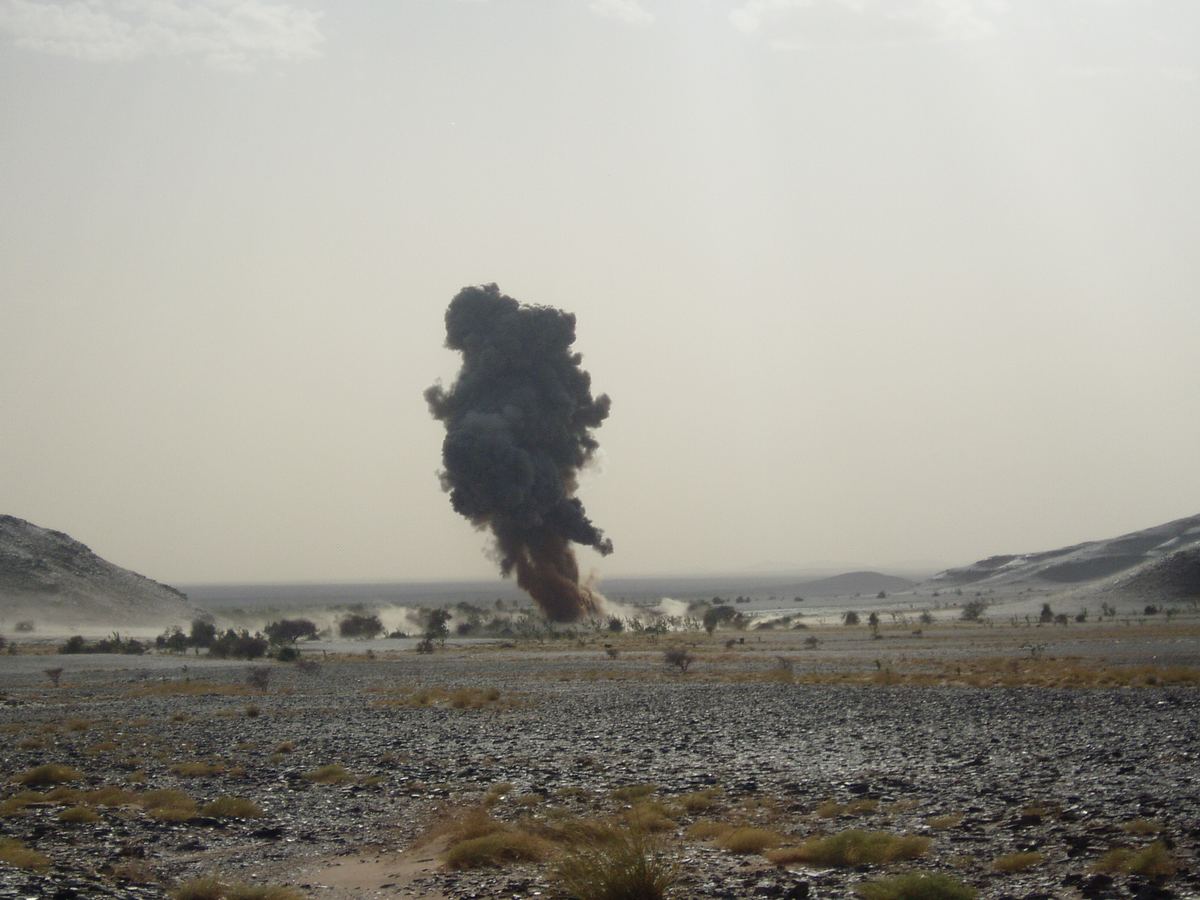
Our services for projects in Hama
Historical desk study and non-technical survey (NTS)
Collection and analysis of archives, testimony and field evidence to define suspected hazardous areas before any intervention. Non-technical survey
Technical survey and UXO survey
Geophysical detection (magnetometry, electromagnetics) and ground verification to confirm and locate explosive ordnance, on land or underwater. UXO survey
Battle area clearance and mine clearance
Search, identification and neutralisation or destruction of UXO, mines and improvised explosive devices by qualified EOD operators. Battle area clearance · Mine clearance
Client representation and quality control
Independent supervision, quality assurance and quality control of clearance contractors on behalf of the project owner, and explosive ordnance safety advice on site.
Training and stockpile management (PSSM)
EOD training, physical security and stockpile management assessments and destruction of surplus ammunition, through the group company GEODE. Stockpile destruction and PSSM
Underwater works
Survey and clearance in ports, rivers and offshore areas with the group company SEMTEC.
Why the DEMINETEC Group?
- ISO 9001, ISO 14001, ISO 45001 and MASE certified.
- Group pre-qualified by UNOPS in 14 disciplines since 2023.
- Experts who have worked in 34 countries, through GEODE (Global EOD Experts) for mine action and SEMTEC for underwater works.
- Teams of former French Navy and Army EOD operators.
- Onshore and underwater capacity within one group.
The DEMINETEC Group and Syria
The group’s experts carried out clearance, demining and training missions in Syria in 2018 and 2019. Any engagement in Syria is subject to prior verification of the applicable international sanctions and export-control rules.
See the international references of the group.
Conflict history and explosive contamination in Hama
Syrian government tanks were deployed at Hama on 3 July 2011 and the army entered the city on 31 July, in an operation that lasted until 4 August 2011. Later fighting concentrated north of the city. Human Rights Watch documented cluster munition rockets fired from BM-21 Grad launchers at Latamneh, north-west of Hama, on 3 January 2013. On 21 March 2017, opposition forces led by Hay'at Tahrir al-Sham opened an offensive with two car bombs at Suran, attacked Qomhana and came within 3 kilometres of Hama city on 29 March. Government forces retook Khitab on 31 March, Suran on 16 April and Halfaya on 23 April; more than 400 air strikes were reported in the northern Hama countryside within 48 hours, and opposition fighters fired more than 40 Grad rockets towards Hama Military Airport.
From 30 April to 31 August 2019, Syrian government forces advanced into north-western Hama while the Syrian and Russian air forces carried out air strikes and ground units fired surface-to-surface missiles and heavy artillery; barrel bomb use was also reported. Kafr Nabudah was captured on 8 May, Qalaat al-Madiq on 9 May, and the pocket of Morek, Kafr Zita and Latamneh on 23 August 2019. On 30 November 2024, opposition forces took Kafr Zita, Latamneh and Morek; fighting followed around Jabal Zayn al-Abidin, Qomhana and Khitab, with more than 45 air strikes reported on 2 December. Opposition forces entered Hama on 5 December 2024, government forces withdrew, and the city and its military airport changed hands that day.
Areas and structures concerned
- Latamneh
- Kafr Zita
- Morek
- Kafr Nabudah
- Qalaat al-Madiq
- Suran
- Qomhana
- Hama Military Airport
Expected ordnance and implications for survey
Human Rights Watch identified 122 mm cluster munition rockets carrying DPICM submunitions at Latamneh in 2013, and Mine Action Review reports that submunitions made up more than 40 per cent of items found by Syria Civil Defence survey in Aleppo, Hama and Idlib. Air-dropped bombs, barrel bombs, surface-to-surface missiles, heavy artillery and Grad rockets were used on the northern front, and HALO reported a landmine accident in Hama in 2025. Survey therefore concentrates on former front lines, farmland, submunition strike areas and deep-buried bombs.
FAQ: explosive risk in Hama
Is the explosive risk in Hama city or in the countryside?
Mostly in the countryside. The army entered Hama in 2011 and government forces withdrew on 5 December 2024, although rockets hit the city during that offensive. The offensives of 2017, 2019 and 2024 were fought to the north and north-west, around Suran, Khitab, Qomhana, Kafr Zita, Latamneh and Morek, where ground changed hands several times.
Why are farmers and children so exposed in Hama?
Many accidents happen on agricultural land. HALO reported four children killed in November 2025 by a landmine while picking olives in Hama, and counted 348 people killed while farming across Syria since December 2024, 95 of them children. HALO also describes cluster munitions as especially dangerous to children because they detonate easily when picked up or stood upon.
Who is surveying and clearing explosive ordnance in Hama governorate?
According to Mine Action Review, Humanity & Inclusion operated in Hama in 2025 and established a base in the centre of Hama, Syrian Arab Red Crescent teams supported by the ICRC conducted non-technical survey, and Syria Civil Defence disposal units answer call-outs. MAG received funding to operate in Homs and Hama. No comprehensive countrywide survey exists, so the full extent of contamination is unknown.
Sources: Mine Action Review — Clearing Cluster Munition Remnants 2026: Syria · The HALO Trust — Press release: HALO Trust Syria: A year of hope has been tainted by tragedy (4 December 2025) · Human Rights Watch — Syria: Army Using New Type of Cluster Munition (14 January 2013) · Wikipedia — Siege of Hama (2011) · Wikipedia — Hama offensive (March–April 2017) · Wikipedia — Northwestern Syria offensive (April–August 2019) · Wikipedia — 2024 Hama offensive
Territorial coverage
Hama city and Hama governorate, including Suran, Taybat al-Imam, Halfaya, Morek, Kafr Zita and Qalaat al-Madiq. Teams and equipment are mobilised to fit each mission: documentary studies, short field surveys or long-duration clearance operations.
Other city pages for the Middle East and Libya: Baghdad · Erbil · Mosul · Tripoli · Misrata · Sirte · Benghazi · Damascus · Homs · Aleppo · Raqqa · Palmyra · Beirut · Amman
Frequently asked questions about UXO clearance in Hama
Which standards apply to explosive ordnance clearance in Syria?
The central coordination body is the Syrian National Mine Action Centre (SNMAC), set up in August 2025 under the Ministry of Emergency and Disaster Management and still establishing itself. Formal national mine action standards do not yet exist, with adoption expected by mid-2027; meanwhile most operators apply their own procedures and UNMAS accredits them using the International Mine Action Standards (IMAS) as the baseline. Operators not contracted by UNMAS task themselves under donor agreements. Mine action is coordinated with the UN through the UNMAS-led Mine Action Area of Responsibility, and operators must comply with applicable international sanctions and export-control rules.
What does a project owner need before starting works in Hama?
A historical desk study and a non-technical survey to define the hazard, then a technical survey or UXO survey of the project footprint, clearance where evidence of contamination is found, and a handover document stating the areas and depths treated. The scope depends on the site history and on the depth of the works.
How long does a mission take?
Duration depends on the area, the search depth and the density of contamination: from a few weeks for a desk study to several months or more for clearance operations on major projects.
Does the group work underwater?
Yes. Through the group company SEMTEC, the group carries out commercial diving, underwater magnetometry and neutralisation of submerged ordnance in ports, rivers and coastal areas.
Contact the DEMINETEC Group about Hama
For any desk study, survey or clearance request, contact our teams:
DEMINETEC SAS285 avenue Marcel Paul
83500 La Seyne-sur-Mer, FRANCE
Tel: +33 9 52 51 00 63
Email: contact@deminetec.com