
UXO and mine clearance in Mosul
Explosive ordnance risk management in Iraq – DEMINETEC GroupUXO, ERW and mine clearance in Mosul
The DEMINETEC Group provides explosive ordnance risk management to public and private clients with projects in Mosul, Iraq: historical desk study, non-technical and technical survey, UXO survey, battle area clearance, mine clearance and EOD support. The group has worked in 34 countries and operates to the International Mine Action Standards (IMAS), the requirements of the national authorities and the contract specifications.
In short.
- Mosul was held by the Islamic State group (ISIS) from June 2014 and retaken in a nine-month battle between October 2016 and July 2017.
- The battle left IEDs, improvised mines, suicide belts, mortars, rockets, grenades and air-dropped ordnance, much of it under rubble in the Old City.
- Clearance in Ninewa Governorate is regulated by Iraq's Directorate for Mine Action (DMA), which accredits operators and issues task orders, with technical support from UNMAS.
Historical UXO context of Mosul
Mosul, the main city of Ninewa Governorate, straddles the Tigris. The Islamic State group (ISIS) seized it in June 2014 and held it for three years. The offensive to retake the city began on 16 October 2016 and the Iraqi government declared victory on 10 July 2017, after months of air strikes, artillery fire and urban fighting. Older layers also exist: Iraq's legacy contamination dates from the 1980–1988 war with Iran, the 1991 Gulf War and the 2003 invasion.
Contamination is documented across the city. In November 2017 more than 100 explosive hazards were reported to clearance teams within two days on Ninewa Road in the Old City, and about 1,320 items were removed from the Al Shifa Hospital Complex between October 2017 and March 2019. By April 2020 some 62,000 explosive hazards had been cleared from more than 1,422 sites in Mosul. Iraqi Security Forces and UNMAS with its implementing partners have cleared sites in the city, and NGOs including MAG and FSD work in Ninewa Governorate.
Reconstruction in Mosul depends on prior clearance: UNDP states that rehabilitation of a site cannot begin until UNMAS or an implementing partner has cleared it. The Old City held an estimated 10 million tonnes of rubble after the battle, which clearance teams have had to search for explosive items. The preparatory phase of UNESCO's rebuilding of the Al-Nouri Mosque complex, started in autumn 2018, included demining, and by 2022 it had removed 21 items of UXO from the area where 124 historic houses are being rebuilt.
Our services for projects in Mosul
Historical desk study and non-technical survey (NTS)
Collection and analysis of archives, testimony and field evidence to define suspected hazardous areas before any intervention. Non-technical survey
Technical survey and UXO survey
Geophysical detection (magnetometry, electromagnetics) and ground verification to confirm and locate explosive ordnance, on land or underwater. UXO survey
Battle area clearance and mine clearance
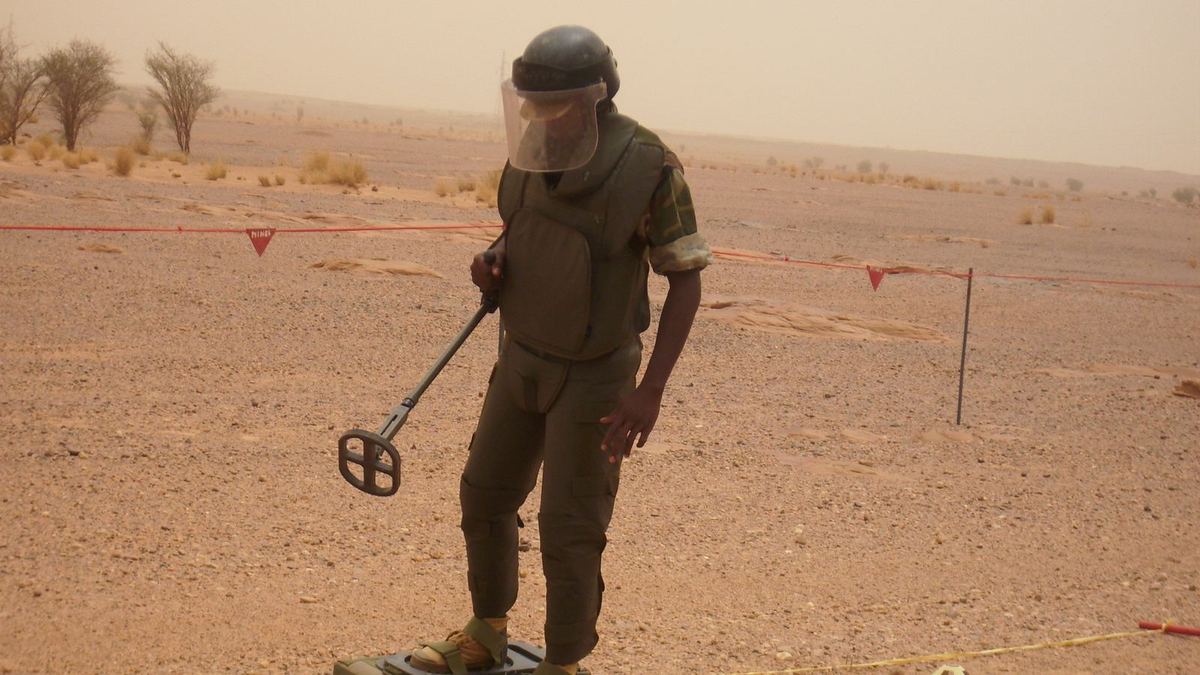
Search, identification and neutralisation or destruction of UXO, mines and improvised explosive devices by qualified EOD operators. Battle area clearance · Mine clearance
Client representation and quality control
Independent supervision, quality assurance and quality control of clearance contractors on behalf of the project owner, and explosive ordnance safety advice on site.
Training and stockpile management (PSSM)
EOD training, physical security and stockpile management assessments and destruction of surplus ammunition, through the group company GEODE. Stockpile destruction and PSSM
Underwater works
Survey and clearance in ports, rivers and offshore areas with the group company SEMTEC.
Why the DEMINETEC Group?
- ISO 9001, ISO 14001, ISO 45001 and MASE certified.
- Group pre-qualified by UNOPS in 14 disciplines since 2023.
- Experts who have worked in 34 countries, through GEODE (Global EOD Experts) for mine action and SEMTEC for underwater works.
- Teams of former French Navy and Army EOD operators.
- Onshore and underwater capacity within one group.
The DEMINETEC Group and Iraq
The DEMINETEC Group worked in Iraq between 2016 and 2022 (training, assessment and expertise, underwater EOD), and DEMINETEC SAS has a branch registered in Baghdad.
See the international references of the group.
Conflict history and explosive contamination in Mosul
ISIS seized Mosul in June 2014. The offensive to retake it began on 16 October 2016 with Iraqi Security Forces, Kurdish Peshmerga and Popular Mobilisation Forces advancing village by village through Ninewa Governorate, supported by a United States-led coalition providing air strikes and artillery. Iraqi counter-terrorism forces began their assault on the eastern Karama district on 1 November 2016 and entered the city limits the same day. By 22 November coalition air strikes had struck four of the five Tigris bridges, and the Old Bridge, the last one functioning, was reported destroyed on 27 December. The University of Mosul was captured on 14 January 2017 and eastern Mosul was declared retaken on 24 January. ISIS defended with car bombs, mortars, roadside IEDs, land mines and tunnels rigged with explosives.
The offensive on western Mosul began on 19 February 2017. Fighting moved towards the Old City, with coalition and Iraqi air strikes and howitzer and rocket artillery fire on one side, and ISIS car bombs, IEDs and booby-traps on the other. The Al-Hadba minaret of the Al-Nouri Mosque complex was destroyed in 2017. The Iraqi government formally declared victory on 10 July 2017, and fighting in the last pocket of the Old City continued until 20 July. The Al Shifa Hospital Complex in West Mosul, used by ISIS as a headquarters, was heavily bombed during the battle. UNMAS was granted access to the Old City to assess, survey and clear explosive hazards in November 2017, complementing the work of the Iraqi Security Forces.
Areas and structures concerned
- Old City of Mosul, including Ninewa Road
- Al-Nouri Mosque complex and Al-Hadba minaret
- Al Shifa Hospital Complex (West Mosul)
- Al Zanjili neighbourhood (West Mosul)
- East Mosul Forest, used by ISIS to store explosives and weapons
- University of Mosul
- The five Tigris bridges, including the Old Bridge (Iron Bridge)
- Karama district (East Mosul)
Expected ordnance and implications for survey
Items recorded in Mosul include IEDs and improvised mines, suicide belts, mortar rounds, grenades, rockets, air-dropped ordnance and stockpiles of ISIS-made weapons. Improvised mines are mostly victim-activated by pressure plate, with charges ranging from 3 kg to 100 kg, and devices have been found concealed in houses, furniture and household appliances. Survey therefore combines building-by-building search for IEDs, rubble removal under explosive ordnance disposal supervision and, where air strikes hit, detection of deeper air-delivered bombs beneath collapsed structures.
FAQ: explosive risk in Mosul
Is Mosul clear of explosive ordnance today?
No. UNMAS stated in December 2017 that the Old City would need many years of clearance. Mine Action Review recorded 36.7 km² of improvised mine contamination in Ninewa Governorate at the end of 2024, and UNMAS reported removing 19,172 ERW and 677 IEDs in the governorate in 2025. Many sites have been cleared, but work continues.
What kinds of devices have been found in Mosul's buildings?
Clearance teams have recovered IEDs, suicide belts, mortars, grenades, rockets and air-dropped ordnance. At the Al Shifa Hospital Complex, used by ISIS as a headquarters, about 1,320 explosive items were removed between October 2017 and March 2019, and a stockpile of ISIS-made weapons was found. Improvised devices have been concealed in houses, furniture and household appliances.
Can reconstruction start before a site is cleared?
UNDP states that its rehabilitation work cannot commence until a site has been cleared by UNMAS or one of its implementing partners. At the Al Shifa Hospital Complex, because of the size of the site, clearance and reconstruction ran at the same time, and workers removing rubble in West Mosul were trained to recognise and react to mines and IEDs.
Sources: Mine Action Review — Iraq, Clearing the Mines 2025 · Landmine and Cluster Munition Monitor — Iraq: Mine Action (2018 report) · UNMAS — Where we work: Iraq · UNDP Iraq — In pictures: Clearing Mosul's Mines (April 2020) · United Nations in Iraq — Commencement of the explosive hazards clearance activities in Mosul's Old City (December 2017) · UNESCO — Mosul on the path to reconstruction five years after its liberation · Wikipedia — Battle of Mosul (2016–2017)
Territorial coverage
This page covers Mosul and Ninewa Governorate, including the Old City, West Mosul and East Mosul, and the nearby Bashiqa, Hamdaniya, Tel Kaif and Tel Afar areas. Teams and equipment are mobilised to fit each mission: documentary studies, short field surveys or long-duration clearance operations.
Other city pages for the Middle East and Libya: Baghdad · Erbil · Tripoli · Misrata · Sirte · Benghazi · Damascus · Homs · Hama · Aleppo · Raqqa · Palmyra · Beirut · Amman
Frequently asked questions about UXO clearance in Mosul
Which standards apply to explosive ordnance clearance in Iraq?
Mosul lies in Federal Iraq, where the Directorate for Mine Action (DMA), part of the Ministry of Environment, plans, coordinates and supervises mine action, sets national standards, accredits organisations, approves their standard operating procedures and certifies completed clearance. Operators must be accredited by the DMA and work under the task orders it issues. Since 2021, 23 of Iraq's 35 national mine action standards (NMAS) have been revised with UNMAS support, and a 2024 workshop updated those on building clearance and IEDs. The Landmine Monitor describes the national standards as largely consistent with the International Mine Action Standards (IMAS).
What does a project owner need before starting works in Mosul?
A historical desk study and a non-technical survey to define the hazard, then a technical survey or UXO survey of the project footprint, clearance where evidence of contamination is found, and a handover document stating the areas and depths treated. The scope depends on the site history and on the depth of the works.
How long does a mission take?
Duration depends on the area, the search depth and the density of contamination: from a few weeks for a desk study to several months or more for clearance operations on major projects.
Does the group work underwater?
Yes. Through the group company SEMTEC, the group carries out commercial diving, underwater magnetometry and neutralisation of submerged ordnance in ports, rivers and coastal areas.
Contact the DEMINETEC Group about Mosul
For any desk study, survey or clearance request, contact our teams:
DEMINETEC SAS285 avenue Marcel Paul
83500 La Seyne-sur-Mer, FRANCE
Tel: +33 9 52 51 00 63
Email: contact@deminetec.com