
UXO and mine clearance in Erbil
Explosive ordnance risk management in Iraq – DEMINETEC GroupUXO, ERW and mine clearance in Erbil
The DEMINETEC Group provides explosive ordnance risk management to public and private clients with projects in Erbil, Iraq: historical desk study, non-technical and technical survey, UXO survey, battle area clearance, mine clearance and EOD support. The group has worked in 34 countries and operates to the International Mine Action Standards (IMAS), the requirements of the national authorities and the contract specifications.
In short.
- Erbil Governorate's contamination dates mainly from the 1980–1988 Iran–Iraq War, with additions in 1991, 2003 and the 2014 Islamic State group (ISIS) advance.
- Legacy anti-personnel minefields covered 48.4 km² in 326 confirmed hazardous areas at the end of 2024, alongside UXO, cluster munitions and improvised mines.
- Clearance is regulated by the Iraqi Kurdistan Mine Action Agency (IKMAA), which accredits operators, issues clearance tasks and carries out quality assurance.
Historical UXO context of Erbil
Erbil is the capital of the Kurdistan Region of Iraq. According to the Iraqi Kurdistan Mine Action Agency (IKMAA), most minefields in the region were laid during the Iran–Iraq War (1980–1988), mostly along the borders with Iran and Turkey, and some were added in 1991 and during the 2003 invasion. The Islamic State group (ISIS) offensive of August 2014, which reached Makhmour and Gwer about 20 miles from the city, left a further layer of improvised devices and UXO.
Mine Action Review, using IKMAA data, recorded 326 confirmed hazardous areas of legacy anti-personnel mines covering 48.4 km² in Erbil Governorate at the end of 2024, plus 1.76 km² affected by improvised mines. IKMAA reported clearing 377,643 m² and destroying 681 anti-personnel mines in the governorate in 2024. Its Erbil office reported operations in Choman, Diyana and Rawanduz district in September 2025; around Makhmour, clearance was recorded by IKMAA and Fondation suisse de déminage (FSD). MAG also operates in the region.
The clearance that IKMAA reports for the governorate lies in rural and mountain districts, including land inside the Soran district tourism masterplan area, where 236 mines and other explosive remnants were defused in Choman and Diyana in September 2025. Mine Action Review notes that the regional estimate excludes border areas where insecurity has prevented survey. Road, energy, tourism and agricultural projects in these districts therefore need IKMAA hazard records checked before ground works begin.
Our services for projects in Erbil
Historical desk study and non-technical survey (NTS)
Collection and analysis of archives, testimony and field evidence to define suspected hazardous areas before any intervention. Non-technical survey
Technical survey and UXO survey
Geophysical detection (magnetometry, electromagnetics) and ground verification to confirm and locate explosive ordnance, on land or underwater. UXO survey
Battle area clearance and mine clearance
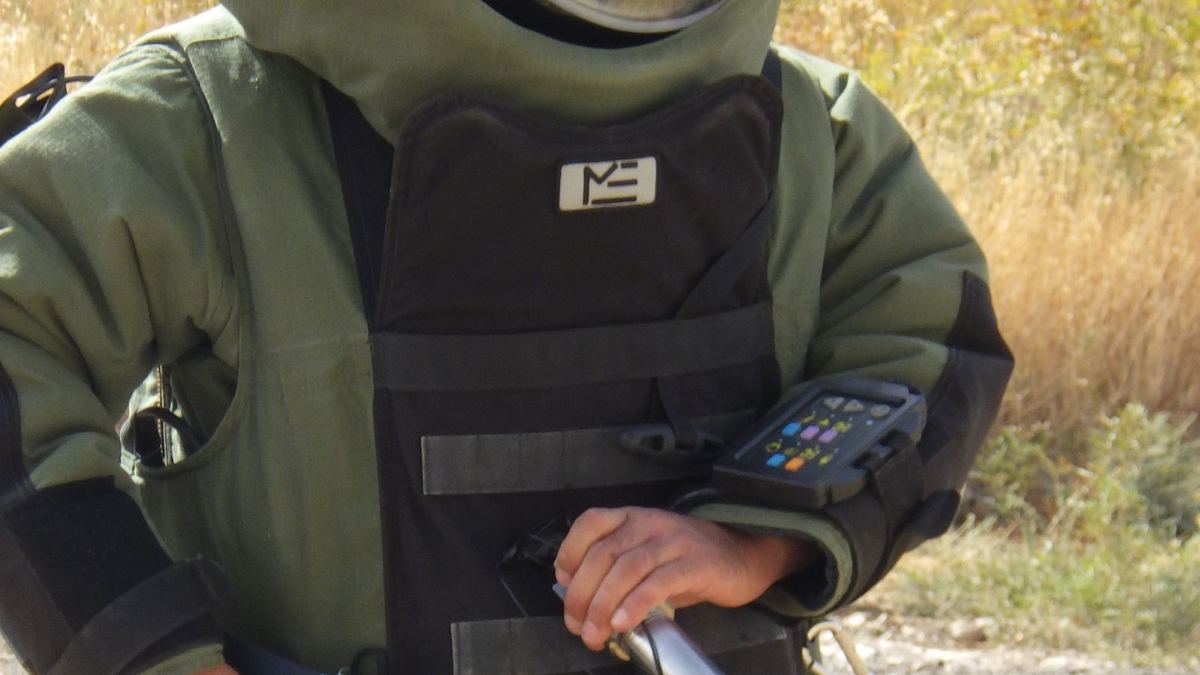
Search, identification and neutralisation or destruction of UXO, mines and improvised explosive devices by qualified EOD operators. Battle area clearance · Mine clearance
Client representation and quality control
Independent supervision, quality assurance and quality control of clearance contractors on behalf of the project owner, and explosive ordnance safety advice on site.
Training and stockpile management (PSSM)
EOD training, physical security and stockpile management assessments and destruction of surplus ammunition, through the group company GEODE. Stockpile destruction and PSSM
Underwater works
Survey and clearance in ports, rivers and offshore areas with the group company SEMTEC.
Why the DEMINETEC Group?
- ISO 9001, ISO 14001, ISO 45001 and MASE certified.
- Group pre-qualified by UNOPS in 14 disciplines since 2023.
- Experts who have worked in 34 countries, through GEODE (Global EOD Experts) for mine action and SEMTEC for underwater works.
- Teams of former French Navy and Army EOD operators.
- Onshore and underwater capacity within one group.
The DEMINETEC Group and Iraq
The DEMINETEC Group worked in Iraq between 2016 and 2022 (training, assessment and expertise, underwater EOD), and DEMINETEC SAS has a branch registered in Baghdad.
See the international references of the group.
Conflict history and explosive contamination in Erbil
IKMAA attributes most of the minefields in what is now the Kurdistan Region to the Iran–Iraq War (1980–1988), laid mostly along the borders with Iran and Turkey. Kurdish institutions in Erbil were effectively controlled by the government of Saddam Hussein until the Kurdish uprising at the end of the 1991 Gulf War, and IKMAA records that some mines were planted in 1991. In May 1994 fighting broke out between the Kurdistan Democratic Party (KDP) and the Patriotic Union of Kurdistan (PUK). On 31 August 1996 about 30,000 Iraqi troops, spearheaded by a Republican Guard armoured division and acting in conjunction with KDP forces, attacked PUK-held Erbil. After the KDP was installed in control of the city, Iraqi Army troops withdrew from the Kurdish region, and the two parties signed a peace agreement in Washington in September 1998.
During the 2003 invasion of Iraq a United States special forces task force was headquartered just outside Erbil, and IKMAA records some mine-laying in that period. The city was later hit by bombings, including attacks on Eid celebrations in February 2004 and a suicide bombing outside a police recruiting centre in May 2005. On 6 August 2014 ISIS advanced to within about 40 km south-west of Erbil and on 7 August it captured Makhmour. United States air strikes began on 8 August west of the city, and Kurdish Peshmerga forces retook Gwer and Makhmour on 10 August. Missiles struck Erbil in February 2021 and again in March 2022.
Areas and structures concerned
- Choman (mines and explosive remnants defused by IKMAA's Erbil office in September 2025)
- Diyana and the Soran district tourism masterplan area
- Rawanduz district (two cluster munitions destroyed in September 2025)
- Makhmour (captured by ISIS on 7 August 2014, retaken on 10 August)
- Gwer (retaken by Peshmerga forces on 10 August 2014)
- The Kurdistan Region's borders with Iran and Turkey, where most minefields are located
Expected ordnance and implications for survey
Recorded contamination in Erbil Governorate is dominated by legacy anti-personnel minefields; IKMAA also reports anti-tank mines across the region, UXO, and cluster munitions such as the two destroyed in Rawanduz district in 2025. Improvised mines are recorded in two confirmed hazardous areas, and UXO was the main item destroyed around Makhmour. Survey therefore starts from IKMAA minefield records and non-technical survey, followed by manual or mechanical clearance; ground held by ISIS in 2014 also requires search procedures for improvised devices.
FAQ: explosive risk in Erbil
Where is explosive contamination recorded in Erbil Governorate?
Mine Action Review, citing IKMAA data, recorded 326 confirmed hazardous areas of legacy anti-personnel mines covering 48.4 km² in the governorate at the end of 2024, plus 1.76 km² of improvised mines. IKMAA's Erbil office reported operations in Choman, Diyana and Rawanduz district in 2025. The regional estimate excludes border areas where insecurity has prevented survey.
Which conflicts left the ordnance found around Erbil?
IKMAA attributes most minefields in the Kurdistan Region to the Iran–Iraq War of 1980–1988, with some laid in 1991 and during the 2003 invasion. The ISIS advance of August 2014, which reached Makhmour and Gwer, about 20 miles from Erbil, added improvised devices and UXO in the areas that were later retaken.
Who authorises clearance work in Erbil?
In the Kurdistan Region the regulator is IKMAA, which is also an operator. It approves organisations' annual plans and issues clearance tasks, and its quality assurance and accreditation directorate monitors the work with the Erbil mine action centre. Mine Action Review reports that IKMAA had accredited seven companies for clearance in 2023. The federal Directorate for Mine Action regulates the rest of Iraq.
Sources: Mine Action Review — Iraq, Clearing the Mines 2025 · Landmine and Cluster Munition Monitor — Iraq: Mine Action (2018 report) · Iraqi Kurdistan Mine Action Agency (IKMAA) — IKMAA response for displacements and returns (presentation hosted by UN missions) · Kurdistan Regional Government — Kurdistan Mine Action Agency Steps Up Efforts to Eliminate Explosive Threats (September 2025) · Wikipedia — Erbil · Wikipedia — Iraqi Kurdish Civil War · Wikipedia — Northern Iraq offensive (August 2014)
Territorial coverage
This page covers Erbil Governorate in the Kurdistan Region of Iraq, including Choman, Soran, Diyana and Rawanduz, and the nearby Makhmour and Gwer areas south-west of the city. Teams and equipment are mobilised to fit each mission: documentary studies, short field surveys or long-duration clearance operations.
Other city pages for the Middle East and Libya: Baghdad · Mosul · Tripoli · Misrata · Sirte · Benghazi · Damascus · Homs · Hama · Aleppo · Raqqa · Palmyra · Beirut · Amman
Frequently asked questions about UXO clearance in Erbil
Which standards apply to explosive ordnance clearance in Iraq?
Mine action in the Kurdistan Region's four governorates, including Erbil, is overseen by the Iraqi Kurdistan Mine Action Agency (IKMAA), which reports to the Kurdistan Regional Government's Council of Ministers and acts as both regulator and operator; the Directorate for Mine Action (DMA) covers Federal Iraq. Operators must be accredited by IKMAA, work to tasks it issues and are subject to its quality assurance. A 2024 Erbil workshop organised by UNMAS with both authorities updated 11 of Iraq's national mine action standards (NMAS), which the Landmine Monitor describes as largely consistent with the International Mine Action Standards (IMAS).
What does a project owner need before starting works in Erbil?
A historical desk study and a non-technical survey to define the hazard, then a technical survey or UXO survey of the project footprint, clearance where evidence of contamination is found, and a handover document stating the areas and depths treated. The scope depends on the site history and on the depth of the works.
How long does a mission take?
Duration depends on the area, the search depth and the density of contamination: from a few weeks for a desk study to several months or more for clearance operations on major projects.
Does the group work underwater?
Yes. Through the group company SEMTEC, the group carries out commercial diving, underwater magnetometry and neutralisation of submerged ordnance in ports, rivers and coastal areas.
Contact the DEMINETEC Group about Erbil
For any desk study, survey or clearance request, contact our teams:
DEMINETEC SAS285 avenue Marcel Paul
83500 La Seyne-sur-Mer, FRANCE
Tel: +33 9 52 51 00 63
Email: contact@deminetec.com