
UXO and mine clearance in Beirut
Explosive ordnance risk management in Lebanon – DEMINETEC GroupUXO, ERW and mine clearance in Beirut
The DEMINETEC Group provides explosive ordnance risk management to public and private clients with projects in Beirut, Lebanon: historical desk study, non-technical and technical survey, UXO survey, battle area clearance, mine clearance and EOD support. The group has worked in 34 countries and operates to the International Mine Action Standards (IMAS), the requirements of the national authorities and the contract specifications.
In short.
- Beirut carries legacy ordnance from the 1975–1990 civil war, the 1982 siege and the 2006 conflict, plus new UXO from air strikes since 2023.
- Expected items are air-delivered bombs and artillery shells, often under rubble in the southern suburbs; mines and submunitions lie mainly in southern Lebanon.
- The Lebanon Mine Action Centre (LMAC), part of the Lebanese Armed Forces, coordinates, accredits and tasks all operators under national mine action standards (NMAS).
Historical UXO context of Beirut
Explosive ordnance in and around Beirut dates from several periods. The Landmine and Cluster Munition Monitor traces Lebanon's contamination to the 1975–1990 civil war and the Israeli invasions of 1978, 1982 and 2006. Around the capital, a 2020 GICHD case study records minefields laid during the civil war and cluster munition strikes. Since October 2023, repeated Israeli air strikes on Beirut's southern suburbs have left additional UXO and other explosive remnants of war (ERW), and strikes on the capital intensified again in early 2026.
Documented locations differ by period. GICHD shows a high concentration of already cleared areas around Beirut, where the Lebanon Mine Action Centre (LMAC) itself conducts technical survey and clearance. The Monitor names the southern suburbs, known as Dahieh (Ghobeiry, Haret Hreik, Bourj el-Barajneh, Ouzai, Hay El-Saloum), among areas with new UXO. In Mount Lebanon Governorate, Mine Action Review recorded 669,373 square metres of cluster munition contamination at the end of 2025. Emergency call-outs are handled by Lebanese Armed Forces engineering units, alongside accredited non-governmental operators.
For project owners, the main concern today is unexploded air-delivered ordnance in destroyed and damaged buildings. Mine Action Review reports that Lebanon has shifted priorities towards emergency UXO and rubble clearance in response to air strikes. This affects reconstruction in the southern suburbs and works near Rafic Hariri International Airport, which lies south of Dahieh. The 2020 port explosion, by contrast, involved ammonium nitrate rather than military ordnance, so rebuilding at the Port of Beirut raises debris and hazardous-material issues more than a documented UXO problem.
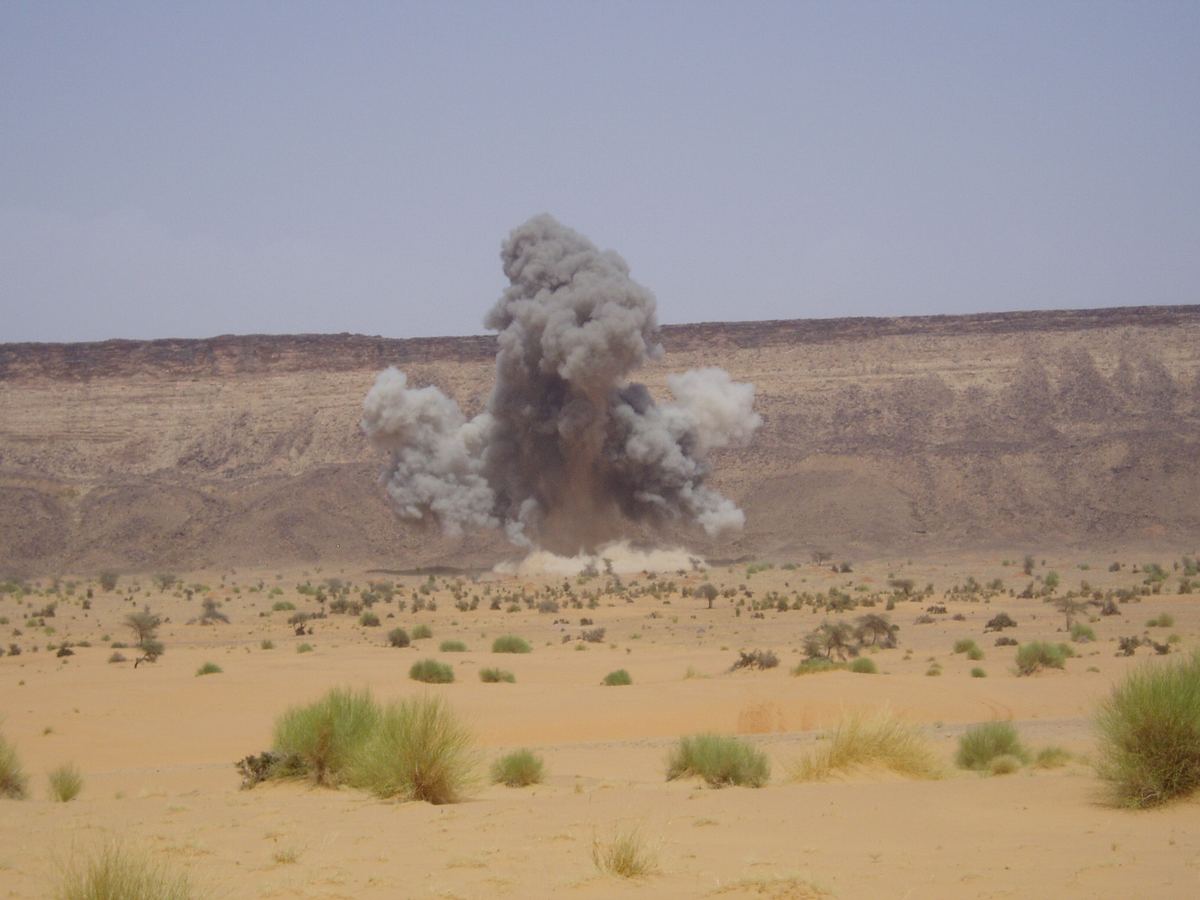
Our services for projects in Beirut
Historical desk study and non-technical survey (NTS)
Collection and analysis of archives, testimony and field evidence to define suspected hazardous areas before any intervention. Non-technical survey
Technical survey and UXO survey
Geophysical detection (magnetometry, electromagnetics) and ground verification to confirm and locate explosive ordnance, on land or underwater. UXO survey
Battle area clearance and mine clearance
Search, identification and neutralisation or destruction of UXO, mines and improvised explosive devices by qualified EOD operators. Battle area clearance · Mine clearance
Client representation and quality control
Independent supervision, quality assurance and quality control of clearance contractors on behalf of the project owner, and explosive ordnance safety advice on site.
Training and stockpile management (PSSM)
EOD training, physical security and stockpile management assessments and destruction of surplus ammunition, through the group company GEODE. Stockpile destruction and PSSM
Underwater works
Survey and clearance in ports, rivers and offshore areas with the group company SEMTEC.
Why the DEMINETEC Group?
- ISO 9001, ISO 14001, ISO 45001 and MASE certified.
- Group pre-qualified by UNOPS in 14 disciplines since 2023.
- Experts who have worked in 34 countries, through GEODE (Global EOD Experts) for mine action and SEMTEC for underwater works.
- Teams of former French Navy and Army EOD operators.
- Onshore and underwater capacity within one group.
The DEMINETEC Group and Lebanon
The group’s experts have worked in neighbouring Syria (2018–2019) and in Iraq (2016–2022); Lebanon is not yet among the group’s 34 countries of operation.
See the international references of the group.
Conflict history and explosive contamination in Beirut
During the Lebanese Civil War (1975–1990), fighting left minefields and other ERW in the Beirut area, according to GICHD. In 1982, during the Israeli invasion of Lebanon, the city was besieged. Israeli forces closed the ring around Beirut on 13 June 1982, isolating Palestine Liberation Organization (PLO) forces and part of the Syrian forces inside the city, chiefly West Beirut. For about seven weeks the city was attacked from sea, air and land; by the end of the first week of July some 500 buildings had been destroyed by shells and bombs, and the Camille Chamoun Sports City Stadium was bombed. Israeli forces secured the airport and some southern suburbs. On 21 August 1982 the first troops of a multinational force arrived to supervise the departure of the PLO.
In July–August 2006, during a 33-day conflict between Israel and Hezbollah, Dahieh, the southern suburbs of Beirut, was severely bombed by Israel before the ceasefire of 14 August 2006. On 4 August 2020, 2,750 tonnes of ammonium nitrate stored in Warehouse 12 at the Port of Beirut detonated, leaving a crater about 124 metres wide and damaging Gemmayze, Achrafieh, Karantina and Mar Mikhaël; the blast was caused by the stored ammonium nitrate, not by military ordnance. From October 2023, Israeli strikes again hit the southern suburbs, including the air strikes of 27 September 2024 in which Hezbollah leader Hassan Nasrallah was killed. A ceasefire was brokered in November 2024, but hostilities escalated from late 2025 and peaked in April 2026 with heavy Israeli air strikes on Beirut.
Areas and structures concerned
- Haret Hreik, Ghobeiry and Bourj el-Barajneh (southern suburbs, Dahieh)
- Ouzai and Hay El-Saloum
- Tahwitat al-Ghadir (air strike of 27 March 2026)
- West Beirut (1982 siege)
- Camille Chamoun Sports City Stadium
- Rafic Hariri International Airport and its surroundings
- Port of Beirut, Warehouse 12 and grain elevator (2020 ammonium nitrate blast)
- Gemmayze, Mar Mikhaël, Achrafieh and Karantina (2020 blast damage)
Expected ordnance and implications for survey
Ordnance documented in the Beirut area includes air-delivered bombs dropped on the southern suburbs in 2006 and since 2023, shells and bombs fired from sea, air and land during the 1982 siege, civil-war minefields, and cluster munition remnants recorded around the capital and in Mount Lebanon. Elsewhere in Lebanon, strikes on ammunition stores have also scattered stored munitions (kick-outs). For survey, this implies searching rubble and collapsed structures, detecting deep-buried air-delivered bombs, and checking the clearance records held by LMAC before any excavation.
FAQ: explosive risk in Beirut
Is there still unexploded ordnance in Beirut?
Yes, mainly in the southern suburbs. The Landmine and Cluster Munition Monitor reports that repeated Israeli strikes since October 2023 on Beirut's southern suburbs, southern Lebanon and the Bekaa Valley have left additional UXO and ERW. Mine Action Review adds that heavy air strikes hit Beirut again in April 2026 and that ordnance in rubble has become a clearance priority.
Did the 4 August 2020 port explosion leave explosive ordnance behind?
No ordnance is documented. The blast was caused by 2,750 tonnes of ammonium nitrate stored in Warehouse 12 at the Port of Beirut, alongside fireworks. Other hazardous chemicals were stored at the port, and on 3 September 2020 the Lebanese Army announced that it had found a further 4.35 tonnes of ammonium nitrate near entrance 9.
Who deals with a suspect item found on a site in Beirut?
Finds are reported to the police, the nearest military post or the LMAC hotline. According to GICHD, Lebanese Armed Forces headquarters then tasks the nearest engineering unit, normally the same day. Non-governmental operators may only deal with landmines and cluster munitions; any other type of munition requires a Lebanese Armed Forces engineering unit.
Sources: Landmine and Cluster Munition Monitor — Lebanon: Contamination, Land Release & Risk Education · Mine Action Review — Clearing Cluster Munition Remnants 2026 (Lebanon chapter) · GICHD — Risk Management in Mine Action, Case Study: Lebanon (2020) · Lebanon Mine Action Center (LMAC) — NMAS 07.30 Guide for the Accreditation of Mine Action Implementing Agencies · Wikipedia — Siege of Beirut · Wikipedia — 2020 Beirut explosion · Wikipedia — Dahieh
Territorial coverage
Beirut and the adjoining Baabda District of Mount Lebanon Governorate, including the southern suburbs of Haret Hreik, Ghobeiry, Bourj el-Barajneh, Ouzai and Hay El-Saloum. Teams and equipment are mobilised to fit each mission: documentary studies, short field surveys or long-duration clearance operations.
Other city pages for the Middle East and Libya: Baghdad · Erbil · Mosul · Tripoli · Misrata · Sirte · Benghazi · Damascus · Homs · Hama · Aleppo · Raqqa · Palmyra · Amman
Frequently asked questions about UXO clearance in Beirut
Which standards apply to explosive ordnance clearance in Lebanon?
Mine action in Lebanon is under military control. The Lebanon Mine Action Authority (LMAA), chaired by the Minister of Defence, has overall responsibility; the Lebanon Mine Action Centre (LMAC), part of the Lebanese Armed Forces, executes and coordinates the programme, with a regional centre in Nabatiyeh. Lebanon's National Mine Action Standards (NMAS), first issued in 2010 and last updated in late 2023, are aligned with the International Mine Action Standards (IMAS). Any implementing agency must obtain LMAC accreditation at organisational, team and individual level, have its standard operating procedures accepted, and receive its tasks from LMAC.
What does a project owner need before starting works in Beirut?
A historical desk study and a non-technical survey to define the hazard, then a technical survey or UXO survey of the project footprint, clearance where evidence of contamination is found, and a handover document stating the areas and depths treated. The scope depends on the site history and on the depth of the works.
How long does a mission take?
Duration depends on the area, the search depth and the density of contamination: from a few weeks for a desk study to several months or more for clearance operations on major projects.
Does the group work underwater?
Yes. Through the group company SEMTEC, the group carries out commercial diving, underwater magnetometry and neutralisation of submerged ordnance in ports, rivers and coastal areas.
Contact the DEMINETEC Group about Beirut
For any desk study, survey or clearance request, contact our teams:
DEMINETEC SAS285 avenue Marcel Paul
83500 La Seyne-sur-Mer, FRANCE
Tel: +33 9 52 51 00 63
Email: contact@deminetec.com