
UXO and mine clearance in Palmyra
Explosive ordnance risk management in Syria – DEMINETEC GroupUXO, ERW and mine clearance in Palmyra
The DEMINETEC Group provides explosive ordnance risk management to public and private clients with projects in Palmyra, Syria: historical desk study, non-technical and technical survey, UXO survey, battle area clearance, mine clearance and EOD support. The group has worked in 34 countries and operates to the International Mine Action Standards (IMAS), the requirements of the national authorities and the contract specifications.
In short.
- Palmyra changed hands four times between May 2015 and March 2017 and again in December 2024, and successive occupants left mines and IEDs.
- Anti-personnel and anti-vehicle mines, improvised devices and unexploded ordnance are reported in the ancient ruins, the modern town of Tadmur and the surrounding desert.
- Mine action falls under the Ministry of Emergency and Disaster Management and its national centre, with UNMAS coordinating and accrediting humanitarian operators against IMAS.
Historical UXO context of Palmyra
Palmyra, next to the modern town of Tadmur in Homs governorate, was taken by the Islamic State group (ISIS) on 21 May 2015, recaptured by Syrian government forces with Russian air support on 27 March 2016, lost again on 11 December 2016 and retaken on 2 March 2017. Government forces and allied militias then held it until 7 December 2024, when the Syrian Free Army captured the town. Mine laying is reported for both the ISIS withdrawals and the later garrison period.
After the 2016 recapture, Russian and Syrian disposal teams removed 4,000 explosive devices from the ruins and 1,000 from the town between 29 March and 30 April. Military officials told The National that at least 17 tonnes of mines, including 700 anti-personnel and anti-armour mines laid around the World Heritage site, were cleared between 8 December 2024 and mid-January 2025. The HALO Trust reconnoitred the site in May 2025 and reported that the modern town also needs clearing of explosive threats.
UNESCO inscribed the Site of Palmyra in 1980 and placed it on the List of World Heritage in Danger in 2013; its corrective measures include improving accessibility and security by removal of land mines, to allow safe passage of people in the property. The same report notes an international road across the site and a pipeline through the southern necropolis. Monument stabilisation, the return of a pre-2011 population of more than 100,000, and activity around the Hayyan gas fields contested in 2017 all involve ground that was fought over.
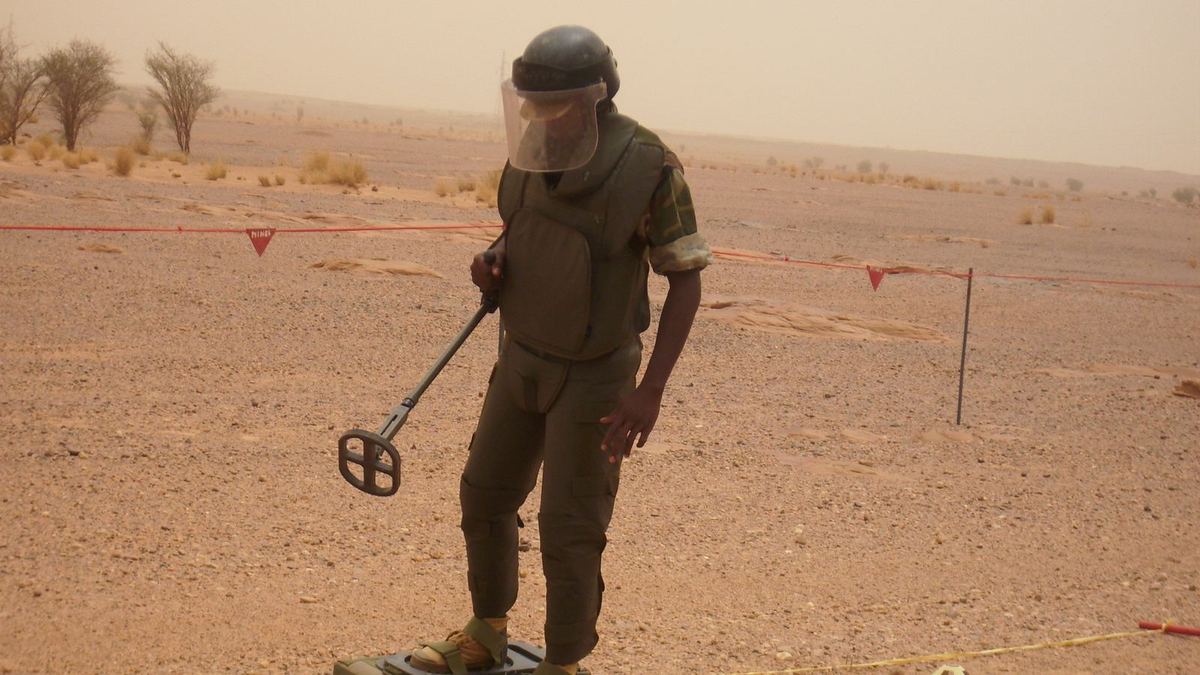
Our services for projects in Palmyra
Historical desk study and non-technical survey (NTS)
Collection and analysis of archives, testimony and field evidence to define suspected hazardous areas before any intervention. Non-technical survey
Technical survey and UXO survey
Geophysical detection (magnetometry, electromagnetics) and ground verification to confirm and locate explosive ordnance, on land or underwater. UXO survey
Battle area clearance and mine clearance
Search, identification and neutralisation or destruction of UXO, mines and improvised explosive devices by qualified EOD operators. Battle area clearance · Mine clearance
Client representation and quality control
Independent supervision, quality assurance and quality control of clearance contractors on behalf of the project owner, and explosive ordnance safety advice on site.
Training and stockpile management (PSSM)
EOD training, physical security and stockpile management assessments and destruction of surplus ammunition, through the group company GEODE. Stockpile destruction and PSSM
Underwater works
Survey and clearance in ports, rivers and offshore areas with the group company SEMTEC.
Why the DEMINETEC Group?
- ISO 9001, ISO 14001, ISO 45001 and MASE certified.
- Group pre-qualified by UNOPS in 14 disciplines since 2023.
- Experts who have worked in 34 countries, through GEODE (Global EOD Experts) for mine action and SEMTEC for underwater works.
- Teams of former French Navy and Army EOD operators.
- Onshore and underwater capacity within one group.
The DEMINETEC Group and Syria
The group’s experts carried out clearance, demining and training missions in Syria in 2018 and 2019. Any engagement in Syria is subject to prior verification of the applicable international sanctions and export-control rules.
See the international references of the group.
Conflict history and explosive contamination in Palmyra
ISIS attacked Tadmur on 13 May 2015 and entered Palmyra on 21 May. It destroyed the Temple of Baalshamin on 23 August, the cella of the Temple of Bel on 30 August, several tower tombs including the Tower of Elahbel, and damaged the Monumental Arch in October. Russian air strikes on the area began on 9 March 2016 and the Syrian army's ground attack on 12 March, at Al-Dawah to the west. Government forces secured Jabal Hayyan on 15 March, then the Palmyra Triangle junction, the Semiramis Hotel and the Tombs Valley on 24 March and Palmyra Castle on 25 March, with artillery support withheld near the ruins. ISIS began planting land mines as it withdrew, and the town, prison and airbase fell on 27 March 2016.
ISIS retook Palmyra in an offensive from 8 to 11 December 2016 and advanced west towards the Tiyas (T4) airbase. On 20 January 2017 it was reported to have toppled 12 of the 16 columns of the Tetrapylon and damaged the façade of the Roman theatre. The Syrian army, with Hezbollah and Russian support, counter-attacked from 13 January, took full control of the Hayyan gas fields on 18 February and fought for the Jazal and al-Mahr fields. A remote-controlled IED struck a Russian column from Tiyas in February. After an assault on 1 March on the Palmyra Triangle, the castle and Jabal al-Tar, ISIS withdrew, having mined many points in the town, which was recaptured on 2 March 2017; the airport was secured by 4 March.
Areas and structures concerned
- Archaeological site of Palmyra (Temple of Bel, Monumental Arch, Roman theatre, Tetrapylon)
- Tombs Valley and the southern necropolis
- Palmyra Castle, the Mamluk-era fort above the ruins
- Modern town of Tadmur, including the Al-Amiriya district
- Palmyra airbase and prison
- Palmyra Triangle road junction
- Jabal Hayyan and Jabal al-Tar
- Hayyan gas fields
Expected ordnance and implications for survey
Mines photographed at Palmyra in early 2025 were identified as Iranian YM-1B and Soviet PMN-2 anti-personnel mines and the Soviet TM-57 anti-tank mine; the perimeter of the ruins is believed to have been mined against vehicles, and explosives were stored in homes and other buildings. ISIS-laid mines and IEDs from 2016 and 2017, including remote-controlled devices, add to this. Survey therefore involves minefield clearance on open desert ground, building search in the town, and methods compatible with conservation inside the World Heritage property.
FAQ: explosive risk in Palmyra
Is the ancient site of Palmyra accessible?
In May 2025 The HALO Trust, after a reconnaissance, described the World Heritage site as inaccessible to visitors because of the fear of explosives left from multiple battles. UNESCO's 2024 state of conservation report still lists the removal of land mines, to allow safe passage of people in the property, among the corrective measures required for the site.
Which periods does the mine contamination at Palmyra date from?
Several. Accounts of the 2016 and 2017 offensives describe ISIS planting land mines and mining many points in the town before withdrawing. Military officials interviewed by The National in 2025 attributed the mines around the ruins and around former military positions to the government forces and allied militias that held Palmyra until December 2024.
How much clearance has been reported at Palmyra?
Reported figures are partial. Russian and Syrian teams removed 4,000 explosive devices from the ruins and 1,000 from the town in spring 2016, and military officials reported at least 17 tonnes of mines cleared between December 2024 and mid-January 2025. Mine Action Review notes that army engineering clearance is not conducted to humanitarian standards and will probably need rechecking.
Sources: Wikipedia — Palmyra · Wikipedia — Palmyra offensive (March 2016) · Wikipedia — Palmyra offensive (2017) · UNESCO World Heritage Centre — State of Conservation (SOC 2024): Site of Palmyra (Syrian Arab Republic) · The National — 'Death everywhere': Unexploded remnants of war affecting Syrian homes in Palmyra · The HALO Trust — Making heritage sites safe for the future · Mine Action Review — Clearing Cluster Munition Remnants 2026: Syria
Territorial coverage
Palmyra (Tadmur) in Homs governorate and the surrounding desert, including Al-Dawah, Tiyas and the T4 airbase, Jabal Hayyan, and the Hayyan, Jazal and al-Mahr fields. Teams and equipment are mobilised to fit each mission: documentary studies, short field surveys or long-duration clearance operations.
Other city pages for the Middle East and Libya: Baghdad · Erbil · Mosul · Tripoli · Misrata · Sirte · Benghazi · Damascus · Homs · Hama · Aleppo · Raqqa · Beirut · Amman
Frequently asked questions about UXO clearance in Palmyra
Which standards apply to explosive ordnance clearance in Syria?
Responsibility for mine action lies with the Ministry of Emergency and Disaster Management, under which the Syrian National Mine Action Centre (SNMAC) was established in August 2025; the centre is still being set up. Mine action in Syria is coordinated with the United Nations through UNMAS, which leads the Mine Action Area of Responsibility, and operators must comply with applicable international sanctions and export-control rules. Syria has no formal national standards yet; drafts are expected to be finalised by the end of 2026. UNMAS accredits humanitarian operators using IMAS as the baseline, and they work to their own procedures.
What does a project owner need before starting works in Palmyra?
A historical desk study and a non-technical survey to define the hazard, then a technical survey or UXO survey of the project footprint, clearance where evidence of contamination is found, and a handover document stating the areas and depths treated. The scope depends on the site history and on the depth of the works.
How long does a mission take?
Duration depends on the area, the search depth and the density of contamination: from a few weeks for a desk study to several months or more for clearance operations on major projects.
Does the group work underwater?
Yes. Through the group company SEMTEC, the group carries out commercial diving, underwater magnetometry and neutralisation of submerged ordnance in ports, rivers and coastal areas.
Contact the DEMINETEC Group about Palmyra
For any desk study, survey or clearance request, contact our teams:
DEMINETEC SAS285 avenue Marcel Paul
83500 La Seyne-sur-Mer, FRANCE
Tel: +33 9 52 51 00 63
Email: contact@deminetec.com