
UXO and mine clearance in Misrata
Explosive ordnance risk management in Libya – DEMINETEC GroupUXO, ERW and mine clearance in Misrata
The DEMINETEC Group provides explosive ordnance risk management to public and private clients with projects in Misrata, Libya: historical desk study, non-technical and technical survey, UXO survey, battle area clearance, mine clearance and EOD support. The group has worked in 34 countries and operates to the International Mine Action Standards (IMAS), the requirements of the national authorities and the contract specifications.
In short.
- The 2011 siege left UXO, cluster munition remnants and mines; ammunition depot explosions in 2016, 2020 and 2025 added further contamination.
- Documented items include MAT-120 submunitions, Type 84 scatterable anti-vehicle mines, T-AB-1 anti-personnel mines and munitions thrown out of storage bunkers.
- The Libyan Mine Action Centre (LibMAC), which has a sub-office in Misrata, accredits and tasks operators under national standards (LibMAS), with UNMAS technical support.
Historical UXO context of Misrata
Misrata is a port city on Libya's Mediterranean coast. Its contamination has two origins. The first is the battle of 18 February to 15 May 2011, when government forces shelled the city and its port and fought rebel forces along Tripoli Street. The second is a series of unplanned explosions at ammunition storage sites: at a large store close to the airport in 2016 and 2020, and at a depot in a populated area on 31 August 2025.
Human Rights Watch documented MAT-120 cluster mortar projectiles over the el-Shawahda neighbourhood in April 2011 and Type 84 scatterable anti-vehicle mines fired into the port area in May 2011. Since 2022 The HALO Trust has identified 1,472 submunitions at the Misrata Air College ammunition storage area, where bunker clearance was continuing in 2026. At the 2025 blast site, LibMAC led the response with five non-governmental organisations and UNMAS technical support; by late November 2025, 8,702 items of UXO had been disposed of.
The port, the airport and the adjoining air base were fought over in 2011 and are part of the city's transport infrastructure today. According to UNSMIL, the August 2025 explosion affected a radius of three to four kilometres in a populated area and injured 21 people; of 18,367 square metres of hazardous area identified, 7,419 had been cleared by late November 2025. In Misrata, stored ammunition is therefore as much a factor for land use and building works as the remnants of the siege.
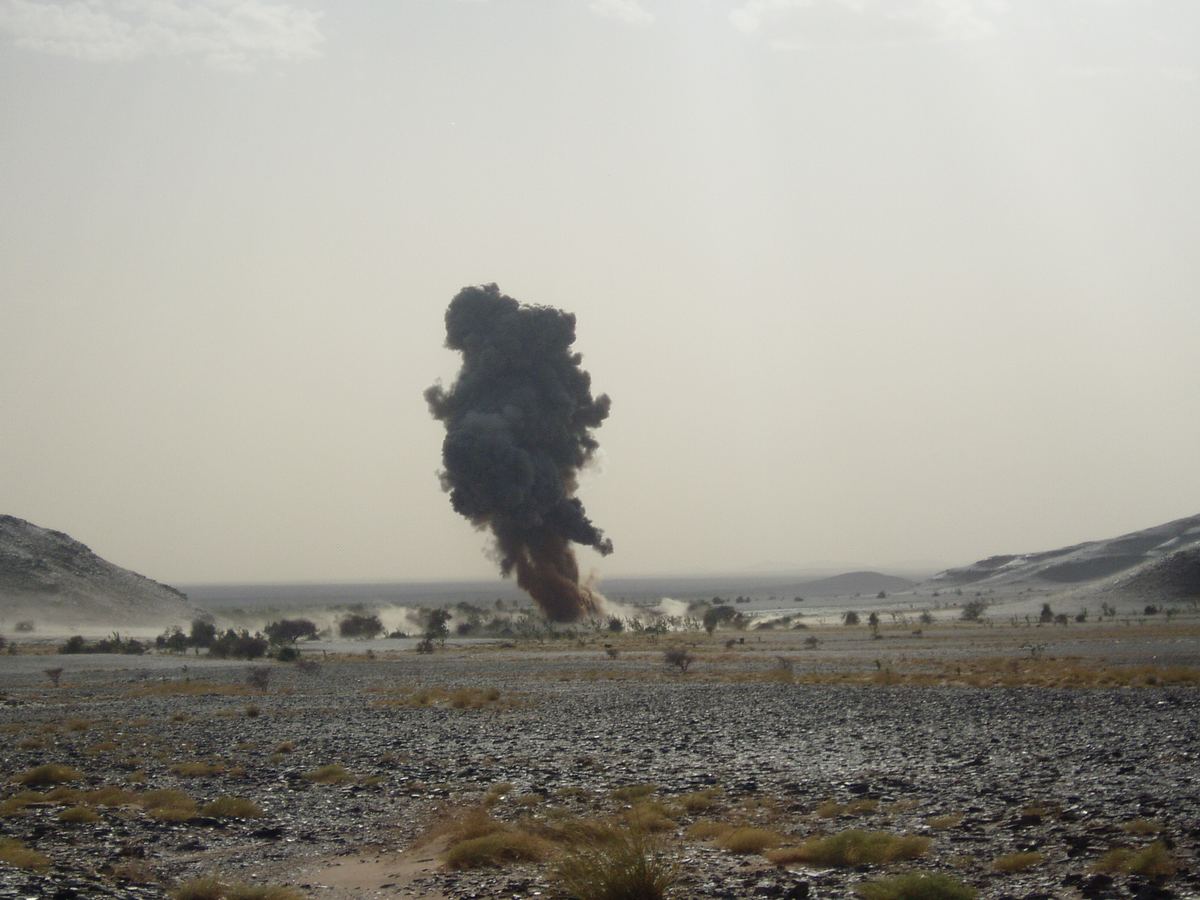
Our services for projects in Misrata
Historical desk study and non-technical survey (NTS)
Collection and analysis of archives, testimony and field evidence to define suspected hazardous areas before any intervention. Non-technical survey
Technical survey and UXO survey
Geophysical detection (magnetometry, electromagnetics) and ground verification to confirm and locate explosive ordnance, on land or underwater. UXO survey
Battle area clearance and mine clearance
Search, identification and neutralisation or destruction of UXO, mines and improvised explosive devices by qualified EOD operators. Battle area clearance · Mine clearance
Client representation and quality control
Independent supervision, quality assurance and quality control of clearance contractors on behalf of the project owner, and explosive ordnance safety advice on site.
Training and stockpile management (PSSM)
EOD training, physical security and stockpile management assessments and destruction of surplus ammunition, through the group company GEODE. Stockpile destruction and PSSM
Underwater works
Survey and clearance in ports, rivers and offshore areas with the group company SEMTEC.
Why the DEMINETEC Group?
- ISO 9001, ISO 14001, ISO 45001 and MASE certified.
- Group pre-qualified by UNOPS in 14 disciplines since 2023.
- Experts who have worked in 34 countries, through GEODE (Global EOD Experts) for mine action and SEMTEC for underwater works.
- Teams of former French Navy and Army EOD operators.
- Onshore and underwater capacity within one group.
The DEMINETEC Group and Libya
Libya is one of the 34 countries where the group has operated (clearance and demining, 2026). Any engagement in Libya is subject to prior verification of the applicable international sanctions and export-control rules.
See the international references of the group.
Conflict history and explosive contamination in Misrata
The battle of Misrata lasted from 18 February to 15 May 2011 and opposed forces loyal to Muammar Gaddafi's government to rebel forces holding the city. Government units attacked with tanks, artillery and mortars and, from April, Grad rockets. Fighting was concentrated along Tripoli Street, the main road from the south-western outskirts to the centre, and in the suburbs of Al Ghiran and Zawiyat al-Mahjoub. Coalition aircraft began striking government forces in and around the city on 23 March. On the night of 14 April Human Rights Watch researchers observed at least three MAT-120 120mm cluster mortar projectiles, each carrying 21 submunitions, explode over the el-Shawahda neighbourhood, about 300 metres from Misrata hospital.
The port was a target throughout the battle and was partially closed by artillery fire and mines from 29 April to 9 May. Government forces laid sea mines in front of the harbour in late April, and on the night of 5 May Grad rockets delivered Type 84 Model A scatterable anti-vehicle mines into the port area, where guards found 28 the next day. Amnesty International researchers documented T-AB-1 low-metal anti-personnel mines in the Tammina neighbourhood on 25 May. Rebel forces took the airport and the nearby military air base on 11 May. After 15 May fighting moved towards Dafniya, west of the city, and the outskirts of Tawergha to the south.
Areas and structures concerned
- Tripoli Street
- Port of Misrata
- El-Shawahda neighbourhood
- Tammina neighbourhood
- Misrata airport and Air College ammunition storage area
- Al Ghiran
- Zawiyat al-Mahjoub
- Skeirat ammunition depot site
Expected ordnance and implications for survey
Misrata presents three families of hazard: unexploded tank, artillery, mortar and Grad munitions from the 2011 battle; MAT-120 submunitions and mines of the Type 84 and T-AB-1 types documented that year; and munitions thrown out of bunkers by depot explosions. In 2025 HALO cleared six bunkers at the Air College storage area, recovering 86 submunitions and 7,307 other items of UXO. T-AB-1 mines have a low metal content, and ejected ammunition may lie buried under bunker debris, which calls for mechanical excavation and subsurface search.
FAQ: explosive risk in Misrata
Were cluster munitions used in Misrata?
Yes. Human Rights Watch reported that government forces fired MAT-120 120mm cluster mortar projectiles into residential areas of Misrata in April 2011, and its researchers saw at least three explode over the el-Shawahda neighbourhood on 14 April. Submunitions have also been found at the Misrata Air College ammunition storage area, where HALO has identified 1,472 since 2022.
What happened at the Misrata ammunition depot in August 2025?
According to UNSMIL, unstable munitions ignited on 31 August 2025 at an ammunition depot in a populated area of Misrata. The explosion affected a radius of three to four kilometres and injured 21 people. LibMAC led the response with five non-governmental organisations and technical support from UNMAS, and 8,702 items of UXO had been disposed of by late November 2025.
Were mines laid in Misrata in 2011?
Yes. Human Rights Watch confirmed that Grad rockets delivered Type 84 Model A scatterable anti-vehicle mines into the port area on the night of 5 May 2011, and that T-AB-1 anti-personnel mines were found buried in a dirt road in the Tammina neighbourhood. The use of sea mines at the port was also documented.
Sources: Wikipedia — Battle of Misrata (2011) · Human Rights Watch — Libya: Cluster Munitions Strike Misrata (15 April 2011) · Human Rights Watch — Landmines in Libya: Technical Briefing Note (19 July 2011) · UNSMIL — UN and Italy review progress on clearing Misratah blast site (30 November 2025) · The HALO Trust — Libya: clearing mines and training teams · Mine Action Review — Clearing Cluster Munition Remnants 2026: Libya · United Nations Security Council — Committee established pursuant to resolution 1970 (2011) concerning Libya
Territorial coverage
Misrata District, including the port area, Al Ghiran, Zawiyat al-Mahjoub, Dafniya and Tawergha. Teams and equipment are mobilised to fit each mission: documentary studies, short field surveys or long-duration clearance operations.
Other city pages for the Middle East and Libya: Baghdad · Erbil · Mosul · Tripoli · Sirte · Benghazi · Damascus · Homs · Hama · Aleppo · Raqqa · Palmyra · Beirut · Amman
Frequently asked questions about UXO clearance in Misrata
Which standards apply to explosive ordnance clearance in Libya?
Clearance in Misrata falls under the Libyan Mine Action Centre (LibMAC), mandated by the Minister of Defence in 2011, which keeps a sub-office in the city. Operators need LibMAC accreditation and a task order, and their work is checked by LibMAC against the Libyan Mine Action Standards (LibMAS), approved in 2017 and considered by operators to be aligned with IMAS. Mine action is coordinated with the United Nations through UNMAS, which forms the Mine Action Section of UNSMIL, and operators must comply with applicable international sanctions, including the UN regime under Security Council resolution 1970 (2011), and export-control rules.
What does a project owner need before starting works in Misrata?
A historical desk study and a non-technical survey to define the hazard, then a technical survey or UXO survey of the project footprint, clearance where evidence of contamination is found, and a handover document stating the areas and depths treated. The scope depends on the site history and on the depth of the works.
How long does a mission take?
Duration depends on the area, the search depth and the density of contamination: from a few weeks for a desk study to several months or more for clearance operations on major projects.
Does the group work underwater?
Yes. Through the group company SEMTEC, the group carries out commercial diving, underwater magnetometry and neutralisation of submerged ordnance in ports, rivers and coastal areas.
Contact the DEMINETEC Group about Misrata
For any desk study, survey or clearance request, contact our teams:
DEMINETEC SAS285 avenue Marcel Paul
83500 La Seyne-sur-Mer, FRANCE
Tel: +33 9 52 51 00 63
Email: contact@deminetec.com