
UXO and mine clearance in Aleppo
Explosive ordnance risk management in Syria – DEMINETEC GroupUXO, ERW and mine clearance in Aleppo
The DEMINETEC Group provides explosive ordnance risk management to public and private clients with projects in Aleppo, Syria: historical desk study, non-technical and technical survey, UXO survey, battle area clearance, mine clearance and EOD support. The group has worked in 34 countries and operates to the International Mine Action Standards (IMAS), the requirements of the national authorities and the contract specifications.
In short.
- Urban fighting from July 2012 to December 2016, followed by clashes in late 2024 and January 2026, left explosive ordnance across Aleppo.
- Recorded hazards include air-dropped bombs, barrel bombs, artillery shells, rockets, mortar bombs, improvised projectiles, submunitions and mines, often buried under rubble.
- The Syrian National Mine Action Centre, created in August 2025, is the national coordination body; UNMAS leads UN coordination and accredits operators against IMAS.
Historical UXO context of Aleppo
Aleppo's explosive contamination comes mainly from the battle of 19 July 2012 to 22 December 2016, when the city was divided between a government-held west and an opposition-held east, with Kurdish YPG forces in Sheikh Maqsoud. More ordnance was added when opposition forces took the city between 29 November and 2 December 2024, and again during fighting between Syrian government forces and the Syrian Democratic Forces (SDF) in Sheikh Maqsoud, Ashrafieh and Bani Zeid in January 2026.
Satellite imagery for September and October 2016 showed more than 950 new impact sites in the opposition-held neighbourhoods, according to Humanity & Inclusion. For 2025, Mine Action Review lists The HALO Trust, Safety Solutions, the ICRC and Syria Civil Defence disposal teams as active in Aleppo governorate, with clearance recorded around Hadher and Zarbah. In March 2026 army engineering units checked Bani Zeid, Ashrafieh and the Layramoun roundabout for explosives ahead of a campaign to remove about 150,000 cubic metres of rubble, according to the state news agency SANA.
A damage assessment published in March 2026 by the Ministry of Local Administration and Environment with UN-Habitat counted nearly 50,000 residential units destroyed or severely damaged in Aleppo governorate. Rebuilding them means excavating rubble that may conceal UXO. Between 8 December 2024 and mid-January 2026 the National Mine Action Centre recorded 151 explosive ordnance incidents in the governorate, with 104 deaths and 175 injuries. Debris removal, water and sewage network repairs, industrial areas such as Sheikh Najjar and Layramoun, and restoration in the World Heritage Old City are all concerned.
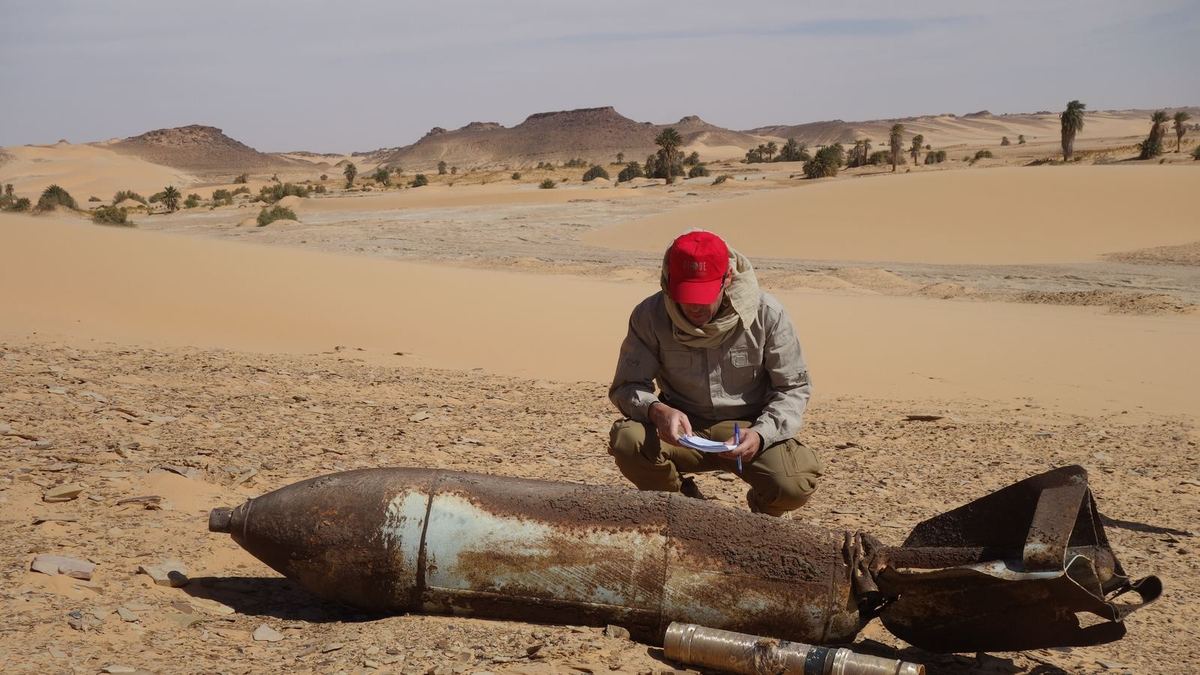
Our services for projects in Aleppo
Historical desk study and non-technical survey (NTS)
Collection and analysis of archives, testimony and field evidence to define suspected hazardous areas before any intervention. Non-technical survey
Technical survey and UXO survey
Geophysical detection (magnetometry, electromagnetics) and ground verification to confirm and locate explosive ordnance, on land or underwater. UXO survey
Battle area clearance and mine clearance
Search, identification and neutralisation or destruction of UXO, mines and improvised explosive devices by qualified EOD operators. Battle area clearance · Mine clearance
Client representation and quality control
Independent supervision, quality assurance and quality control of clearance contractors on behalf of the project owner, and explosive ordnance safety advice on site.
Training and stockpile management (PSSM)
EOD training, physical security and stockpile management assessments and destruction of surplus ammunition, through the group company GEODE. Stockpile destruction and PSSM
Underwater works
Survey and clearance in ports, rivers and offshore areas with the group company SEMTEC.
Why the DEMINETEC Group?
- ISO 9001, ISO 14001, ISO 45001 and MASE certified.
- Group pre-qualified by UNOPS in 14 disciplines since 2023.
- Experts who have worked in 34 countries, through GEODE (Global EOD Experts) for mine action and SEMTEC for underwater works.
- Teams of former French Navy and Army EOD operators.
- Onshore and underwater capacity within one group.
The DEMINETEC Group and Syria
The group’s experts carried out clearance, demining and training missions in Syria in 2018 and 2019. Any engagement in Syria is subject to prior verification of the applicable international sanctions and export-control rules.
See the international references of the group.
Conflict history and explosive contamination in Aleppo
Fighting began in Salaheddine, in the south-west of the city, on the night of 19 July 2012. For four years the front line ran through the Old City: a fire caused by shelling damaged the Al-Madina Souq in September 2012, the minaret of the Great Mosque was destroyed, the Citadel was damaged, and tunnel bombs were used in the Old City and around al-Hatab Square in April 2015. Syrian government forces and their allies bombed opposition-held districts from the air, and the use of barrel bombs and cluster munitions is documented. Opposition groups fired rockets, mortars and improvised hell-cannon projectiles made from gas canisters, and used car bombs. Government forces took the Sheikh Najjar industrial district, north of the city, in 2014.
On 25 June 2016 the Syrian army and allied forces opened an offensive to cut the Castello highway, the last opposition supply route, and by late July eastern Aleppo was surrounded. An opposition counter-attack through Ramouseh broke the encirclement in August, before the siege was re-imposed on 4 September. The final government offensive began on 15 November 2016 and took Hanano, Sakhour, Jabal Badro and Bustan al-Basha; the evacuation was completed on 22 December 2016, when the army declared full control. On 29 November 2024 opposition forces led by Hay'at Tahrir al-Sham entered the city and took the Citadel the next day. In January 2026 government forces and the SDF fought in Sheikh Maqsoud, Ashrafieh and Bani Zeid from 6 January until a ceasefire on 11 January.
Areas and structures concerned
- Old City of Aleppo and the Al-Madina Souq
- Citadel of Aleppo
- Salaheddine
- Hanano and Sakhour (eastern Aleppo)
- Ramouseh
- Castello highway
- Sheikh Maqsoud, Ashrafieh and Bani Zeid
- Sheikh Najjar industrial district
Expected ordnance and implications for survey
Weapons documented in Aleppo include large air-delivered high-explosive bombs, barrel bombs, cluster munitions, artillery shells, rockets, mortar bombs and improvised gas-canister projectiles. In a 2018–2020 HALO assessment of Aleppo and Idlib governorates, unexploded submunitions were the most frequent ordnance type. For survey this implies explosive hazard assessment before and during rubble removal, deep search where large bombs struck, attention to cellars, tunnels and collapsed multi-storey buildings, and battle area clearance on open ground around the city.
FAQ: explosive risk in Aleppo
Is there still unexploded ordnance in Aleppo?
Yes. Aleppo governorate had the third-highest number of explosive ordnance incidents in Syria between 8 December 2024 and mid-January 2026, with 151 recorded by the National Mine Action Centre. The risk is reported to be particularly acute in rural areas, but in January 2026 residents of Sheikh Maqsoud were also waiting for UXO clearance before returning home.
Who clears explosive ordnance in Aleppo?
For 2025, Mine Action Review lists The HALO Trust, Safety Solutions (an UNMAS implementing partner), the ICRC and Syria Civil Defence disposal teams, now part of the Ministry of Emergency and Disaster Management, as working in Aleppo governorate. In March 2026 SANA also reported army engineering units and Civil Defence teams checking city districts for explosives before rubble removal.
Why does rubble removal in Aleppo need explosive ordnance support?
Humanity & Inclusion estimates that 10 to 30 per cent of munitions fail to detonate and that explosive hazards lie dormant in rubble, streets, houses and tunnel networks. In January 2026 The HALO Trust said its teams were working with rubble-removal crews in the Old City, carrying out explosive hazard assessments in case dangerous items were found in the debris.
Sources: Wikipedia — Battle of Aleppo (2012–2016) · Wikipedia — Battle of Aleppo (2024) · Mine Action Review — Clearing Cluster Munition Remnants 2026: Syria · Humanity & Inclusion — Explosive ordnance contamination in Syria (February 2025) · European Union Agency for Asylum — Syria: Security Situation (July 2026), 2.1.6 Aleppo governorate: conflict-related infrastructure damage and explosive remnants of war · Arab News — Can Syria's recovery outpace the hidden dangers left by years of war? · SANA — Aleppo launches major campaign to clear 150,000 cubic meters of war rubble
Territorial coverage
Aleppo governorate, including the Jebel Saman district around the city and nearby localities such as Atareb, Daret Azza, Zarbah and Hadher. Teams and equipment are mobilised to fit each mission: documentary studies, short field surveys or long-duration clearance operations.
Other city pages for the Middle East and Libya: Baghdad · Erbil · Mosul · Tripoli · Misrata · Sirte · Benghazi · Damascus · Homs · Hama · Raqqa · Palmyra · Beirut · Amman
Frequently asked questions about UXO clearance in Aleppo
Which standards apply to explosive ordnance clearance in Syria?
The national body is the Syrian National Mine Action Centre (SNMAC), set up in August 2025 under the Ministry of Emergency and Disaster Management; it is not yet fully operational. Mine action in Syria is coordinated with the United Nations through the Mine Action Area of Responsibility led by UNMAS, and operators must comply with applicable international sanctions and export-control rules. There are no formal national standards: ten priority standards were in draft in June 2026, so operators follow their own procedures. UNMAS provides operational accreditation using IMAS as the baseline and issues task orders to its implementing partners.
What does a project owner need before starting works in Aleppo?
A historical desk study and a non-technical survey to define the hazard, then a technical survey or UXO survey of the project footprint, clearance where evidence of contamination is found, and a handover document stating the areas and depths treated. The scope depends on the site history and on the depth of the works.
How long does a mission take?
Duration depends on the area, the search depth and the density of contamination: from a few weeks for a desk study to several months or more for clearance operations on major projects.
Does the group work underwater?
Yes. Through the group company SEMTEC, the group carries out commercial diving, underwater magnetometry and neutralisation of submerged ordnance in ports, rivers and coastal areas.
Contact the DEMINETEC Group about Aleppo
For any desk study, survey or clearance request, contact our teams:
DEMINETEC SAS285 avenue Marcel Paul
83500 La Seyne-sur-Mer, FRANCE
Tel: +33 9 52 51 00 63
Email: contact@deminetec.com