
Battle area clearance (BAC) is the systematic and controlled clearance of hazardous areas where the hazard is known not to include mines. It removes unexploded ordnance (UXO), abandoned explosive ordnance (AXO) and cluster munition remnants from former combat zones, bombed sites, firing ranges and the surroundings of ammunition depots. The definition comes from the International Mine Action Standards (IMAS 09.11). DEMINETEC carries out battle area clearance as part of its UXO clearance and EOD services and its mine clearance work.
What battle area clearance covers
Many areas are fought over without ever being mined. What remains there is ordnance that was fired and failed to function, and ordnance that was left behind.
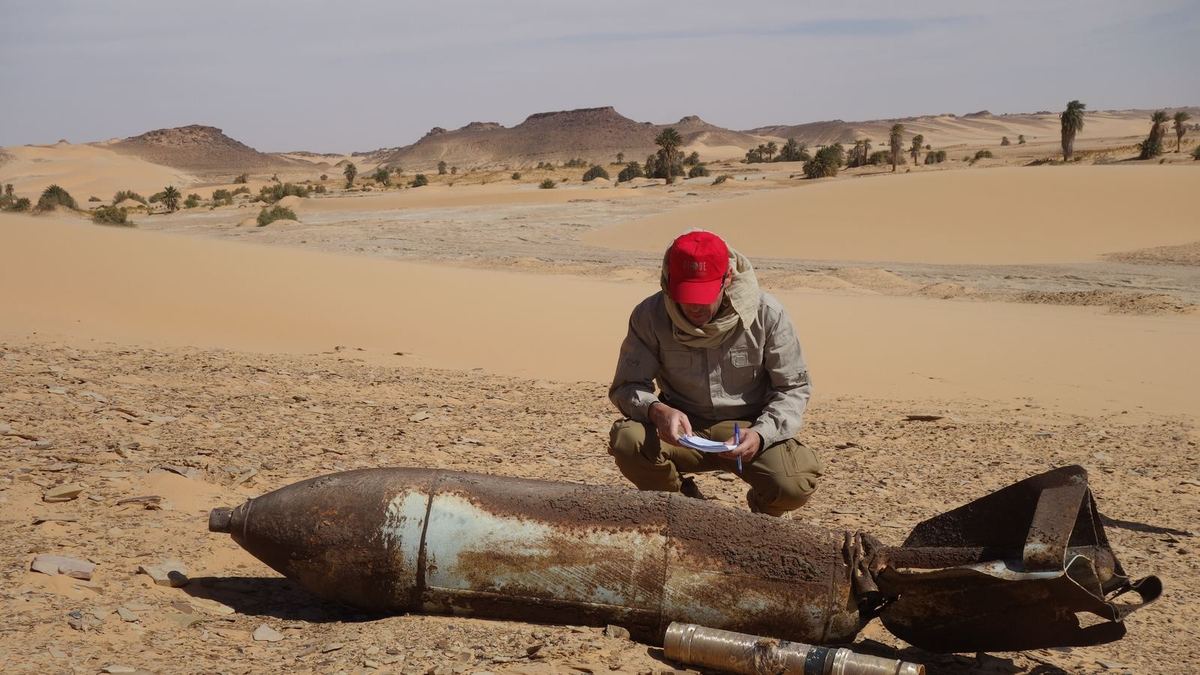
A BAC task deals with artillery and mortar shells, rockets, grenades, aircraft bombs, submunitions and abandoned ammunition, on the surface and below it. Together, unexploded and abandoned ordnance form the explosive remnants of war (ERW) defined by Protocol V to the Convention on Certain Conventional Weapons. The terms are detailed on our page on unexploded ordnance (UXO) and ERW.
The absence of mines is not assumed: it is established by survey before the task starts. If evidence of mines appears during the work, clearance stops in the affected sector and the task is re-assessed under mine clearance procedures.
BAC and mine clearance: the differences
| Battle area clearance | Mine clearance | |
|---|---|---|
| Hazard | UXO, abandoned ordnance, cluster munition remnants. No mines expected. | Anti-personnel and anti-vehicle mines, often mixed with UXO. |
| Typical areas | Former battlefields, impact areas, bombed sites, firing ranges, surroundings of depots. | Minefields, defensive belts, mined routes and verges. |
| Search method | Visual surface search in lines, then detector-assisted subsurface search. | Lane-based manual clearance with detector, prodding and excavation; machines and dogs where accredited. |
| Daily output | Higher, because no pressure-operated or tripwire-operated mines are expected. | Lower: every square metre of each lane is searched to the specified depth. |
| Reference standard | IMAS 09.11 | IMAS 09.10 and the national mine action standards |
Both follow the same land release logic: non-technical survey, technical survey where needed, then clearance of what remains. See mine clearance and demining.
Surface and subsurface clearance
Surface (visual) clearance
Searchers advance in line across marked boxes and locate every item visible on the ground or in vegetation. It is the first pass on any battle area, and sometimes the only one when the task order is limited to surface hazards.
Subsurface clearance
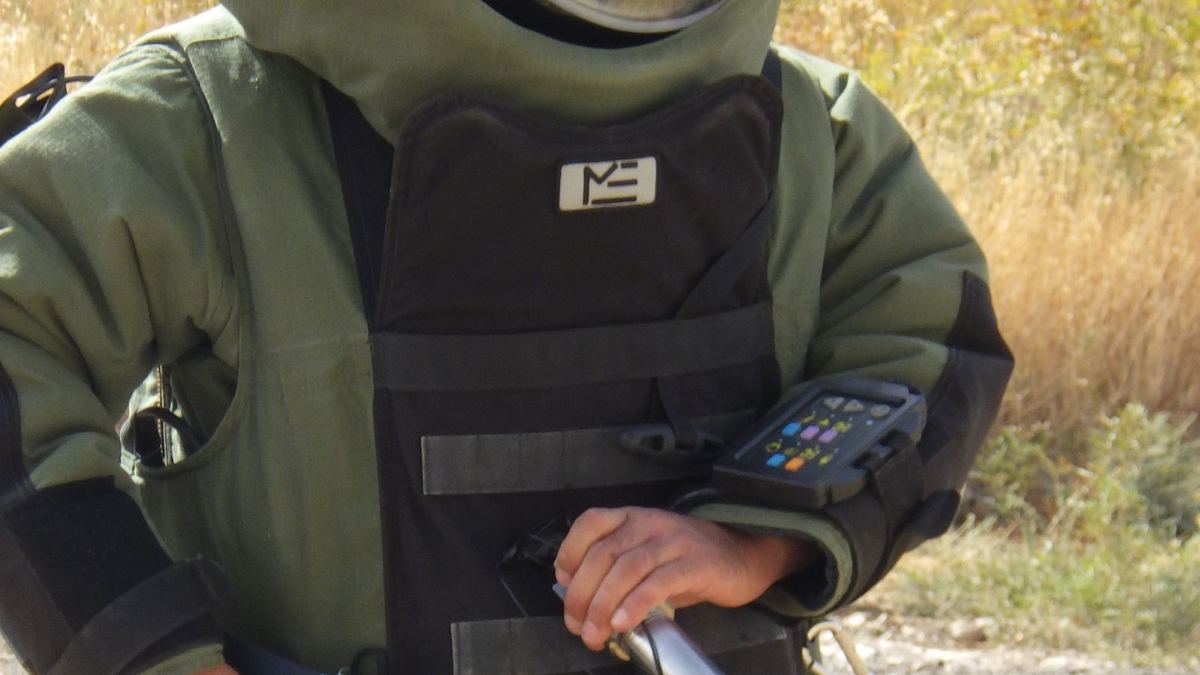
Detectors locate buried items: metal detectors, large-loop detectors and magnetometers. Each signal is investigated by excavation. The depth is set by the national authority or the contract, from the ordnance expected and the future use of the land.
Cluster munition remnants
A cluster strike leaves a footprint of unexploded submunitions. Survey first defines that footprint from evidence, then clearance works outward from each find until a fade-out distance without evidence is reached.
Deep buried bombs
Aircraft bombs can lie several metres deep in soft ground, beyond the reach of hand-held detectors. They are located by magnetometer and borehole UXO surveys, then uncovered by controlled excavation.
How a BAC task is carried out
- Survey and task order: non-technical survey gathers the evidence: type of ordnance used, absence of mines, limits of the area. The task order states the area, the search method and the clearance depth.
- Marking and site setup: boundaries, access lanes, control point, medical evacuation plan and safety distances for the ordnance expected.
- Surface search: vegetation is cut where needed and searchers cover each box in line. Items are marked and left in place for the EOD operator.
- Subsurface search: detector lanes cover each box; every signal is excavated and identified.
- Disposal: an EOD-qualified operator identifies each item and decides whether it is destroyed where it lies or moved to a demolition area.
- Quality control and handover: cleared boxes are checked by sampling. The completion report gives coordinates, depth and items found, and the land is handed over to the authority or the client.
BAC for infrastructure and energy projects
Road, pipeline, power line, solar, wind and mining projects often cross former combat areas, old ranges or the surroundings of destroyed depots. For a developer or an EPC contractor, BAC secures the footprint and the access routes to the depth required by trenches and foundations, and is followed by an EOD watching brief during earthworks. See UXO safety on construction sites and UXO risk management.
When ammunition stocks are found on a battle area, they are handled as a separate task: see stockpile destruction and ammunition management.
Standards and treaties
IMAS 09.11 sets the requirements for battle area clearance. It is read with IMAS 09.10 (clearance requirements), IMAS 07.11 (land release), IMAS 08.20 (technical survey) and IMAS 09.30 (explosive ordnance disposal). On site, the national mine action standards of the host country apply, under its national mine action authority.
Two treaties frame the obligation to clear. Protocol V (2003) to the Convention on Certain Conventional Weapons deals with explosive remnants of war. Article 4 of the 2008 Convention on Cluster Munitions requires each State Party to clear cluster munition remnants no later than ten years after it joins.
Frequently asked questions about battle area clearance
What is battle area clearance (BAC)?
Battle area clearance is the systematic and controlled clearance of hazardous areas where the hazard is known not to include mines. It removes unexploded ordnance, abandoned ordnance and cluster munition remnants from former combat zones, bombed sites and ranges. Its requirements are set by IMAS 09.11.
What is the difference between BAC and mine clearance?
BAC is used where survey shows that mines are not present: teams search the surface visually, then the subsurface with detectors. Mine clearance deals with anti-personnel and anti-vehicle mines and works lane by lane with detector, prodding and excavation. If evidence of mines appears during BAC, work stops in that sector and the task is re-assessed.
To what depth is a battle area cleared?
There is no single depth. The national mine action authority or the contract sets it from the ordnance expected and the future use of the land. The depth is written in the task order and in the completion report.
Does BAC cover cluster munition remnants?
Yes. Unexploded submunitions are among the main hazards treated by battle area clearance. Survey defines the footprint of each strike and clearance covers it until no further evidence is found. The 2008 Convention on Cluster Munitions gives each State Party ten years to clear contaminated areas.
What happens to the ordnance that is found?
Each item is identified by an EOD-qualified operator. Items that cannot be moved are destroyed where they lie, with safety distances and protective works. Items that are safe to move are taken to a demolition area and destroyed there.
Does DEMINETEC carry out battle area clearance?
Yes. Battle area clearance is part of DEMINETEC's UXO and mine clearance work. DEMINETEC works internationally and in France on survey, UXO and mine clearance, risk assessment and stockpile management, alone or with partners, and reports to clients and national authorities in English or French.