
UXO and mine clearance in Benghazi
Explosive ordnance risk management in Libya – DEMINETEC GroupUXO, ERW and mine clearance in Benghazi
The DEMINETEC Group provides explosive ordnance risk management to public and private clients with projects in Benghazi, Libya: historical desk study, non-technical and technical survey, UXO survey, battle area clearance, mine clearance and EOD support. The group has worked in 34 countries and operates to the International Mine Action Standards (IMAS), the requirements of the national authorities and the contract specifications.
In short.
- The 2014–2017 battle between the Libyan National Army (LNA), the Shura Council of Benghazi Revolutionaries and ISIS left mines, booby traps and UXO.
- Mines and booby traps were reported in districts such as Souq al-Hout and Sabri, the central quarters taken by the LNA in mid-2017.
- The Libyan Mine Action Centre (LibMAC), with a sub-office in Benghazi, accredits and tasks operators under LibMAS; military engineers also clear roads.
Historical UXO context of Benghazi
Benghazi is the largest city of Cyrenaica and a major seaport. It was heavily bombed during the Second World War, when it changed hands several times. In 2011 opponents of Muammar Gaddafi took the city on 21 February, and an attack by the Libyan Army on 19 March was pushed back. From 2014 to the end of 2017 the Libyan National Army (LNA) fought the Shura Council of Benghazi Revolutionaries and the Islamic State group (ISIS) district by district.
The central coastal quarters of Sabri and Souq al-Hout suffered heavy bombardment and were among the last to be taken. In January 2018 Reuters described military engineers clearing main roads in Souq al-Hout with basic tools and without mine detectors. UNMAS trained 30 Libyans, including military engineers, in non-technical survey for Benghazi in 2016. Between November 2019 and October 2022 DanChurchAid reported removing 2,815 items of UXO and clearing 386,113 square metres through battle area clearance in the city.
DanChurchAid states that parts of the city and key infrastructure were scattered with explosive items and could not be made safely accessible for reconstruction and refurbishment; it gave risk education to municipal, health, energy supply and construction workers. Reconstruction is under way, notably around the Hawari district. In September 2023 the floods caused by Cyclone Daniel affected Benghazi and, according to DanChurchAid, shifted ordnance into previously cleared areas, a factor to consider when relying on earlier clearance records.
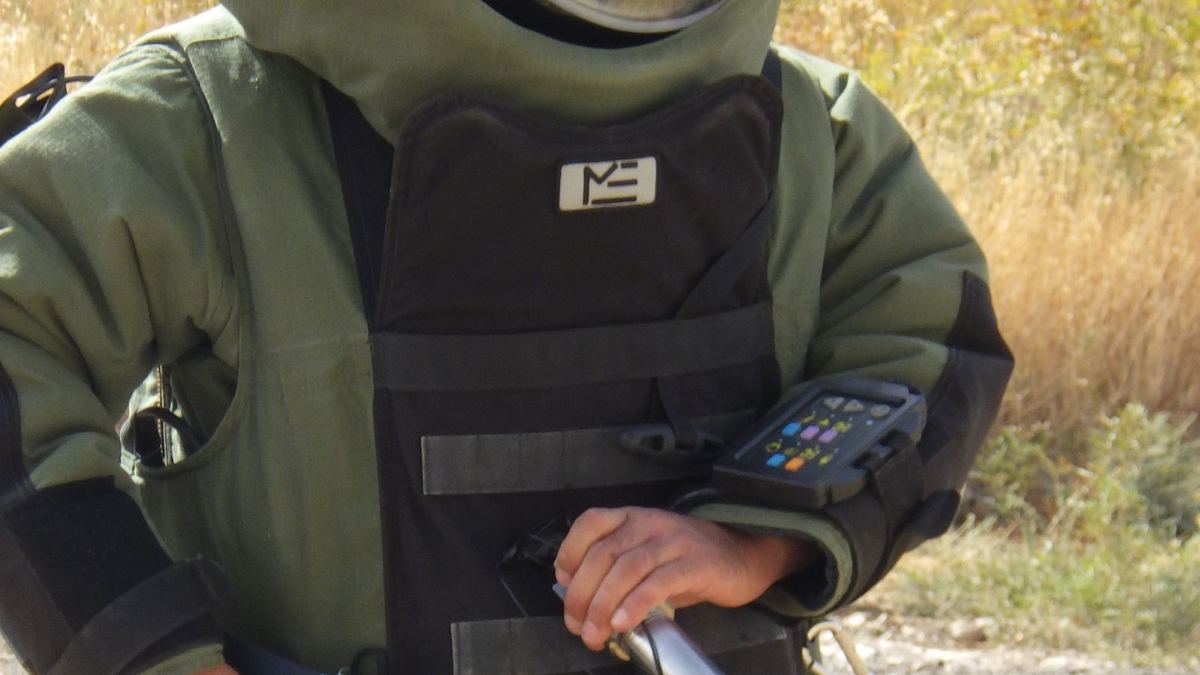
Our services for projects in Benghazi
Historical desk study and non-technical survey (NTS)
Collection and analysis of archives, testimony and field evidence to define suspected hazardous areas before any intervention. Non-technical survey
Technical survey and UXO survey
Geophysical detection (magnetometry, electromagnetics) and ground verification to confirm and locate explosive ordnance, on land or underwater. UXO survey
Battle area clearance and mine clearance
Search, identification and neutralisation or destruction of UXO, mines and improvised explosive devices by qualified EOD operators. Battle area clearance · Mine clearance
Client representation and quality control
Independent supervision, quality assurance and quality control of clearance contractors on behalf of the project owner, and explosive ordnance safety advice on site.
Training and stockpile management (PSSM)
EOD training, physical security and stockpile management assessments and destruction of surplus ammunition, through the group company GEODE. Stockpile destruction and PSSM
Underwater works
Survey and clearance in ports, rivers and offshore areas with the group company SEMTEC.
Why the DEMINETEC Group?
- ISO 9001, ISO 14001, ISO 45001 and MASE certified.
- Group pre-qualified by UNOPS in 14 disciplines since 2023.
- Experts who have worked in 34 countries, through GEODE (Global EOD Experts) for mine action and SEMTEC for underwater works.
- Teams of former French Navy and Army EOD operators.
- Onshore and underwater capacity within one group.
The DEMINETEC Group and Libya
Libya is one of the 34 countries where the group has operated (clearance and demining, 2026). Any engagement in Libya is subject to prior verification of the applicable international sanctions and export-control rules.
See the international references of the group.
Conflict history and explosive contamination in Benghazi
An uprising against Muammar Gaddafi's government began in Benghazi on 15 February 2011, and opponents held the city from 21 February. On 19 March 2011 the Libyan Army attacked Benghazi but was forced back by local resistance and by French air strikes authorised under UN Security Council Resolution 1973. Heavy clashes broke out again on 16 May 2014, when the LNA under Khalifa Haftar attacked Islamist armed groups in the city in what became known as Operation Dignity. The battle of Benghazi proper ran from October 2014 to December 2017 and opposed the LNA to the Shura Council of Benghazi Revolutionaries and to ISIS, with rockets, artillery, tanks, air strikes and suicide car bombs used in residential districts.
The LNA advanced district by district. It took Laithi and Boatni in February 2016, fought around a cement factory west of the city in April 2016, and later captured Gwarsha and Ganfouda. ISIS fighters left Benghazi in January 2017. The LNA announced control of Souq al-Hout on 23 June 2017, after two days of fighting in which many of the soldiers killed were victims of landmines, and Khalifa Haftar declared the city under LNA control on 5 July 2017. The last pocket, in Sidi Akribesh, held out until December 2017. In January 2018 a military source told Reuters that 50 military deminers had been killed and 60 wounded while clearing the fought-over districts.
Areas and structures concerned
- Sabri district
- Souq al-Hout district
- Laithi district
- Boatni district
- Hawari district
- Gwarsha district
- Ganfouda district
- Sidi Akribesh
Expected ordnance and implications for survey
In Benghazi the documented threat is dominated by landmines and booby traps laid during the 2014–2017 battle, together with UXO from rocket, artillery and tank fire and air strikes, and abandoned ammunition caches. DanChurchAid has confirmed legacy IEDs in the city. Reuters reported devices inside homes in Souq al-Hout, so work there starts with non-technical survey and building-by-building IED search before rubble is moved. Battle area clearance covers open ground, and flood-affected zones may need re-survey after Cyclone Daniel in 2023.
FAQ: explosive risk in Benghazi
Which districts of Benghazi are most affected by mines and booby traps?
Reporting points first to Souq al-Hout and Sabri, the central coastal districts where the Shura Council of Benghazi Revolutionaries held out until mid-2017; Reuters described mine clearance in Souq al-Hout in January 2018. Other districts contested during the 2014–2017 battle include Laithi, Boatni, Hawari, Gwarsha, Ganfouda and Sidi Akribesh.
Who has cleared explosive ordnance in Benghazi?
Military engineers of the LNA cleared main roads in the fought-over districts after 2017, according to Reuters. DanChurchAid ran a mine action project in the city from November 2019 to October 2023. Mine Action Review reports that in August 2023 the LNA suspended DanChurchAid, the Danish Refugee Council and the Free Fields Foundation in Benghazi and Sirte for seven months.
Did the 2023 floods change the explosive ordnance risk in Benghazi?
Cyclone Daniel struck north-eastern Libya on 10 September 2023 and caused severe flooding that affected Benghazi, Derna and other populated areas. DanChurchAid reported that floodwaters shifted ordnance, including into previously cleared areas, increasing the risk of exposure to mines and other explosive ordnance, as recorded by Mine Action Review in 2025.
Sources: Wikipedia — Battle of Benghazi (2014–2017) · Wikipedia — Benghazi · Reuters — Mines still claim legs and lives in Libya's Benghazi, months after war ceased (21 January 2018) · DanChurchAid — Fostering Stabilization in Benghazi, Libya, through Integrated Mine Action · UNSMIL — UNMAS Trains 10 Libyan Military Engineers Work in the Field of Mine Action to Survey Areas in Benghazi (16 September 2016) · Mine Action Review — Clearing the Mines 2025 (Libya chapter) · United Nations Security Council — Committee established pursuant to resolution 1970 (2011) concerning Libya
Territorial coverage
Benghazi and its surroundings in Cyrenaica, including Benina, Al-Kwayfiya, Garyounis, Gimeenis and Sidi Khalifa. Teams and equipment are mobilised to fit each mission: documentary studies, short field surveys or long-duration clearance operations.
Other city pages for the Middle East and Libya: Baghdad · Erbil · Mosul · Tripoli · Misrata · Sirte · Damascus · Homs · Hama · Aleppo · Raqqa · Palmyra · Beirut · Amman
Frequently asked questions about UXO clearance in Benghazi
Which standards apply to explosive ordnance clearance in Libya?
Mine action is led by the Libyan Mine Action Centre (LibMAC), mandated by the Minister of Defence in 2011, with headquarters in Tripoli and a sub-office in Benghazi. Libya has no national mine action legislation; LibMAC accredits organisations, issues task orders and checks quality under the Libyan Mine Action Standards (LibMAS), approved in 2017 and aligned with IMAS according to operators. Mine action is coordinated with the United Nations through UNMAS, integrated into UNSMIL as its Mine Action Section, and operators must comply with applicable international sanctions, including the UN regime under Security Council resolution 1970 (2011), and export-control rules.
What does a project owner need before starting works in Benghazi?
A historical desk study and a non-technical survey to define the hazard, then a technical survey or UXO survey of the project footprint, clearance where evidence of contamination is found, and a handover document stating the areas and depths treated. The scope depends on the site history and on the depth of the works.
How long does a mission take?
Duration depends on the area, the search depth and the density of contamination: from a few weeks for a desk study to several months or more for clearance operations on major projects.
Does the group work underwater?
Yes. Through the group company SEMTEC, the group carries out commercial diving, underwater magnetometry and neutralisation of submerged ordnance in ports, rivers and coastal areas.
Contact the DEMINETEC Group about Benghazi
For any desk study, survey or clearance request, contact our teams:
DEMINETEC SAS285 avenue Marcel Paul
83500 La Seyne-sur-Mer, FRANCE
Tel: +33 9 52 51 00 63
Email: contact@deminetec.com