
UXO and mine clearance in Damascus
Explosive ordnance risk management in Syria – DEMINETEC GroupUXO, ERW and mine clearance in Damascus
The DEMINETEC Group provides explosive ordnance risk management to public and private clients with projects in Damascus, Syria: historical desk study, non-technical and technical survey, UXO survey, battle area clearance, mine clearance and EOD support. The group has worked in 34 countries and operates to the International Mine Action Standards (IMAS), the requirements of the national authorities and the contract specifications.
In short.
- Sieges and offensives between 2012 and 2018 in Darayya, Eastern Ghouta, Jobar and Yarmouk Camp left explosive ordnance across Damascus and Rural Damascus.
- Recorded hazards are unexploded rockets, artillery and mortar shells, air-dropped bombs, submunitions, mines and IEDs, some buried under rubble or placed inside houses.
- The Syrian National Mine Action Centre, set up in August 2025, coordinates with UNMAS, which accredits operators against IMAS pending national standards.
Historical UXO context of Damascus
Explosive ordnance in and around Damascus dates mainly from the Syrian civil war. Syrian government forces besieged Darayya and Muadamiyat from November 2012 to October 2016 and Eastern Ghouta from April 2013 to April 2018, while fighting in Jobar, Qaboun, Barzeh and the southern districts of Yarmouk Camp, al-Hajar al-Aswad and Tadamon lasted until May 2018. The Carter Center recorded at least 94,792 uses of explosive munitions in Damascus city and Rural Damascus between July 2013 and May 2019.
The Carter Center found about 70 per cent of that use in 19 locations, including Darayya, Harasta, Douma, Zabadani, Jobar, Arbin, Qaboun and Yarmouk Camp; Darayya alone received 15 per cent. UNMAS and its partner ACHDE cleared about two million square metres of farmland in Darayya between December 2021 and November 2022, destroying 518 items. In 2025, Mine Action Review listed HALO, Norwegian People's Aid, the Danish Refugee Council, the ICRC and Syria Civil Defence units working in Damascus or Rural Damascus.
For reconstruction, the hazard sits where rebuilding is most needed: damaged housing in Jobar, Yarmouk and the Ghouta towns, roads such as the Harasta road, where UNMAS photographed an excavated item, and irrigation channels in Rural Damascus, where the Danish Refugee Council noted UXO placed in the channels. The Carter Center also recorded tunnels linking Qaboun, Tishreen and Barzeh with Eastern Ghouta. Mine Action Review notes that no comprehensive countrywide survey exists, so rubble removal, utility trenching and foundation work call for site survey first.
Our services for projects in Damascus
Historical desk study and non-technical survey (NTS)
Collection and analysis of archives, testimony and field evidence to define suspected hazardous areas before any intervention. Non-technical survey
Technical survey and UXO survey
Geophysical detection (magnetometry, electromagnetics) and ground verification to confirm and locate explosive ordnance, on land or underwater. UXO survey
Battle area clearance and mine clearance
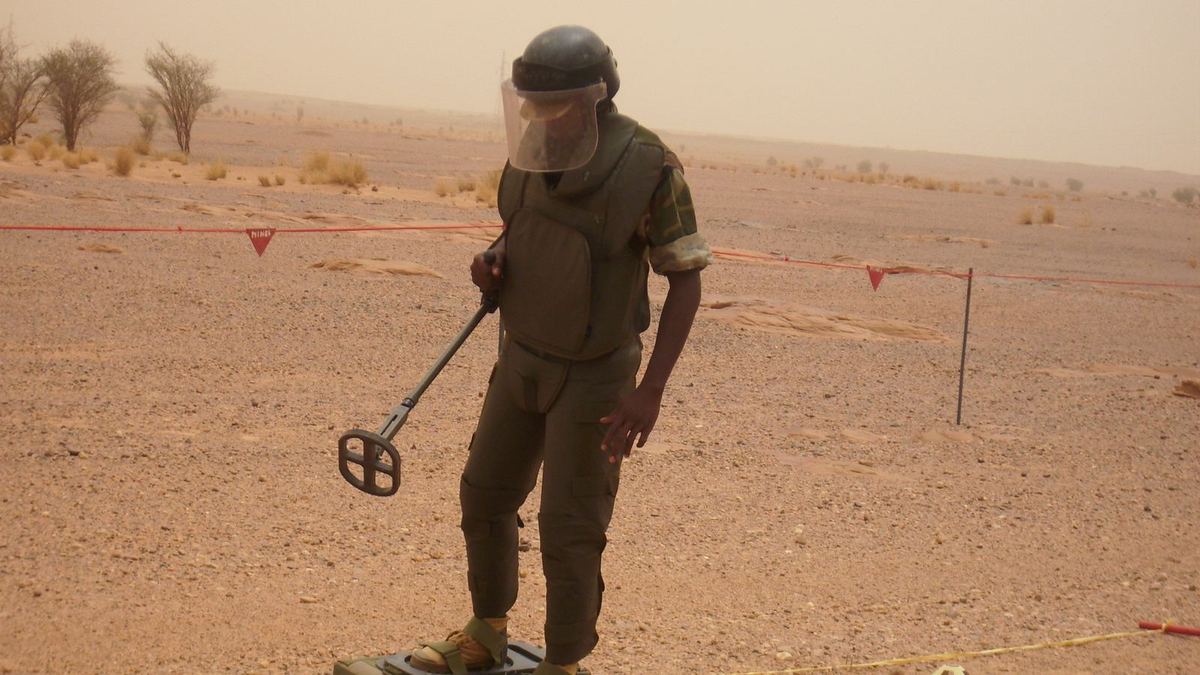
Search, identification and neutralisation or destruction of UXO, mines and improvised explosive devices by qualified EOD operators. Battle area clearance · Mine clearance
Client representation and quality control
Independent supervision, quality assurance and quality control of clearance contractors on behalf of the project owner, and explosive ordnance safety advice on site.
Training and stockpile management (PSSM)
EOD training, physical security and stockpile management assessments and destruction of surplus ammunition, through the group company GEODE. Stockpile destruction and PSSM
Underwater works
Survey and clearance in ports, rivers and offshore areas with the group company SEMTEC.
Why the DEMINETEC Group?
- ISO 9001, ISO 14001, ISO 45001 and MASE certified.
- Group pre-qualified by UNOPS in 14 disciplines since 2023.
- Experts who have worked in 34 countries, through GEODE (Global EOD Experts) for mine action and SEMTEC for underwater works.
- Teams of former French Navy and Army EOD operators.
- Onshore and underwater capacity within one group.
The DEMINETEC Group and Syria
The group’s experts carried out clearance, demining and training missions in Syria in 2018 and 2019. Any engagement in Syria is subject to prior verification of the applicable international sanctions and export-control rules.
See the international references of the group.
Conflict history and explosive contamination in Damascus
Fighting reached the Damascus suburbs in 2012. Syrian government forces besieged Darayya and Muadamiyat from 9 November 2012; Darayya was struck repeatedly with barrel bombs, more than 30 on one day in June 2016, until an evacuation agreement on 24 August 2016, and Muadamiyat followed on 19 October 2016. Opposition fighters entered Jobar in February 2013, and in April 2013 government forces began the siege of Eastern Ghouta, where around 400,000 people were enclosed by 2016. The enclave was held by Jaysh al-Islam, Faylaq al-Rahman, Ahrar al-Sham and Hay'at Tahrir al-Sham. In Damascus city, the Carter Center attributed 82 per cent of recorded munition use to shelling, about 70 per cent of it in Jobar, Qaboun, Yarmouk Camp, Barzeh, Tadamon and Tishreen.
In February 2018, Syrian government forces, supported militarily by Russia, launched a final offensive on Eastern Ghouta. On 11 March the enclave was split into three pockets around Douma, eastern Harasta and Zamalka; Douma was evacuated in April and the siege ended on 14 April 2018. Air strikes on the enclave in November 2017 allegedly included cluster munitions. From 19 April to 21 May 2018, the Syrian army and allied Palestinian militias fought the Islamic State group (ISIS) in Yarmouk Camp, al-Hajar al-Aswad, Qadam and Tadamon, with more than 580 air raids reported. After the Assad government fell in December 2024, Israeli air raids reportedly destroyed at least 34 former weapon storage sites in Damascus, according to Mine Action Review.
Areas and structures concerned
- Darayya
- Jobar
- Yarmouk Camp
- Harasta
- Douma
- Qaboun
- Al-Hajar al-Aswad
- Kisweh
Expected ordnance and implications for survey
The Carter Center recorded rockets, artillery shells, mortars, aircraft bombs and helicopter-dropped barrel bombs as the main munitions used in Damascus and Rural Damascus, and the Danish Refugee Council found 14 submunitions in Kisweh. Mine Action Review reports UXO, anti-personnel and anti-vehicle mines and victim-activated IEDs, often buried under rubble; in Jobar, devices were found inside houses, behind doors and in cupboards, with trip-wired IEDs. Survey therefore combines room-by-room IED search, supervised rubble removal and sub-surface detection for deep-buried bombs.
FAQ: explosive risk in Damascus
Which parts of Damascus city saw the most explosive weapon use?
The Carter Center counted at least 13,094 uses of explosive munitions in Damascus city between July 2013 and May 2019, and about 70 per cent fell on six neighbourhoods: Jobar, Qaboun, Yarmouk Camp, Barzeh, Tadamon and Tishreen. Shelling accounted for 82 per cent. A lack of records elsewhere does not demonstrate that ground is free of ordnance.
How much land around Damascus has been cleared?
Clearance is partial. UNMAS reported about two million square metres of agricultural land cleared in Darayya between December 2021 and November 2022, with 518 items destroyed in 55 demolitions. Norwegian People's Aid prioritised housing units in Yarmouk camp in early 2026. Mine Action Review states that clearance by army engineering units is not conducted to humanitarian standards and may need rechecking.
Are former weapon storage sites a concern in Damascus?
Yes. Mine Action Review reports that the former government left an estimated 1,500 weapon storage sites across Syria and that Israeli raids reportedly destroyed at least 34 in Damascus alone. It also records explosions at arms depots during and after the conflict. Land near former military facilities therefore calls for survey for abandoned ordnance before works begin.
Sources: Mine Action Review — Clearing Cluster Munition Remnants 2026: Syria · UNMAS — Where we work: Syria · UNMAS — Press release: UNMAS Syria completes first handover of cleared land in Darayya, Rural Damascus · The Carter Center — Explosive Weapons Use in Syria, Report 2: Damascus and Rural Damascus · Wikipedia — Siege of Eastern Ghouta · Wikipedia — Siege of Darayya and Muadamiyat · Wikipedia — Southern Damascus offensive (April–May 2018)
Territorial coverage
Damascus city and Rural Damascus (Rif Dimashq) governorate, including Darayya, Douma, Harasta, Arbin, Kisweh and Zabadani. Teams and equipment are mobilised to fit each mission: documentary studies, short field surveys or long-duration clearance operations.
Other city pages for the Middle East and Libya: Baghdad · Erbil · Mosul · Tripoli · Misrata · Sirte · Benghazi · Homs · Hama · Aleppo · Raqqa · Palmyra · Beirut · Amman
Frequently asked questions about UXO clearance in Damascus
Which standards apply to explosive ordnance clearance in Syria?
The Damascus-based Syrian National Mine Action Centre (SNMAC), established in August 2025 under the Ministry of Emergency and Disaster Management, is the designated central coordination body but not yet fully operational. No national mine action standards are in force: ten priority standards were under SNMAC review in June 2026, and operators work to their own procedures. In 2025 UNMAS granted operational accreditation using the International Mine Action Standards (IMAS) as the baseline. Mine action is coordinated with the UN through the UNMAS-led Mine Action Area of Responsibility, and operators must comply with applicable international sanctions and export-control rules.
What does a project owner need before starting works in Damascus?
A historical desk study and a non-technical survey to define the hazard, then a technical survey or UXO survey of the project footprint, clearance where evidence of contamination is found, and a handover document stating the areas and depths treated. The scope depends on the site history and on the depth of the works.
How long does a mission take?
Duration depends on the area, the search depth and the density of contamination: from a few weeks for a desk study to several months or more for clearance operations on major projects.
Does the group work underwater?
Yes. Through the group company SEMTEC, the group carries out commercial diving, underwater magnetometry and neutralisation of submerged ordnance in ports, rivers and coastal areas.
Contact the DEMINETEC Group about Damascus
For any desk study, survey or clearance request, contact our teams:
DEMINETEC SAS285 avenue Marcel Paul
83500 La Seyne-sur-Mer, FRANCE
Tel: +33 9 52 51 00 63
Email: contact@deminetec.com