
UXO clearance, EOD training and PSSM in Rabat
Explosive ordnance risk management in Morocco – DEMINETEC GroupExplosive ordnance, mines and ammunition stockpiles: Rabat, Morocco
The DEMINETEC Group supports public authorities, international organisations and private clients with programmes and projects run from Rabat, Morocco: historical desk study, non-technical and technical survey, UXO and mine clearance, EOD training, and physical security and stockpile management (PSSM) of ammunition. The group has worked in 34 countries and operates to the International Mine Action Standards (IMAS), the International Ammunition Technical Guidelines (IATG), the requirements of the national authorities and the contract specifications.
In short.
- No contamination by mines or explosive remnants of war is documented in Rabat or in the Rabat-Salé-Kénitra region.
- The provinces Morocco declares affected are far from the capital; the Royal Moroccan Armed Forces have conducted demining there since 2007.
- Morocco has neither a national mine action authority nor a mine action centre; it submits voluntary transparency reports.
Explosive ordnance context of Rabat and Morocco
Rabat is not a contaminated city: none of the sources consulted reports mines or explosive remnants of war (ERW) in the capital or in the Rabat-Salé-Kénitra region. The explosive ordnance risk that Morocco declares is a legacy of the 1975–1991 conflict and concerns provinces far from the capital. According to Mine Action Review, the exact extent of contamination is not known.
In its voluntary transparency report covering 2022, Morocco declared the provinces of Akka, Aousserd, Assa-Zag, Boujdour, Dakhla, Laayoune, Smara, Tan-Tan and Tata to be affected; suspected areas have also been reported in the El-Melias corridor, Figuig province. The Royal Moroccan Armed Forces (FAR) carry out demining alone, with no international operator. Morocco states that its mined areas are mapped; any survey therefore depends on the FAR.
For a project managed from Rabat, the issue lies far from the capital: roads, energy, mining and utility networks in the provinces declared affected warrant a historical study and then, where needed, a survey. The Small Arms Survey database records no accidental explosion at a munitions depot in Morocco since 1979 (2021 update). In Kénitra, Moroccan military personnel followed EOD training with American instructors in 2016 and in 2021; the second course also covered the storage and transport of munitions.
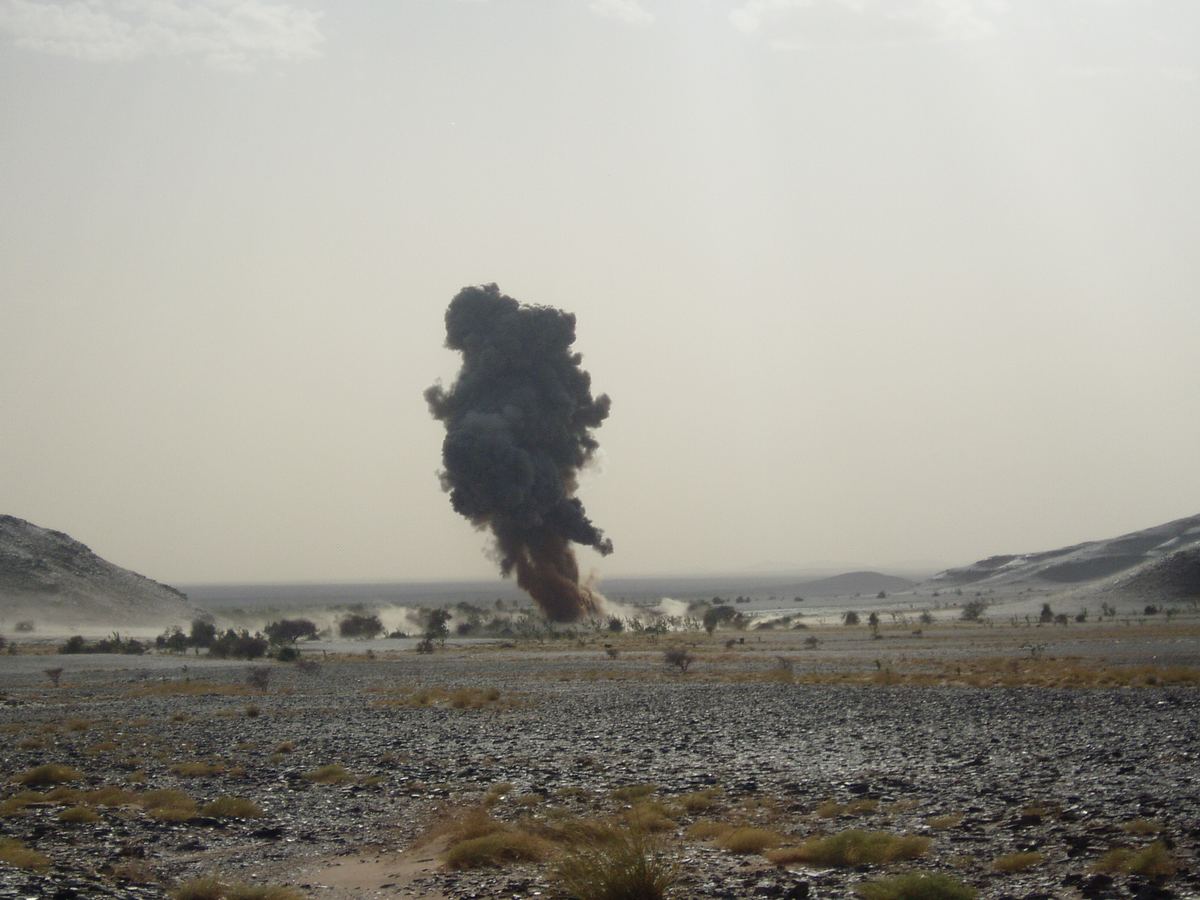
Our services for projects in Rabat
Historical desk study and non-technical survey (NTS)
Collection and analysis of archives, testimony and field evidence to define suspected hazardous areas before any intervention. Non-technical survey
Technical survey and UXO survey
Geophysical detection (magnetometry, electromagnetics) and ground verification to confirm and locate explosive ordnance, on land or underwater. UXO survey
Battle area clearance and mine clearance
Search, identification and neutralisation or destruction of UXO, mines and improvised explosive devices by qualified EOD operators. Battle area clearance · Mine clearance
Client representation and quality control
Independent supervision, quality assurance and quality control of clearance contractors on behalf of the project owner, and explosive ordnance safety advice on site.
Training and stockpile management (PSSM)
EOD training, physical security and stockpile management assessments and destruction of surplus ammunition, through the group company GEODE. Stockpile destruction and PSSM
Underwater works
Survey and clearance in ports, rivers and offshore areas with the group company SEMTEC.
Why the DEMINETEC Group?
- ISO 9001, ISO 14001, ISO 45001 and MASE certified.
- Group pre-qualified by UNOPS in 14 disciplines since 2023.
- Experts who have worked in 34 countries, through GEODE (Global EOD Experts) for mine action and SEMTEC for underwater works.
- Teams of former French Navy and Army EOD operators.
- Onshore and underwater capacity within one group.
The DEMINETEC Group and Morocco
The group’s experts worked in Morocco in 2026 (assessment and expertise).
See the international references of the group.
Demining, treaties and ammunition stockpiles in Morocco
Since 1975, Morocco has registered 2,771 mine and ERW victims, of whom 826 were killed, according to its voluntary report covering 2024. The Royal Moroccan Armed Forces launched major demining operations in 2007, following an increase in the number of victims. For 2024, Morocco reported the destruction of 40 anti-personnel mines, 63 anti-vehicle mines and 142 items of ERW. Mine Action Review indicates that demining appears to be manual only.
Morocco has acceded neither to the Ottawa Convention nor to the Convention on Cluster Munitions; no Article 5 deadline therefore applies. It is party to the Convention on Certain Conventional Weapons and its Amended Protocol II, submits voluntary transparency reports and attends meetings as an observer. On ammunition stockpiles, the country reported needs in 2022 for storage procedures, training and the destruction of surpluses.
Provinces and sites cited
- Rabat-Salé-Kénitra region: no contamination documented
- Kénitra, where the Royal Moroccan Armed Forces receive EOD training
- Provinces of Laayoune, Smara, Boujdour, Dakhla and Aousserd, declared affected by Morocco
- Provinces of Assa-Zag, Tan-Tan, Tata and Akka, declared affected by Morocco
- El-Melias corridor, Figuig province (suspected areas)
Expected ordnance and implications
The ordnance declared consists of anti-personnel and anti-vehicle mines and unexploded ordnance (UXO). Morocco states that its mined areas are mapped; any survey therefore depends on the Royal Moroccan Armed Forces. On stockpiles, it reported needs in 2022 for storage procedures, training and the destruction of surpluses.
FAQ: explosive risk in Rabat and Morocco
Is Rabat affected by mines or unexploded ordnance?
No, the sources consulted document no contamination in Rabat or its region. The provinces that Morocco has declared affected (Laayoune, Smara, Boujdour, Dakhla, Aousserd, Assa-Zag, Tan-Tan, Tata) and, for suspected areas, Figuig province are far from the capital. The subject is therefore handled from Rabat, but for distant sites.
Who carries out demining in Morocco, and under which rules?
Demining is carried out by the Royal Moroccan Armed Forces, with no international operator and no dedicated civilian authority. Morocco has not adopted national mine action legislation or standards; it states that it follows normal safety and environmental protection standards and international techniques. Mine Action Review indicates that demining appears to be manual only.
Is Morocco party to the mine conventions?
Morocco has acceded neither to the Ottawa Convention nor to the Convention on Cluster Munitions: no Article 5 deadline applies. It is, however, party to the Convention on Certain Conventional Weapons and its Amended Protocol II, submits voluntary transparency reports and attends meetings as an observer.
Sources: Mine Action Review — Morocco, Clearing the Mines 2025 · Landmine and Cluster Munition Monitor — Morocco, Mine Ban Policy · GICHD, Ammunition Management Activity Platform (A-MAP) — Morocco · United States Marine Corps — U.S., Morocco improve demining capability, work on center of excellence · U.S. Embassy & Consulates in Morocco — U.S. and Moroccan Armed Forces Conclude Joint Training Programs on Disaster Response and Explosive Hazards
Territorial coverage
From Rabat and the Rabat-Salé-Kénitra region, for sites located in the provinces Morocco declares affected and in Figuig province. Teams and equipment are mobilised to fit each mission: documentary studies, short field surveys or long-duration clearance operations.
Other African capital and city pages: Bamako · Niamey · Ouagadougou · N’Djamena · Yaoundé · Malabo · Lomé · Porto-Novo · Bissau · Addis Ababa · Luanda · Tripoli
Frequently asked questions about explosive ordnance services in Rabat
Which framework applies to mine action and ammunition management in Morocco?
Morocco has neither a national mine action authority nor a mine action centre: the Royal Moroccan Armed Forces conduct demining. The State is party neither to the Ottawa Convention nor to the Convention on Cluster Munitions, but it is party to the Convention on Certain Conventional Weapons and its Amended Protocol II, submits voluntary transparency reports and attends meetings as an observer. No national mine action standard has been adopted; the technical references remain IMAS for clearance and the IATG for physical security and stockpile management (PSSM) of ammunition.
What does a project owner or programme manager need before starting in Rabat?
For works: a historical desk study and a non-technical survey to define the hazard, then a technical survey or UXO survey of the project footprint, clearance where evidence of contamination is found, and a handover document. For ammunition stockpiles: an assessment of the storage sites against the IATG, a risk-reduction plan, training, and the destruction of unserviceable ammunition.
How long does a mission take?
Duration depends on the area, the search depth and the density of contamination: from a few weeks for a desk study to several months or more for clearance operations on major projects.
Does the group work underwater?
Yes. Through the group company SEMTEC, the group carries out commercial diving, underwater magnetometry and neutralisation of submerged ordnance in ports, rivers and coastal areas.
Contact the DEMINETEC Group about Rabat
For any desk study, survey or clearance request, contact our teams:
DEMINETEC SAS285 avenue Marcel Paul
83500 La Seyne-sur-Mer, FRANCE
Tel: +33 9 52 51 00 63
Email: contact@deminetec.com