
UXO clearance, EOD training and PSSM in Addis Ababa
Explosive ordnance risk management in Ethiopia – DEMINETEC GroupExplosive ordnance, mines and ammunition stockpiles: Addis Ababa, Ethiopia
The DEMINETEC Group supports public authorities, international organisations and private clients with programmes and projects run from Addis Ababa, Ethiopia: historical desk study, non-technical and technical survey, UXO and mine clearance, EOD training, and physical security and stockpile management (PSSM) of ammunition. The group has worked in 34 countries and operates to the International Mine Action Standards (IMAS), the International Ammunition Technical Guidelines (IATG), the requirements of the national authorities and the contract specifications.
In short.
- Addis Ababa is not among the regions where mine contamination is recorded; the capital experienced munitions depot explosions in 1991.
- The country reports 125 km² of suspected or confirmed areas (March 2024), 95% of it in the Somali region, and recent UXO in the north.
- The Ethiopian Mine Action Office (EMAO), under the Ministry of Defence, oversees the sector; Article 5 deadline of 31 December 2030.
Explosive ordnance context of Addis Ababa and Ethiopia
Addis Ababa is not recorded as a mined area: Ethiopia records contamination in six regions (Afar, Benishangul-Gumuz, Gambela, Oromia, Somali and Tigray), not in the capital. The city nonetheless remembers the munitions depot explosions of May and June 1991, at the fall of the Mengistu regime. Nationwide, the risk stems from a series of conflicts between 1935 and 2000, then from the Tigray conflict that began in November 2020 and left large quantities of unexploded ordnance (UXO) in the north.
As at March 2024, Ethiopia reported 147 hazardous areas covering 125 km², 95% of it in the Somali region; Mine Action Review estimates the area actually mined at about 20 km². In the north, UNMAS assessed 329 suspected sites in 89 woredas of Afar, Amhara and Tigray between January 2024 and November 2025. The Ethiopian Mine Action Office (EMAO) coordinates the sector with UNMAS support; The HALO Trust, Humanity & Inclusion, MAG, DRC and DCA received desk accreditation in 2024.
From Addis Ababa, where national coordination of the sector takes place, road, energy, mining or agricultural projects located in Tigray, Afar, Amhara or the Somali region require a check on the status of surveys: a nationwide survey is planned for 2026–2027 and the national database was still under development in 2025. Physical security and stockpile management (PSSM) of ammunition is also an issue: in 2020 Ethiopia reported needs for guidelines, training and the destruction of surpluses.
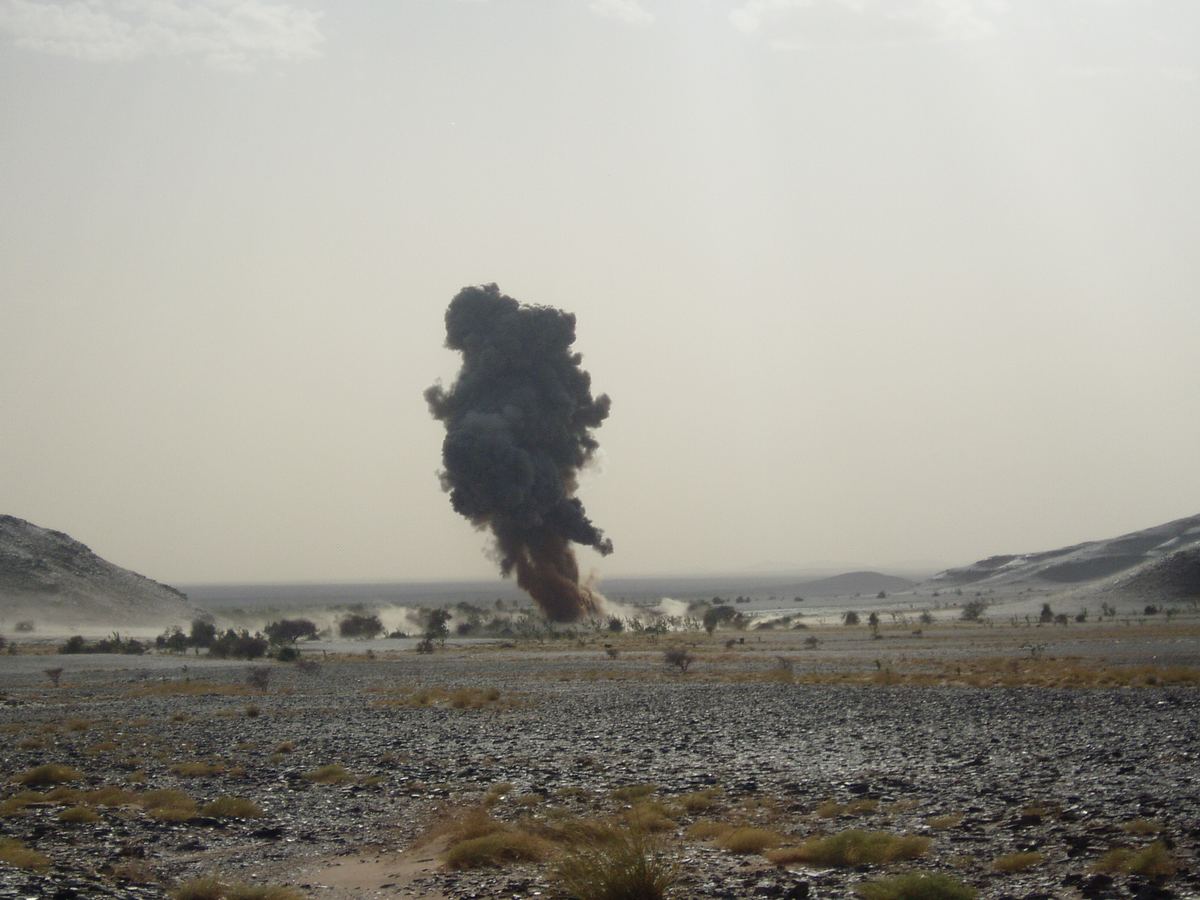
Our services for projects in Addis Ababa
Historical desk study and non-technical survey (NTS)
Collection and analysis of archives, testimony and field evidence to define suspected hazardous areas before any intervention. Non-technical survey
Technical survey and UXO survey
Geophysical detection (magnetometry, electromagnetics) and ground verification to confirm and locate explosive ordnance, on land or underwater. UXO survey
Battle area clearance and mine clearance
Search, identification and neutralisation or destruction of UXO, mines and improvised explosive devices by qualified EOD operators. Battle area clearance · Mine clearance
Client representation and quality control
Independent supervision, quality assurance and quality control of clearance contractors on behalf of the project owner, and explosive ordnance safety advice on site.
Training and stockpile management (PSSM)
EOD training, physical security and stockpile management assessments and destruction of surplus ammunition, through the group company GEODE. Stockpile destruction and PSSM
Underwater works
Survey and clearance in ports, rivers and offshore areas with the group company SEMTEC.
Why the DEMINETEC Group?
- ISO 9001, ISO 14001, ISO 45001 and MASE certified.
- Group pre-qualified by UNOPS in 14 disciplines since 2023.
- Experts who have worked in 34 countries, through GEODE (Global EOD Experts) for mine action and SEMTEC for underwater works.
- Teams of former French Navy and Army EOD operators.
- Onshore and underwater capacity within one group.
The DEMINETEC Group and Ethiopia
The group’s experts worked in Ethiopia in 2017 (assessment and expertise, stockpile management – PSSM).
See the international references of the group.
Conflict history, explosive ordnance and ammunition stockpiles in Ethiopia
Ethiopia’s explosive legacy dates back to the Italian occupation and the East Africa campaigns (1935–1941), then to the Ogaden war with Somalia (1977–1978), a border conflict with Sudan (1980), internal conflicts and the war with Eritrea (1998–2000). In Addis Ababa, on 28 May 1991, the day the forces of the Ethiopian People’s Revolutionary Democratic Front (EPRDF) entered the city, one ammunition dump exploded at the Presidential Palace and another at Shogole, where an estimated 500 people died; on 4 June, an explosion at the dump in the Nefas Silk area killed approximately one hundred people. Ethiopia signed the Ottawa Convention on 3 December 1997, ratified it on 17 December 2004 and became a State Party on 1 June 2005.
In November 2020, armed conflict broke out in Tigray between the federal government and the regional authorities, then spread in 2021 to Afar and Amhara; a cessation of hostilities was agreed in November 2022. According to UNMAS, 1,676 victims of explosive ordnance have been reported in the north since January 2020 (data as of January 2026, not all cases verified), more than 63% of them children. There is also credible evidence of cluster munition remnants, from that conflict and from the 1998–2000 war. The Article 5 deadline, already extended twice and most recently set at 31 December 2025, was extended in December 2025 to 31 December 2030; an updated work plan is due by 30 April 2028.
Areas and sites concerned
- Somali region, 95% of the areas reported as at March 2024
- Tigray: Mekelle, Shire and the border with Eritrea
- Afar: Semera
- Amhara
- Gambela, Oromia and Benishangul-Gumuz
- Gijet and Samre, south-west of Mekelle
- Addis Ababa: Shogole and Nefas Silk, ammunition dumps hit in 1991
Expected ordnance and implications
The ordnance documented consists of anti-personnel and anti-vehicle mines inherited from past conflicts, recent unexploded ordnance (projectiles, mortars, rockets, air-dropped bombs, grenades and fuzes recorded by UNMAS in the north) and cluster munition remnants whose extent remains unknown. Ethiopia states that it has found no evidence of anti-personnel mine use during the recent conflict; the presence of improvised mines in Afar and Amhara is unconfirmed. As historical data are unreliable, any study must combine non-technical survey with local sources.
FAQ: explosive risk in Addis Ababa and Ethiopia
Is Addis Ababa contaminated by mines or unexploded ordnance?
No mine contamination is recorded in Addis Ababa: the reported areas are in Afar, Benishangul-Gumuz, Gambela, Oromia, Somali and Tigray. The capital did, however, experience munitions depot explosions in 1990 and 1991 according to the Small Arms Survey database, including the one at Nefas Silk on 4 June 1991, which killed about one hundred people.
What is Ethiopia’s deadline under the Ottawa Convention?
In December 2025 the Meeting of States Parties granted a third extension, to 31 December 2030. Ethiopia plans surveys in 2026–2027, then clearance of confirmed areas from 2028 to 2030, and must submit an updated work plan by 30 April 2028. The announced budget, 30.9 million US dollars, depends on donors for 90% of the total.
Where is the risk highest for a project in Ethiopia?
The reported areas are concentrated in the Somali region, where 600 km² recorded in error were removed from the database in 2024. The immediate danger lies rather in the north: in Tigray, according to the Danish Refugee Council, the main threat comes from hundreds of items of unexploded ordnance on people’s land, not from conventional minefields.
Sources: Mine Action Review — Ethiopia, Clearing the Mines 2025 · UNMAS — Ethiopia · AP Mine Ban Convention — Decisions on the request submitted by Ethiopia for an extended Article 5 deadline (22MSP, 4 December 2025) · Landmine and Cluster Munition Monitor — Ethiopia, Mine Ban Policy · Mine Action Review — Clearing Cluster Munition Remnants 2025 (Ethiopia) · Human Rights Watch — Evil Days, chapter 15: Armed Decision: The North, 1988-91 · GICHD, Ammunition Management Activity Platform (A-MAP) — Ethiopia
Territorial coverage
From Addis Ababa, the areas concerned are Tigray (Mekelle, Shire), Afar (Semera), Amhara and the Somali region. Teams and equipment are mobilised to fit each mission: documentary studies, short field surveys or long-duration clearance operations.
Other African capital and city pages: Bamako · Niamey · Ouagadougou · N’Djamena · Yaoundé · Malabo · Lomé · Porto-Novo · Bissau · Luanda · Tripoli
Frequently asked questions about explosive ordnance services in Addis Ababa
Which framework applies to mine action and ammunition management in Ethiopia?
The Ethiopian Mine Action Office (EMAO), established in 2001 by Council of Ministers Regulation No. 70/2001 and placed under the Ministry of Defence since 2019, coordinates the sector and accredits operators. Ethiopia has been a State Party to the Ottawa Convention since 1 June 2005; it is not party to the Convention on Cluster Munitions. Twelve national mine action standards (NMAS) were issued in 2024; the States Parties ask that they remain aligned with IMAS. The IATG serve as the reference for ammunition stockpiles.
What does a project owner or programme manager need before starting in Addis Ababa?
For works: a historical desk study and a non-technical survey to define the hazard, then a technical survey or UXO survey of the project footprint, clearance where evidence of contamination is found, and a handover document. For ammunition stockpiles: an assessment of the storage sites against the IATG, a risk-reduction plan, training, and the destruction of unserviceable ammunition.
How long does a mission take?
Duration depends on the area, the search depth and the density of contamination: from a few weeks for a desk study to several months or more for clearance operations on major projects.
Does the group work underwater?
Yes. Through the group company SEMTEC, the group carries out commercial diving, underwater magnetometry and neutralisation of submerged ordnance in ports, rivers and coastal areas.
Contact the DEMINETEC Group about Addis Ababa
For any desk study, survey or clearance request, contact our teams:
DEMINETEC SAS285 avenue Marcel Paul
83500 La Seyne-sur-Mer, FRANCE
Tel: +33 9 52 51 00 63
Email: contact@deminetec.com