
UXO clearance, EOD training and PSSM in Niamey
Explosive ordnance risk management in Niger – DEMINETEC GroupExplosive ordnance, mines and ammunition stockpiles: Niamey, Niger
The DEMINETEC Group supports public authorities, international organisations and private clients with programmes and projects run from Niamey, Niger: historical desk study, non-technical and technical survey, UXO and mine clearance, EOD training, and physical security and stockpile management (PSSM) of ammunition. The group has worked in 34 countries and operates to the International Mine Action Standards (IMAS), the International Ammunition Technical Guidelines (IATG), the requirements of the national authorities and the contract specifications.
In short.
- No mined area is recorded in Niamey; a single mine incident is reported there, in January 2008, on the western outskirts of the city.
- The country’s only confirmed mined area is at Madama, in Agadez region, about 2,000 km from the capital.
- Improvised explosive devices mainly affect Tillabéri and Diffa; the CNCCAI, an interministerial commission created in 1994, holds the mine action mandate.
Explosive ordnance context of Niamey and Niger
Niamey appears in no inventory of mined areas. The sources report one isolated incident: on 8 January 2008, a journalist was killed by a mine buried in a track on the western outskirts, the first case in the capital, at a time when the army and an armed movement had been in conflict in Agadez region since February 2007. On the night of 28 to 29 January 2026, Air Base 101, on the Diori-Hamani airport site, was attacked; fires in an ammunition depot were reported.
The risk falls into two sets. In the north, a confirmed hazardous area of 177,760 m² remains near the Madama military post, Bilma department. In the south-west and south-east, improvised mines affect Tillabéri and Diffa: 76 incidents in 2024, of which 52 in Tillabéri and 24 in Diffa. The CNCCAI coordinates; military engineering specialists and the defence and security forces neutralise devices. UNMAS was present from 2021 to the end of 2022; HI continues risk education in Tillabéri and Diffa.
From Niamey, the projects exposed are those that head out towards Tillabéri, Diffa or the far north. On 17 December 2024, an IED targeted a hydraulic infrastructure construction site near Tam (Maïné-Soroa): one worker killed, three injured. In 2022, the 55 incidents logged by UNMAS were all IEDs emplaced on roads. On stockpiles, the A-MAP platform records no accidental depot explosion since 1979, but needs in management standards and surplus destruction remain; eight personnel were trained at CPADD, in Benin, in 2023.
Our services for projects in Niamey
Historical desk study and non-technical survey (NTS)
Collection and analysis of archives, testimony and field evidence to define suspected hazardous areas before any intervention. Non-technical survey
Technical survey and UXO survey
Geophysical detection (magnetometry, electromagnetics) and ground verification to confirm and locate explosive ordnance, on land or underwater. UXO survey
Battle area clearance and mine clearance
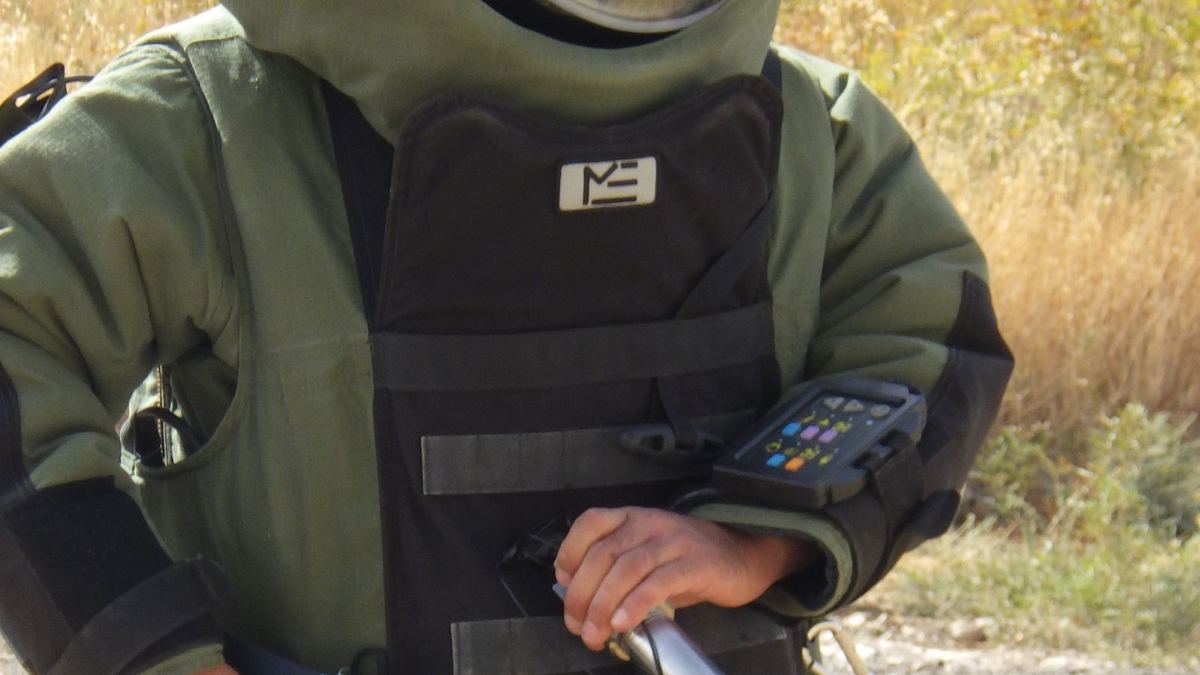
Search, identification and neutralisation or destruction of UXO, mines and improvised explosive devices by qualified EOD operators. Battle area clearance · Mine clearance
Client representation and quality control
Independent supervision, quality assurance and quality control of clearance contractors on behalf of the project owner, and explosive ordnance safety advice on site.
Training and stockpile management (PSSM)
EOD training, physical security and stockpile management assessments and destruction of surplus ammunition, through the group company GEODE. Stockpile destruction and PSSM
Underwater works
Survey and clearance in ports, rivers and offshore areas with the group company SEMTEC.
Why the DEMINETEC Group?
- ISO 9001, ISO 14001, ISO 45001 and MASE certified.
- Group pre-qualified by UNOPS in 14 disciplines since 2023.
- Experts who have worked in 34 countries, through GEODE (Global EOD Experts) for mine action and SEMTEC for underwater works.
- Teams of former French Navy and Army EOD operators.
- Onshore and underwater capacity within one group.
The DEMINETEC Group and Niger
The group’s experts worked in Niger in 2019 and 2020 (training).
See the international references of the group.
Conflict history, explosive ordnance and ammunition stockpiles in Niger
Niger ratified the Ottawa Convention on 23 March 1999, and it entered into force for the country on 1 September 1999. Its first report, in 2002, flagged suspected areas; in June 2008, the country declared that this presence was no longer suspected. Meanwhile, the conflict that began in February 2007 between the army and the Mouvement des Nigériens pour la justice, in Agadez region, brought incidents far from the north: in December 2007, anti-tank mines killed two people and seriously injured four in Maradi and Tahoua, others were defused in Dosso and in Zinder region, each side accusing the other. Recorded casualties reached 109 in 2007 and 155 in 2008.
In June 2011, an assessment mission discovered a mined area at the Madama military post. First estimated at 2,400 m², it was revised to 39,304 m² after the 2014 surveys, and an additional area of 196,253 m², containing anti-personnel and anti-tank mines, was identified. More than sixty deminers were deployed there from November 2014; the last campaign, from July 2019 to March 2020, covered 18,483 m² and destroyed 323 anti-personnel mines. The Article 5 deadline, first set at 1 September 2009, has been extended five times, most recently in November 2024, to 31 December 2029. Since 2015, the IED threat has taken hold in Diffa and Tillabéri; from 1999 to 2024, 713 mine and explosive remnants of war casualties were recorded.
Areas and sites concerned
- Madama (Bilma department, Agadez region)
- Tillabéri region, in the three-border area
- Diffa region, near Lake Chad (N’Guigmi, Bosso)
- Tam, Maïné-Soroa area
- Baroua–Bosso road
- Dosso
- Maradi and Tahoua
- Western outskirts of Niamey (2008 incident)
Expected ordnance and implications
At Madama, the ordnance consists of conventional anti-personnel mines, mostly of the M-51 type, hard to detect with standard detectors, and anti-tank mines; full manual excavation is described as the only effective method there, in sandy ground. In Tillabéri and Diffa, the devices are IEDs emplaced on roads: from January to mid-September 2025, the CNCCAI counted eight radio-controlled and fourteen victim-operated. A survey therefore separates these two settings. For stockpiles, diversions are documented at Ouallam (2014), Bosso and Tassara (2016).
FAQ: explosive risk in Niamey and Niger
Is Niamey contaminated by mines or explosive remnants of war?
No: no mined area is documented in Niamey. The sources report one isolated incident, on 8 January 2008, when a mine buried in a track on the western outskirts killed a journalist. In January 2026, the attack on Air Base 101 was accompanied by fires in an ammunition depot; the sources do not describe residual contamination following that event.
Where are the at-risk areas in Niger?
The only confirmed mined area, 177,760 m², lies near the Madama military post, in Bilma department, Agadez region. Improvised mines mainly concern Tillabéri, in the three-border area, and Diffa, near Lake Chad; incidents are also reported in Dosso, Tahoua and Agadez. From 2016 to the end of 2022, 183 incidents killed 203 people and injured 204.
What is Niger’s deadline under the Ottawa Convention?
Niger must destroy the anti-personnel mines in mined areas under its jurisdiction no later than 31 December 2029, a deadline granted in November 2024. The 2025–2029 work plan covers Madama only, at an estimated cost of 2.87 million US dollars. No survey or clearance took place in 2024; the last operation ended in March 2020.
Sources: Mine Action Review — Clearing the Mines 2025 (chapitre Niger) · Convention sur l’interdiction des mines antipersonnel — Analyse de la demande de prolongation du Niger (5e Conférence d’examen, 2024) · Landmine and Cluster Munition Monitor — Niger: Impact · Landmine and Cluster Munition Monitor — Niger: Cluster Munition Ban Policy · OCHA (ReliefWeb) — Afrique de l’Ouest : rapport sur la situation humanitaire, janvier 2008 · GICHD — Ammunition Management Activity Platform (A-MAP), fiche Niger · Wikipédia — Attaque de l’aéroport de Niamey
Territorial coverage
Niamey and, in Niger, the regions of Tillabéri, Dosso, Tahoua, Maradi, Agadez and Diffa. Teams and equipment are mobilised to fit each mission: documentary studies, short field surveys or long-duration clearance operations.
Other African capital and city pages: Bamako · Ouagadougou · N’Djamena · Yaoundé · Malabo · Lomé · Porto-Novo · Bissau · Addis Ababa · Luanda · Tripoli
Frequently asked questions about explosive ordnance services in Niamey
Which framework applies to mine action and ammunition management in Niger?
The Commission nationale pour la collecte et le contrôle des armes illicites (CNCCAI), created in 1994 and reporting to the Civil Cabinet of the President, manages mine action and acts as focal point for disarmament treaties. Niger ratified the Ottawa Convention on 23 March 1999 and the Convention on Cluster Munitions on 2 June 2009. Its national standards, updated in 2022 with UNMAS and HI, cover clearance, non-technical survey, risk education and community liaison; the country reports having revised them in line with IMAS. For stockpiles, the IATG are the international reference.
What does a project owner or programme manager need before starting in Niamey?
For works: a historical desk study and a non-technical survey to define the hazard, then a technical survey or UXO survey of the project footprint, clearance where evidence of contamination is found, and a handover document. For ammunition stockpiles: an assessment of the storage sites against the IATG, a risk-reduction plan, training, and the destruction of unserviceable ammunition.
How long does a mission take?
Duration depends on the area, the search depth and the density of contamination: from a few weeks for a desk study to several months or more for clearance operations on major projects.
Does the group work underwater?
Yes. Through the group company SEMTEC, the group carries out commercial diving, underwater magnetometry and neutralisation of submerged ordnance in ports, rivers and coastal areas.
Contact the DEMINETEC Group about Niamey
For any desk study, survey or clearance request, contact our teams:
DEMINETEC SAS285 avenue Marcel Paul
83500 La Seyne-sur-Mer, FRANCE
Tel: +33 9 52 51 00 63
Email: contact@deminetec.com