
UXO clearance, EOD training and PSSM in Malabo
Explosive ordnance risk management in Equatorial Guinea – DEMINETEC GroupExplosive ordnance, mines and ammunition stockpiles: Malabo, Equatorial Guinea
The DEMINETEC Group supports public authorities, international organisations and private clients with programmes and projects run from Malabo, Equatorial Guinea: historical desk study, non-technical and technical survey, UXO and mine clearance, EOD training, and physical security and stockpile management (PSSM) of ammunition. The group has worked in 34 countries and operates to the International Mine Action Standards (IMAS), the International Ammunition Technical Guidelines (IATG), the requirements of the national authorities and the contract specifications.
In short.
- No contamination by mines or unexploded ordnance is documented in Malabo; Equatorial Guinea has not reported any mined area.
- The documented risk relates to ammunition depots: the explosions at the Nkoantoma camp in Bata on 7 March 2021 killed at least 107 people.
- The country has been party to the Ottawa Convention since 1999; the sources consulted mention no national mine action authority.
Explosive ordnance context of Malabo and Equatorial Guinea
No mined area or unexploded ordnance contamination is documented in Malabo, on the island of Bioko. Equatorial Guinea has not reported any area where anti-personnel mines are known or suspected to be emplaced, and its initial report of 2014 states that it holds no stockpile of such mines. Only one allegation of mine use on Bioko in 2004, noted by the Landmine Monitor, has gone unanswered by the authorities. The explosive risk documented in the country is that of ammunition depots.
That risk materialised in Bata, the economic capital, on the mainland. On 7 March 2021, explosions in the armoury and military camp of Nkoantoma scattered ammunition across the city, with contamination recorded up to about 7 km from the epicentre. A security team coordinated by UNREC, experts from the GICHD’s AMAT, a UNDAC team mobilised by OCHA and explosive ordnance disposal specialists from France, Qatar, Cameroon and the United States worked in support of the Equatorial Guinean authorities.
For a project run from Malabo, no clearance of mined areas needs to be planned. The relevant issue is the safety of ammunition and explosives stockpiles located near inhabited areas or worksites. After Bata, UNREC set out three priorities: safe destruction of unexploded explosives, training of personnel in handling and storage, and improved design of depots, preferably underground. The GICHD also notes needs for technical assessments and for physical security and stockpile management (PSSM).
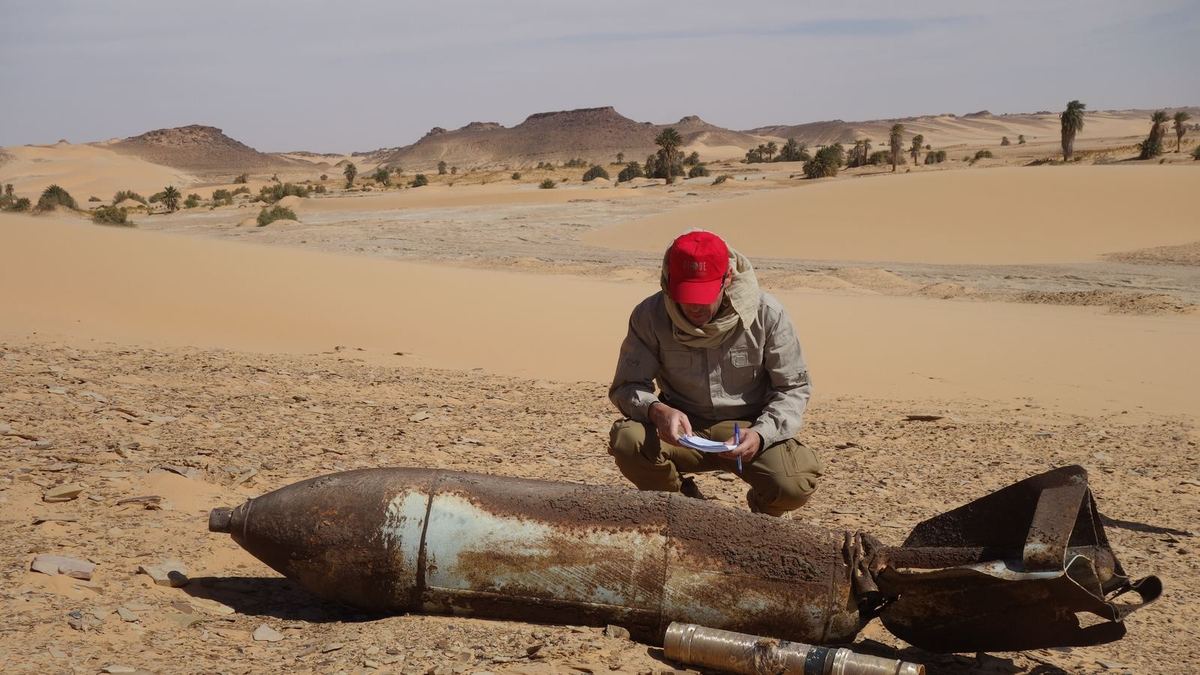
Our services for projects in Malabo
Historical desk study and non-technical survey (NTS)
Collection and analysis of archives, testimony and field evidence to define suspected hazardous areas before any intervention. Non-technical survey
Technical survey and UXO survey
Geophysical detection (magnetometry, electromagnetics) and ground verification to confirm and locate explosive ordnance, on land or underwater. UXO survey
Battle area clearance and mine clearance
Search, identification and neutralisation or destruction of UXO, mines and improvised explosive devices by qualified EOD operators. Battle area clearance · Mine clearance
Client representation and quality control
Independent supervision, quality assurance and quality control of clearance contractors on behalf of the project owner, and explosive ordnance safety advice on site.
Training and stockpile management (PSSM)
EOD training, physical security and stockpile management assessments and destruction of surplus ammunition, through the group company GEODE. Stockpile destruction and PSSM
Underwater works
Survey and clearance in ports, rivers and offshore areas with the group company SEMTEC.
Why the DEMINETEC Group?
- ISO 9001, ISO 14001, ISO 45001 and MASE certified.
- Group pre-qualified by UNOPS in 14 disciplines since 2023.
- Experts who have worked in 34 countries, through GEODE (Global EOD Experts) for mine action and SEMTEC for underwater works.
- Teams of former French Navy and Army EOD operators.
- Onshore and underwater capacity within one group.
The DEMINETEC Group and Equatorial Guinea
The group’s experts worked in Equatorial Guinea in 2021 (assessment and expertise, stockpile management – PSSM).
See the international references of the group.
Conflict history, explosive ordnance and ammunition stockpiles in Equatorial Guinea
On 7 March 2021, at around 2 p.m., a series of explosions occurred at the Nkoantoma military camp, on the south-eastern outskirts of Bata; the last significant detonation came about two hours later. The official toll relayed by the United Nations is 107 dead; 615 people received medical care and the inter-agency assessment refers to more than 700 injured, while the Small Arms Survey records 105 deaths and 600 injuries. President Teodoro Obiang Nguema Mbasogo attributed the accident to negligently stored explosives and to nearby land-clearing fires, an explanation questioned by human rights organisations and by the Associated Press. According to a preliminary UNITAR analysis, 243 structures were heavily damaged or destroyed. On 9 March, Bata was declared a catastrophe zone.
The explosions threw ammunition into neighbouring districts: a 107 mm rocket warhead was recovered 1.6 km from the site, and debris mixed with ammunition was found at a nearby waste dump, where a further explosion was reported on 24 March 2021. A French team supported national forces inside the military compound, while Qatari and American teams swept civilian districts. A sixteen-member UNDAC team was deployed from 12 March to 2 April. As regards treaties, Equatorial Guinea acceded to the Ottawa Convention on 16 September 1998, in force on 1 March 1999, with no mined area reported under Article 5; it is not party to the Convention on Cluster Munitions.
Areas and sites concerned
- Nkoantoma military camp (Bata)
- Nkoantoma neighbourhood, north-west of the explosion site
- Razel, south of the explosion site (Bata)
- Bata, economic capital, on the mainland
- Bata General Hospital
- Malabo
- Bioko island
Expected ordnance and implications
The documented items all stem from the Bata accident: military ammunition and explosives thrown out or damaged, including at least one 107 mm rocket warhead, explosive residues liable to pollute soil and wells, and debris mixed with ammunition in waste. No mine is reported in the sources consulted. The issue is therefore one of stockpile management: condition and inventory of ammunition, design of storehouses, distance from housing, then the location and destruction of ammunition scattered after an accident.
FAQ: explosive risk in Malabo and Equatorial Guinea
Is Malabo contaminated by mines or unexploded ordnance?
No contamination is documented in Malabo. Equatorial Guinea has not reported any mined area under the Ottawa Convention, and the Landmine Monitor mentions only an allegation of mine use on the island of Bioko in 2004, to which the authorities have not responded. The only major explosive accident recorded in the country occurred in Bata, on the mainland.
What happened in Bata in 2021?
On 7 March 2021, explosions at the Nkoantoma military camp killed 107 people according to the official toll and injured more than 600. Unexploded ordnance was recorded up to about 7 km from the epicentre. Locating, removing and destroying it involved national and foreign teams, together with public information campaigns and a telephone hotline.
Has the Bata site now been cleared?
The sources consulted date mainly from 2021 and give no final account of the clearance. At the end of March 2021, the United Nations reported that the identification, removal and destruction of unexploded ordnance were advancing, while expressing concern about waste-picking and informal recycling. A project near the former Nkoantoma camp should therefore have the current status checked with the authorities.
Sources: Anti-Personnel Mine Ban Convention — Equatorial Guinea · Landmine and Cluster Munition Monitor — Equatorial Guinea, Mine Ban Policy · GICHD A-MAP — Equatorial Guinea · OCHA (ReliefWeb) — 2021 Bata Explosions, Multi-Cluster/Sector Initial Rapid Assessment (MIRA) · OCHA (ReliefWeb) — Equatorial Guinea: Bata Explosions, Situation Report No. 2, 28 March 2021 · James Madison University CISR — Journal of Conventional Weapons Destruction 27.3, Department of State’s Quick Reaction Force · Wikipedia — 2021 Bata explosions
Territorial coverage
Malabo and Bioko island, together with Bata and the mainland part of the country, including Mongomo, Ebebiyín and the island of Annobón. Teams and equipment are mobilised to fit each mission: documentary studies, short field surveys or long-duration clearance operations.
Other African capital and city pages: Bamako · Niamey · Ouagadougou · N’Djamena · Yaoundé · Lomé · Porto-Novo · Bissau · Addis Ababa · Luanda · Tripoli
Frequently asked questions about explosive ordnance services in Malabo
Which framework applies to mine action and ammunition management in Equatorial Guinea?
The sources consulted mention no national mine action authority in Equatorial Guinea; in 2021, the United Nations dealt with the Ministry of Defence and with a national emergency response committee chaired by the Minister of the Interior. The country has been party to the Ottawa Convention since 1 March 1999, without specific implementing legislation, and is party neither to the Convention on Cluster Munitions nor to the Convention on Certain Conventional Weapons. No national standard is reported: IMAS and, for stockpiles, the IATG serve as international references.
What does a project owner or programme manager need before starting in Malabo?
For works: a historical desk study and a non-technical survey to define the hazard, then a technical survey or UXO survey of the project footprint, clearance where evidence of contamination is found, and a handover document. For ammunition stockpiles: an assessment of the storage sites against the IATG, a risk-reduction plan, training, and the destruction of unserviceable ammunition.
How long does a mission take?
Duration depends on the area, the search depth and the density of contamination: from a few weeks for a desk study to several months or more for clearance operations on major projects.
Does the group work underwater?
Yes. Through the group company SEMTEC, the group carries out commercial diving, underwater magnetometry and neutralisation of submerged ordnance in ports, rivers and coastal areas.
Contact the DEMINETEC Group about Malabo
For any desk study, survey or clearance request, contact our teams:
DEMINETEC SAS285 avenue Marcel Paul
83500 La Seyne-sur-Mer, FRANCE
Tel: +33 9 52 51 00 63
Email: contact@deminetec.com