
UXO clearance, EOD training and PSSM in Porto-Novo
Explosive ordnance risk management in Benin – DEMINETEC GroupExplosive ordnance, mines and ammunition stockpiles: Porto-Novo, Benin
The DEMINETEC Group supports public authorities, international organisations and private clients with programmes and projects run from Porto-Novo, Benin: historical desk study, non-technical and technical survey, UXO and mine clearance, EOD training, and physical security and stockpile management (PSSM) of ammunition. The group has worked in 34 countries and operates to the International Mine Action Standards (IMAS), the International Ammunition Technical Guidelines (IATG), the requirements of the national authorities and the contract specifications.
In short.
- No contamination by mines or explosive remnants of war is documented in Porto-Novo, the official capital, or in Cotonou, the economic capital.
- The documented risk concerns the north, in Alibori and Atacora, where improvised explosive devices are reported, and obsolete ammunition stockpiles.
- The CNLCPAL, under the presidency, is the national focal point; the CPADD in Ouidah has trained mine clearance specialists since 2003.
Explosive ordnance context of Porto-Novo and Benin
Porto-Novo, the official capital of Benin, and Cotonou, the economic capital, show no documented contamination by mines or explosive remnants of war in the sources consulted. Benin has declared that it has never used or produced anti-personnel mines and hosts, in Ouidah, a regional mine clearance training centre. The country’s explosive risk is of a different kind: improvised explosive devices reported in the northern departments from 2022 onwards, and obsolete or unstable ammunition in the depots of the defence and security forces.
The recorded events are located in Atacora and Alibori: W National Park in February 2022, Kandi on 17 April 2025, Matéri. Landmine Monitor has listed Benin, since 2023, among the states facing an emerging threat from improvised devices. The Armed Forces Materiel Directorate has run a destruction programme with the NGO MAG since 2019: in April 2022, nearly 12,000 weapons and 400 tonnes of ammunition remained to be destroyed. In Ouidah, the CPADD, inaugurated on 25 April 2003, trains course participants from across the continent.
From Porto-Novo or Cotonou, a project owner therefore does not have to deal with legacy contamination on the coast. The points to watch lie elsewhere: roads, tracks and protected areas in the north, where the threat from improvised devices is assessed before any works; military sites and depots, where the Toffo explosion of 1 May 2023 is a reminder of the importance of ammunition stockpile management (PSSM); firing ranges and destruction sites, for which the national assessment of April 2022 identifies regular clearance and upgrading to standards as options.
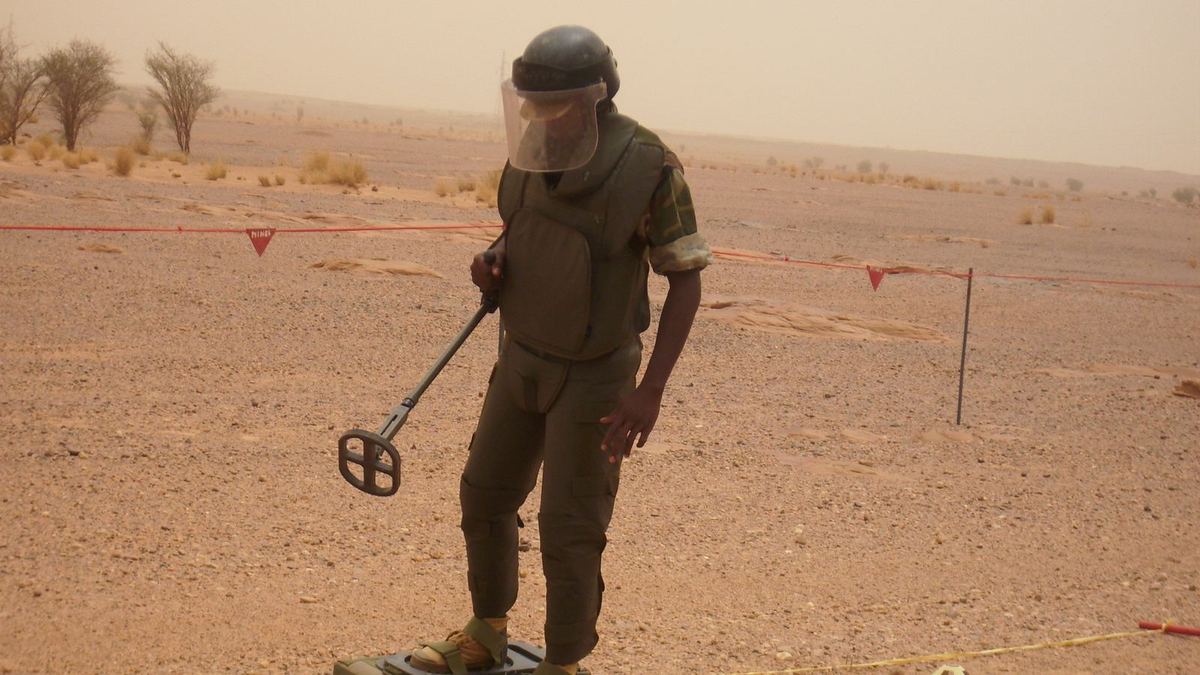
Our services for projects in Porto-Novo
Historical desk study and non-technical survey (NTS)
Collection and analysis of archives, testimony and field evidence to define suspected hazardous areas before any intervention. Non-technical survey
Technical survey and UXO survey
Geophysical detection (magnetometry, electromagnetics) and ground verification to confirm and locate explosive ordnance, on land or underwater. UXO survey
Battle area clearance and mine clearance
Search, identification and neutralisation or destruction of UXO, mines and improvised explosive devices by qualified EOD operators. Battle area clearance · Mine clearance
Client representation and quality control
Independent supervision, quality assurance and quality control of clearance contractors on behalf of the project owner, and explosive ordnance safety advice on site.
Training and stockpile management (PSSM)
EOD training, physical security and stockpile management assessments and destruction of surplus ammunition, through the group company GEODE. Stockpile destruction and PSSM
Underwater works
Survey and clearance in ports, rivers and offshore areas with the group company SEMTEC.
Why the DEMINETEC Group?
- ISO 9001, ISO 14001, ISO 45001 and MASE certified.
- Group pre-qualified by UNOPS in 14 disciplines since 2023.
- Experts who have worked in 34 countries, through GEODE (Global EOD Experts) for mine action and SEMTEC for underwater works.
- Teams of former French Navy and Army EOD operators.
- Onshore and underwater capacity within one group.
The DEMINETEC Group and Benin
The group’s experts worked in Benin from 2015 to 2018 (training, assessment and expertise, stockpile management – PSSM).
See the international references of the group.
Conflict history, explosive ordnance and ammunition stockpiles in Benin
Benin has not experienced an armed conflict that left minefields. The explosive risk comes from the spread of insecurity from the Sahel towards its northern borders: according to UNIDIR, threats linked to weapons, ammunition and components of improvised explosive devices have increased in the region since 2019. In January 2022, at least two soldiers were killed when their vehicle struck a home-made mine in Atacora. On 8 and 10 February 2022, three improvised devices hit patrols in W National Park, leaving nine dead and twelve wounded according to the government. In December 2023, two soldiers were killed by an explosive device of an unspecified type.
Landmine Monitor 2025 reports civilians injured or killed by improvised mines while fishing or riding tricycles or motorcycles, and cites two events attributed to JNIM: a man killed and a child injured in Kandi, in Alibori, on 17 April 2025, and a farmer killed in Matéri, in Atacora. On 1 May 2023, the accidental explosion of the Toffo ammunition depot destroyed the 16 anti-personnel mines retained for training. Benin ratified the Ottawa Convention on 25 September 1998, becoming a State Party on 1 March 1999, and the Convention on Cluster Munitions on 10 July 2017. No Article 5 deadline applies to it.
Areas and sites concerned
- W National Park (Triple Point area)
- Atacora department
- Matéri (Atacora)
- Kandi (Alibori)
- Border areas with Burkina Faso, Niger, Nigeria and Togo
- Toffo (ammunition depot)
- Ouidah (CPADD, 50 km west of Cotonou)
Expected ordnance and implications
Three categories of explosive ordnance are documented in Benin: improvised explosive devices (IEDs), including victim-activated improvised mines and booby-trapped bodies reported in the north; obsolete or unstable ammunition in depots, destroyed under a programme started in 2019; and firing ranges reserved for heavy weapons, which require regular clearance. The country holds no cluster munitions. Depending on the area, the preliminary study therefore focuses on the threat from improvised devices or on the military history of a site.
FAQ: explosive risk in Porto-Novo and Benin
Are Porto-Novo or Cotonou contaminated by mines or unexploded ordnance?
No, according to the sources consulted: no contamination by mines or explosive remnants of war is documented in Porto-Novo, the official capital, or in Cotonou. Benin reported no contamination by improvised mines in its transparency report of October 2024 and has no clearance deadline under the Ottawa Convention. The documented risk concerns the north of the country and ammunition depots.
What is the CPADD in Ouidah?
The Centre de perfectionnement aux actions post-conflictuelles de déminage et de dépollution is a national school with a regional remit, created by Benin with support from France. Set up in Ouidah in 2002 and inaugurated on 25 April 2003, it provides training in countering explosive devices and securing ammunition depots; in November 2024, Benin reported more than 4,400 specialists trained for 49 countries.
What happened at the Toffo ammunition depot in 2023?
On 1 May 2023, an accidental explosion struck the Toffo ammunition depot. According to Benin’s transparency report, 16 anti-personnel mines retained for training and 14 anti-vehicle mines were destroyed there. The country subsequently stated that it no longer holds anti-personnel mines under Article 3 of the Ottawa Convention. The accident illustrates what is at stake in managing ageing stockpiles.
Sources: Landmine and Cluster Munition Monitor — Benin, Mine Ban Policy · Landmine and Cluster Munition Monitor — Benin, Cluster Munition Ban Policy · Landmine and Cluster Munition Monitor — Landmine Monitor 2025 · CPADD — Accueil : historique, mission et moyens du centre de Ouidah · AP Mine Ban Convention — Déclaration du Bénin à la cinquième Conférence d’examen (Siem Reap, 29 novembre 2024) · UNIDIR — Gestion des armes et des munitions, aperçu de pays : République du Bénin · Africanews — Bénin : au moins 9 morts dans 3 attaques à la bombe au parc W
Territorial coverage
Area concerned: Porto-Novo and Ouémé department, Cotonou and Ouidah on the coast, Toffo, and, to the north, Kandi, Matéri and the departments of Alibori and Atacora. Teams and equipment are mobilised to fit each mission: documentary studies, short field surveys or long-duration clearance operations.
Other African capital and city pages: Bamako · Niamey · Ouagadougou · N’Djamena · Yaoundé · Malabo · Lomé · Bissau · Addis Ababa · Luanda · Tripoli
Frequently asked questions about explosive ordnance services in Porto-Novo
Which framework applies to mine action and ammunition management in Benin?
The sources consulted do not describe a national mine clearance programme in Benin. The National Commission to Combat the Proliferation of Small Arms and Light Weapons (CNLCPAL), under the responsibility of the Presidency, is the focal point for weapons and ammunition management and for the ECOWAS Convention; stockpiles fall under the Ministry of Defence, the general staff and the Armed Forces Materiel Directorate. Benin is party to the Ottawa Convention, for which implementing legislation has yet to be adopted, and to the Convention on Cluster Munitions. Technical references: IMAS, and the IATG for stockpiles.
What does a project owner or programme manager need before starting in Porto-Novo?
For works: a historical desk study and a non-technical survey to define the hazard, then a technical survey or UXO survey of the project footprint, clearance where evidence of contamination is found, and a handover document. For ammunition stockpiles: an assessment of the storage sites against the IATG, a risk-reduction plan, training, and the destruction of unserviceable ammunition.
How long does a mission take?
Duration depends on the area, the search depth and the density of contamination: from a few weeks for a desk study to several months or more for clearance operations on major projects.
Does the group work underwater?
Yes. Through the group company SEMTEC, the group carries out commercial diving, underwater magnetometry and neutralisation of submerged ordnance in ports, rivers and coastal areas.
Contact the DEMINETEC Group about Porto-Novo
For any desk study, survey or clearance request, contact our teams:
DEMINETEC SAS285 avenue Marcel Paul
83500 La Seyne-sur-Mer, FRANCE
Tel: +33 9 52 51 00 63
Email: contact@deminetec.com