
UXO clearance, EOD training and PSSM in N’Djamena
Explosive ordnance risk management in Chad – DEMINETEC GroupExplosive ordnance, mines and ammunition stockpiles: N’Djamena, Chad
The DEMINETEC Group supports public authorities, international organisations and private clients with programmes and projects run from N’Djamena, Chad: historical desk study, non-technical and technical survey, UXO and mine clearance, EOD training, and physical security and stockpile management (PSSM) of ammunition. The group has worked in 34 countries and operates to the International Mine Action Standards (IMAS), the International Ammunition Technical Guidelines (IATG), the requirements of the national authorities and the contract specifications.
In short.
- No mined area is recorded in N’Djamena; the risk there comes from ammunition, as the Goudji depot explosion of June 2024 showed.
- Recorded mined areas, about 77.6 km² at the end of 2024, are concentrated in Tibesti, Borkou and Ennedi, a legacy of the conflict with Libya.
- The Haut Commissariat National au Déminage (HCND), based in N’Djamena, oversees mine action under national standards aligned with IMAS.
Explosive ordnance context of N’Djamena and Chad
N’Djamena is not among the mined areas recorded in Chad, all of which lie in the northern provinces. The capital has nevertheless seen urban fighting, notably from 2 to 4 February 2008, and then an accidental explosion at an ammunition depot in the Goudji district on the night of 18 to 19 June 2024, during which shells were thrown beyond the site. The documented risk in the city therefore relates to unexploded ordnance and storage, not to minefields.
According to Mine Action Review, 119 confirmed or suspected mined areas covered about 77.6 km² at the end of 2024 in Borkou, Ennedi East and West, and Tibesti, the last of which holds more than half. The Wadi Doum minefield alone accounts for 16.4 km². Explosive remnants of war are also reported in Kanem and in the east. The HCND, the Army Engineers and the General Directorate of the Strategic Reserve (DGRS) operate, with MAG as the only international clearance operator.
For a project run from N’Djamena, explosive ordnance matters mainly outside the capital: northern tracks used by gold miners, routes in Borkou and Ennedi, and the Lake Chad area, where improvised explosive devices are reported. The 2024 floods displaced mines and ordnance in the north. In the city, the issue is physical security and stockpile management (PSSM): after Goudji, 154 tonnes of munitions were destroyed, followed by a further 7.1 tonnes at Massaguet in early 2026.
Our services for projects in N’Djamena
Historical desk study and non-technical survey (NTS)
Collection and analysis of archives, testimony and field evidence to define suspected hazardous areas before any intervention. Non-technical survey
Technical survey and UXO survey
Geophysical detection (magnetometry, electromagnetics) and ground verification to confirm and locate explosive ordnance, on land or underwater. UXO survey
Battle area clearance and mine clearance
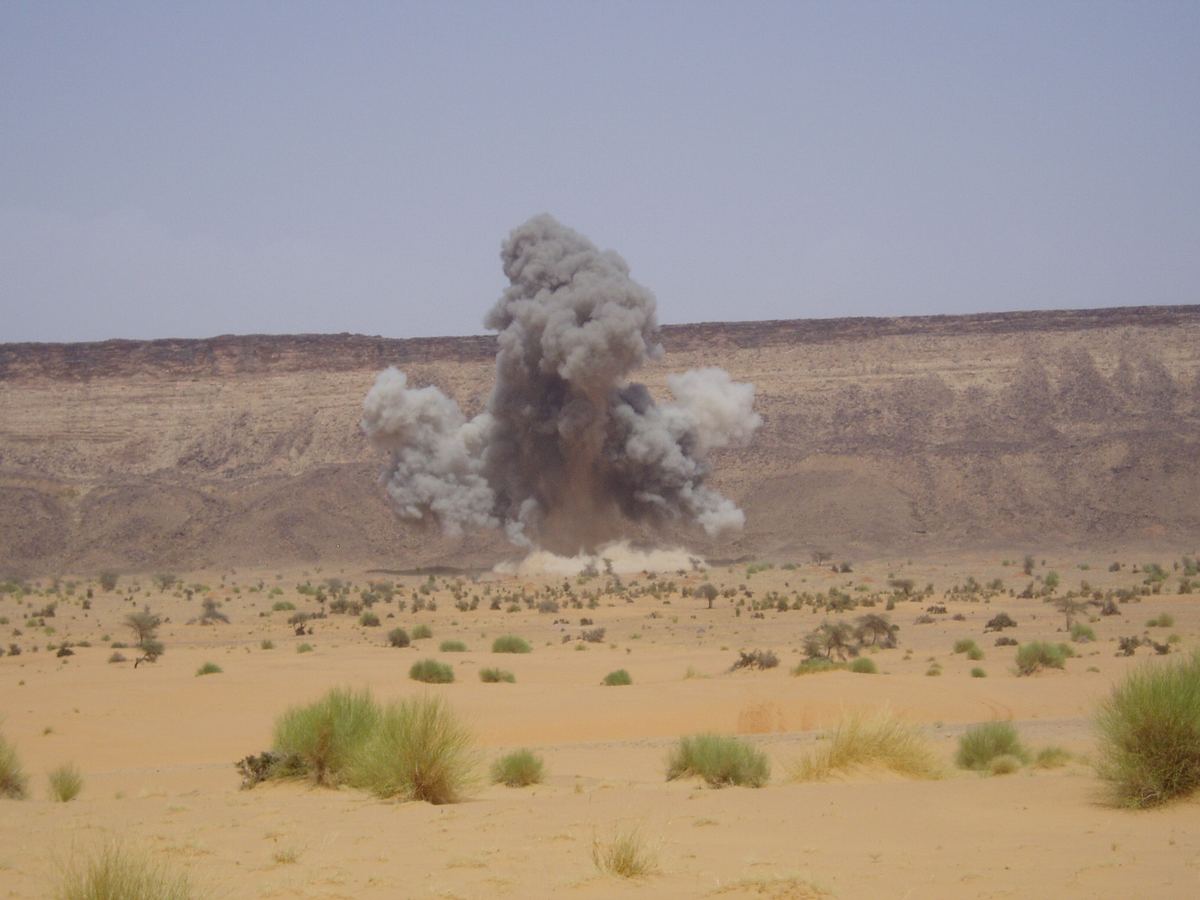
Search, identification and neutralisation or destruction of UXO, mines and improvised explosive devices by qualified EOD operators. Battle area clearance · Mine clearance
Client representation and quality control
Independent supervision, quality assurance and quality control of clearance contractors on behalf of the project owner, and explosive ordnance safety advice on site.
Training and stockpile management (PSSM)
EOD training, physical security and stockpile management assessments and destruction of surplus ammunition, through the group company GEODE. Stockpile destruction and PSSM
Underwater works
Survey and clearance in ports, rivers and offshore areas with the group company SEMTEC.
Why the DEMINETEC Group?
- ISO 9001, ISO 14001, ISO 45001 and MASE certified.
- Group pre-qualified by UNOPS in 14 disciplines since 2023.
- Experts who have worked in 34 countries, through GEODE (Global EOD Experts) for mine action and SEMTEC for underwater works.
- Teams of former French Navy and Army EOD operators.
- Onshore and underwater capacity within one group.
The DEMINETEC Group and Chad
The group’s experts worked in Chad from 2016 to 2020 (assessment and expertise, training).
See the international references of the group.
Conflict history, explosive ordnance and ammunition stockpiles in Chad
Contamination in the north dates back to the Libyan occupation of the Aouzou Strip from 1973 and to the Chadian–Libyan conflicts of 1978 to 1987: anti-personnel and anti-vehicle mines, unexploded ordnance and, in Tibesti, suspected cluster munition remnants. At Ouadi Doum, the contamination combines mines with remnants of the French bombardments of 1986. Thirty years of internal conflict add to this. N’Djamena saw an attack repelled in April 2006, then fighting from 2 to 4 February 2008 between a rebel coalition (UFDD, UFDD-F, RFC) and the Chadian National Army, around the presidential palace and in the city centre. In April 2021, clashes in Kanem left thousands of items of unexploded ordnance, partly removed in 2022 and 2023.
In Lac province, improvised mines attributed to Boko Haram were reported in 2018 and 2019, and a device killed seven Chadian soldiers in March 2024. On the night of 18 to 19 June 2024, a DGRS ammunition depot exploded in Goudji, in northern N’Djamena, near the international airport: the government announced at least 9 dead and 46 injured, the HCND 2 dead and 38 injured. Chad ratified the Ottawa Convention on 6 May 1999; its Article 5 deadline, extended five times, is set at 1 January 2030. The Convention on Cluster Munitions has been in force for Chad since 1 September 2013, with a deadline of 1 October 2026 and an extension requested to 1 October 2030.
Areas and sites concerned
- Goudji, northern district of N’Djamena (ammunition depot)
- Tibesti: Aouzou, Bardaï and Wour
- Faya-Largeau and Yarda (Borkou)
- Wadi Doum (Ennedi West)
- Nohi and Mounou (Ennedi East)
- Kanem
- Lac province
- Massaguet (Hadjer-Lamis)
Expected ordnance and implications
The sources describe anti-personnel and anti-vehicle mines, unexploded ordnance from fighting, suspected cluster munition remnants in Tibesti, improvised mines in Lac province and ammunition thrown out by the Goudji explosion. A survey must therefore distinguish between old minefields, recent battle areas and the surroundings of depots. For stockpiles, the documented actions are the destruction of munitions and the rehabilitation of storage facilities, a field in which MAG has worked in Chad since 2004.
FAQ: explosive risk in N’Djamena and Chad
Is N’Djamena a mined area?
No mined area is recorded there: those described by Mine Action Review lie in Borkou, Ennedi and Tibesti. In the capital, the documented risk comes from ammunition: urban fighting in 2006 and 2008, then the Goudji depot explosion in June 2024, where three HCND teams cleared the site over several weeks.
How extensive is contamination in Chad?
At the end of 2024, Mine Action Review recorded 119 mined or suspected areas, about 77.6 km², of which 43.27 km² are in Tibesti. At the end of 2023 there were in addition 178 km² of recorded battle area, including one area of 177 km² in Kanem. The Landmine Monitor recorded 16 mine and explosive remnant casualties in 2024, all civilians.
Which international deadlines apply to Chad?
Under the Ottawa Convention, Chad must complete mine clearance by 1 January 2030, a deadline granted at the end of 2024; Mine Action Review considers that it is not on track to meet it. For cluster munitions, the deadline was set at 1 October 2026 and an extension to 1 October 2030 has been requested.
Sources: Mine Action Review — Chad, Clearing the Mines 2025 · Mine Action Review — Chad, Clearing Cluster Munition Remnants 2026 · Landmine and Cluster Munition Monitor — Chad, Impact · Anti-Personnel Mine Ban Convention — Chad · Wikipedia — N'Djamena ammunition depot explosions · Wikipedia — Battle of N'Djamena (2008) · MAG (Mines Advisory Group) — Chad
Territorial coverage
N’Djamena and its region, together with the areas of Faya-Largeau, Bardaï, Fada, Abéché and Lac province. Teams and equipment are mobilised to fit each mission: documentary studies, short field surveys or long-duration clearance operations.
Other African capital and city pages: Bamako · Niamey · Ouagadougou · Yaoundé · Malabo · Lomé · Porto-Novo · Bissau · Addis Ababa · Luanda · Tripoli
Frequently asked questions about explosive ordnance services in N’Djamena
Which framework applies to mine action and ammunition management in Chad?
The Haut Commissariat National au Déminage (HCND), created by decree in 1998 and placed since June 2024 under the Ministry of Armed Forces, Veterans and War Victims, coordinates mine action from N’Djamena, with offices in Bardaï, Faya-Largeau, Fada and Abéché. Chad is party to the Ottawa Convention and to the Convention on Cluster Munitions; Law No. 26 of 2006 deals with anti-personnel mines. Twenty-two national standards (NNAMT) are aligned with IMAS. For stockpiles, the IATG are the international reference.
What does a project owner or programme manager need before starting in N’Djamena?
For works: a historical desk study and a non-technical survey to define the hazard, then a technical survey or UXO survey of the project footprint, clearance where evidence of contamination is found, and a handover document. For ammunition stockpiles: an assessment of the storage sites against the IATG, a risk-reduction plan, training, and the destruction of unserviceable ammunition.
How long does a mission take?
Duration depends on the area, the search depth and the density of contamination: from a few weeks for a desk study to several months or more for clearance operations on major projects.
Does the group work underwater?
Yes. Through the group company SEMTEC, the group carries out commercial diving, underwater magnetometry and neutralisation of submerged ordnance in ports, rivers and coastal areas.
Contact the DEMINETEC Group about N’Djamena
For any desk study, survey or clearance request, contact our teams:
DEMINETEC SAS285 avenue Marcel Paul
83500 La Seyne-sur-Mer, FRANCE
Tel: +33 9 52 51 00 63
Email: contact@deminetec.com