
UXO clearance, EOD training and PSSM in Ouagadougou
Explosive ordnance risk management in Burkina Faso – DEMINETEC GroupExplosive ordnance, mines and ammunition stockpiles: Ouagadougou, Burkina Faso
The DEMINETEC Group supports public authorities, international organisations and private clients with programmes and projects run from Ouagadougou, Burkina Faso: historical desk study, non-technical and technical survey, UXO and mine clearance, EOD training, and physical security and stockpile management (PSSM) of ammunition. The group has worked in 34 countries and operates to the International Mine Action Standards (IMAS), the International Ammunition Technical Guidelines (IATG), the requirements of the national authorities and the contract specifications.
In short.
- No mined area is documented in Ouagadougou; Centre region does not appear in the national list of affected communes submitted in 2025.
- The risk comes from improvised explosive devices, including improvised mines, emplaced mainly along roads in Sahel, Est and Centre-Nord regions.
- The Commission nationale de contrôle des armes (CNCA) is the national mine action authority; neutralising devices falls to the military engineers.
Explosive ordnance context of Ouagadougou and Burkina Faso
Ouagadougou is not described as a mined area. The baseline list submitted in 2025 records 226 communes, affected or suspected, in ten of the thirteen regions; Centre region, where the capital lies, is not among them. The city has, however, suffered armed attacks: on 15 January 2016, when explosive devices were used, then in August 2017 and on 2 March 2018. An accidental explosion at a private storage site there killed four people and injured 38 in 2014.
The national report covering 2022 and 2023 counted 729 IED incidents since 2017, mostly in Sahel (197), Est (164), Centre-Nord (123), Nord (86) and Boucle du Mouhoun (65). From 2017 to June 2024, 817 incidents were logged, with a spread towards Cascades. The CNCA coordinates; the National Demining Centre, set up in 2023 within the military engineers, intervenes. UNMAS closed its office in August 2024; DCA, DRC, HI and MAG deliver risk education and capacity building.
For a project run from Ouagadougou, the risk lies with the routes: more than 59% of the devices recorded in Burkina Faso, Mali and Niger from 2020 to 2024 were along roads. The surroundings of the Boungou mining site, in Est region, were affected in 2018. Roads, mining concessions and energy structures outside Centre region call for a commune-by-commune review of incidents. For depots, MAG has since 2015 carried out assessments of ammunition storage sites and physical security and stockpile management (PSSM) training.
Our services for projects in Ouagadougou
Historical desk study and non-technical survey (NTS)
Collection and analysis of archives, testimony and field evidence to define suspected hazardous areas before any intervention. Non-technical survey
Technical survey and UXO survey
Geophysical detection (magnetometry, electromagnetics) and ground verification to confirm and locate explosive ordnance, on land or underwater. UXO survey
Battle area clearance and mine clearance
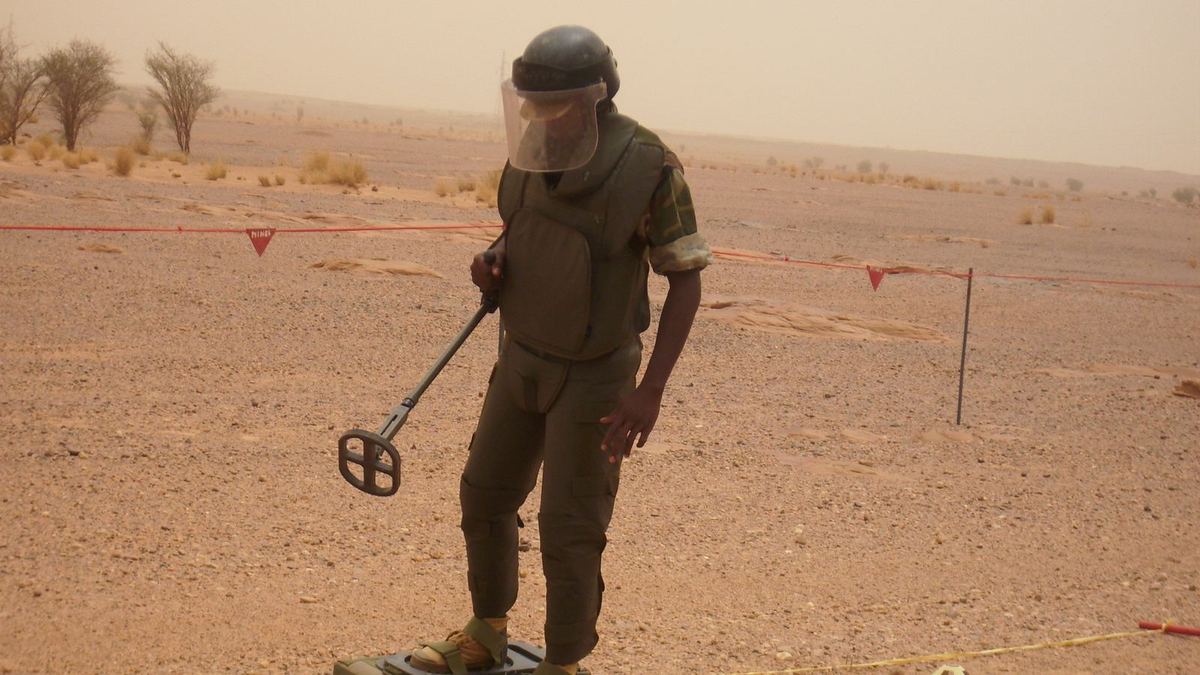
Search, identification and neutralisation or destruction of UXO, mines and improvised explosive devices by qualified EOD operators. Battle area clearance · Mine clearance
Client representation and quality control
Independent supervision, quality assurance and quality control of clearance contractors on behalf of the project owner, and explosive ordnance safety advice on site.
Training and stockpile management (PSSM)
EOD training, physical security and stockpile management assessments and destruction of surplus ammunition, through the group company GEODE. Stockpile destruction and PSSM
Underwater works
Survey and clearance in ports, rivers and offshore areas with the group company SEMTEC.
Why the DEMINETEC Group?
- ISO 9001, ISO 14001, ISO 45001 and MASE certified.
- Group pre-qualified by UNOPS in 14 disciplines since 2023.
- Experts who have worked in 34 countries, through GEODE (Global EOD Experts) for mine action and SEMTEC for underwater works.
- Teams of former French Navy and Army EOD operators.
- Onshore and underwater capacity within one group.
The DEMINETEC Group and Burkina Faso
The group’s experts worked in Burkina Faso between 2016 and 2026 (training).
See the international references of the group.
Conflict history, explosive ordnance and ammunition stockpiles in Burkina Faso
Burkina Faso signed the Ottawa Convention on 3 December 1997 and ratified it on 16 September 1998; it has been in force there since 1 March 1999, and the 2000 report flagged no mined area. The explosive threat emerged on 15 January 2016, during the attack on a hotel and a café-restaurant in Ouagadougou, which killed 30 people and was claimed by AQIM. In August 2017, IED attacks resumed in Soum province, in Sahel region; on 17 August, an army vehicle struck a device at Touronata and three soldiers were killed. On 2 March 2018, the armed forces general staff and the French embassy were attacked in Ouagadougou by a JNIM commando.
The first civilian IED victim was recorded in 2019. On 8 September 2019, a transport lorry struck a device between Barsalogho and Guendbila; on 4 January 2020, a bus struck a device between Toéni and Tougan and fourteen civilians were killed. Two coups followed one another in January and September 2022. In June 2023, the country informed States Parties of the use of improvised mines, detailed in a report submitted in 2024. The 2023–2027 national counter-IED strategy was adopted on 30 August 2024. With the original Article 5 deadline of 1 March 2009 having passed, a first extension request was submitted on 30 April 2025; in December 2025 the Twenty-Second Meeting of the States Parties granted a deadline running to 31 December 2028.
Areas and sites concerned
- Soum province and Djibo (Sahel region)
- Est region: Fada N’Gourma, Pama, Boungou
- Centre-Nord: Sanmatenga province, Barsalogho
- Nord region: Yatenga province
- Boucle du Mouhoun: Toéni–Tougan road
- Cascades: Comoé province
- Hauts-Bassins and Bobo-Dioulasso
- Ouagadougou (attacks from 2016 to 2018, explosion in 2014)
Expected ordnance and implications
The devices documented are IEDs, mostly victim-activated and treated as improvised anti-personnel mines, together with command-detonated devices. Made from everyday components (fertiliser, fuel, batteries) in cans, gas bottles or bags, they are laid without a regular pattern, sometimes again after clearance. Drone-dropped devices have been reported since late 2023. A survey therefore relies on incident coordinates rather than polygons. For stockpiles, diversions are documented in Ouagadougou in 2011 and 2016.
FAQ: explosive risk in Ouagadougou and Burkina Faso
Is Ouagadougou contaminated by mines or unexploded ordnance?
No mined area is documented in Ouagadougou, and Centre region does not appear in the list of 226 affected or suspected communes drawn up in 2025. The city saw armed attacks in 2016, 2017 and 2018 and an accidental explosion at a private storage site in 2014. The risk from improvised explosive devices lies in the other regions.
Which regions of Burkina Faso are concerned?
The 2025 list covers ten of the thirteen regions: Boucle du Mouhoun (37 communes), Hauts-Bassins (33), Centre-Nord (28), Est (27), Sahel (26), Nord (22), Centre-Est (21), Centre-Ouest (13), Sud-Ouest (10) and Cascades (9). The count brings together 124 communes that have had incidents and 102 neighbouring communes under suspicion; it does not measure surface areas.
Who deals with an explosive device in Burkina Faso?
Only military-led demining is carried out: the engineers’ EOD unit, supported by the National Demining Centre, locates and destroys devices. NGOs conduct neither survey nor clearance; the 2025 request opens the way to non-technical survey where security has improved. In 2024, 224 casualties from improvised mines were recorded, 62% of them civilians.
Sources: Mine Action Review — Clearing the Mines 2025 (chapitre Burkina Faso) · Landmine and Cluster Munition Monitor — Burkina Faso: Impact · Convention sur l’interdiction des mines antipersonnel — Burkina Faso, fiche État partie · Convention sur l’interdiction des mines antipersonnel — Décision sur la demande de prolongation du Burkina Faso (22e Assemblée des États parties, 2025) · GICHD — Ammunition Management Activity Platform (A-MAP), fiche Burkina Faso · GICHD — Engins explosifs improvisés au Sahel : réponses humanitaires et capacités actuelles (avril 2026) · Wikipédia — Insurrection djihadiste au Burkina Faso
Territorial coverage
Ouagadougou and Centre region, together with Centre-Nord, Nord, Sahel, Est, Boucle du Mouhoun and Hauts-Bassins around Bobo-Dioulasso. Teams and equipment are mobilised to fit each mission: documentary studies, short field surveys or long-duration clearance operations.
Other African capital and city pages: Bamako · Niamey · N’Djamena · Yaoundé · Malabo · Lomé · Porto-Novo · Bissau · Addis Ababa · Luanda · Tripoli
Frequently asked questions about explosive ordnance services in Ouagadougou
Which framework applies to mine action and ammunition management in Burkina Faso?
The Commission nationale de contrôle des armes (CNCA), which operates under the Prime Minister, is the national mine action authority: it coordinates survey, clearance, risk education and reporting. The National Demining Centre sits within the military engineers. Burkina Faso is party to the Ottawa Convention and to the Convention on Cluster Munitions. Twelve Burkinabè mine action standards (NOBAM), developed from 2021 to 2023 and said to align with IMAS, cover among others non-technical survey (NOBAM 05) and IED neutralisation (NOBAM 12). For stockpiles, the IATG are the international reference.
What does a project owner or programme manager need before starting in Ouagadougou?
For works: a historical desk study and a non-technical survey to define the hazard, then a technical survey or UXO survey of the project footprint, clearance where evidence of contamination is found, and a handover document. For ammunition stockpiles: an assessment of the storage sites against the IATG, a risk-reduction plan, training, and the destruction of unserviceable ammunition.
How long does a mission take?
Duration depends on the area, the search depth and the density of contamination: from a few weeks for a desk study to several months or more for clearance operations on major projects.
Does the group work underwater?
Yes. Through the group company SEMTEC, the group carries out commercial diving, underwater magnetometry and neutralisation of submerged ordnance in ports, rivers and coastal areas.
Contact the DEMINETEC Group about Ouagadougou
For any desk study, survey or clearance request, contact our teams:
DEMINETEC SAS285 avenue Marcel Paul
83500 La Seyne-sur-Mer, FRANCE
Tel: +33 9 52 51 00 63
Email: contact@deminetec.com